French court sentences 3 Syrian officials to life in prison in absentia for war crimes

1 / 2
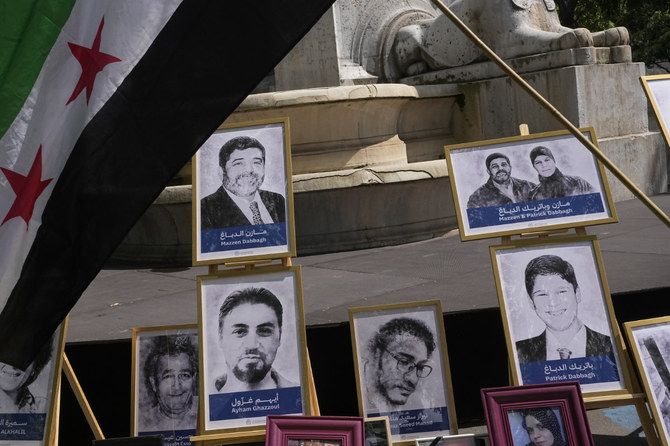
Portraits of Patrick Dabbagh, bottom right, and his father Mazen Dabbagh, top left, are seen during a demonstration on May 21, 2024 at a courtroom in Paris. (AP)
2 / 2
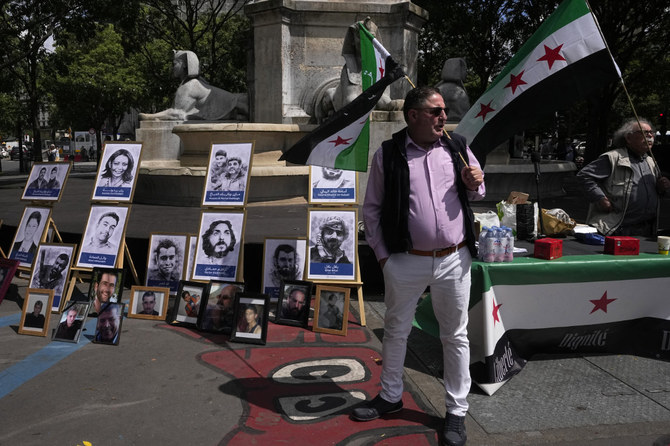
Activists hold Syrian flags next to portraits of alleged victims of the Syrian regime, during a demonstration on May 21, 2024 at a courtroom in Paris. (AP)
Short Url
Updated 25 May 2024
Follow

French court sentences 3 Syrian officials to life in prison in absentia for war crimes

  • The trial focused on the officials’ role in the alleged 2013 arrest in Damascus of Mazen Dabbagh, a Franco-Syrian father, and his son Patrick, and their subsequent torture and killing
  • Former intelligence officials Ali Mamlouk, Jamil Hassan, and Abdel Salam Mahmoud are the most senior Syrian officials to go on trial in a European court over crimes allegedly committed during the country’s civil war

PARIS: A Paris court sentenced three high-ranking Syrian officials in absentia to life in prison Friday for complicity in war crimes in a landmark case against the regime of Syrian President Bashar Assad and the first such case in Europe.

The trial focused on the officials’ role in the alleged 2013 arrest in Damascus of Mazen Dabbagh, a Franco-Syrian father, and his son Patrick, and their subsequent torture and killing. The four-day trial featured harrowing testimonies from survivors and searing accounts from Mazen’s brother.
Though the verdict was cathartic for plaintiffs, France and Syria do not have an extradition treaty, making the outcome largely symbolic. International arrest warrants for the three former Syrian intelligence officials — Ali Mamlouk, Jamil Hassan, and Abdel Salam Mahmoud — have been issued since 2018 to no avail.
They are the most senior Syrian officials to go on trial in a European court over crimes allegedly committed during the country’s civil war.
The court proceedings came as Assad has started to shed his longtime status as a pariah that stemmed from the violence unleashed on his opponents. Human rights groups involved in the case hoped it would refocus attention on alleged atrocities.
Clémence Bectarte, the Dabbagh family lawyer from the International Federation for Human Rights, said the verdict was the “first recognition in France of the crimes against humanity of the Syrian regime.”
“It is a message of hope for all Syrian victims who are waiting for justice. It is a message that must be addressed to states so that they do not normalize their relations with the regime of Bashar Assad,” she said.
The trial began Tuesday over the alleged torture and killing of the French-Syrian father and son who were arrested at the height of Arab Spring-inspired anti-government protests. The two were arrested in Damascus following a crackdown on demonstrations that later turned into a brutal civil war, now in its 14th year.
The probe into their disappearance started in 2015 when Obeida Dabbagh, Mazen’s brother, testified to investigators already examining war crimes in Syria.
Obeida Dabbagh and his wife, Hanane, are parties to the trial along with non-governmental organizations. They testified in court on Thursday, the third day of the trial.
Obeida Dabbagh said he hoped the trial would set a precedent for holding Assad accountable. “Hundreds of thousands of Syrians have died. Even today, some live in fear and terror,” he said.
Despite the defendants’ absence, the trial’s significance was underscored by Brigitte Herremans, a senior researcher at the Human Rights Center of Ghent University. “It’s very important that perpetrators from the regime side are held accountable, even if it’s mainly symbolic. It means a lot for the fight against impunity,” she said.


Kosovo, Serbia ‘need to normalize’ relations

Updated 5 sec ago
Follow

Kosovo, Serbia ‘need to normalize’ relations

  • Kosovo, which hopes to join NATO, has also been cultivating relations with Washington in recent months, by removing tariffs on American products

PRISTINA: Kosovo and Serbia need to “normalize” their relations, Kosovo’s Prime Minister Albin Kurti said, several days before legislative elections where he is seeking to extend his term with more solid backing.

Kurti has been in office since 2021 and previous accords signed with Serbia — which does not recognize the independence of its former province — have yet to be respected.

“We need to normalize relations with Serbia,” said Kurti. “But normalizing relations with a neighboring authoritarian regime that doesn’t recognize you, that also doesn’t admit to the crimes committed during the war, is quite difficult,” he added.

Tensions between the two neighbors are regularly high.

“We do have a normalization agreement,” Kurti said, referring to the agreement signed under the auspices of the EU in 2023.

“We must implement it, which implies mutual recognition between the countries, at least de facto recognition.”

But to resume dialogue, Serbia “must hand over Milan Radoicic,” a Serb accused of plotting an attack in northern Kosovo in 2023, Kurti asserted, hoping that “the EU, France, and Germany will put pressure” on Belgrade to do so.

Kosovo, which hopes to join NATO, has also been cultivating relations with Washington in recent months, by removing tariffs on American products and agreeing to accept up to 50 migrants from third countries extradited by the US. So far, only one has arrived.

“We are not asking for any financial assistance in return,” Kurti emphasized. “We are doing this to help the US, which is a partner, an ally, a friend,” added the prime minister, who did not rule out making similar agreements with European countries.

Unable to secure enough seats in the February 2025 parliamentary elections, Kurti was forced to call early elections on Sunday, after 10 months of political deadlock during which the divided parliament failed to form a coalition.

“We need a decisive victory. In February, we won 42.3 percent, and this time we want to exceed 50 percent,” he said.