

Zelensky rejects Olympic truce call, saying it could help Russia

1 / 2
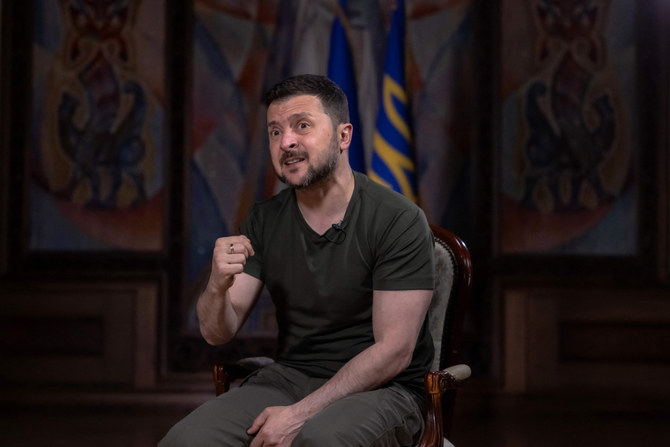
Ukrainian President Volodymyr Zelensky speaks during an interview with AFP at the Presidential Office in Kyiv on May 17, 2024, amid the Russian invasion of Ukraine. (AFP)
2 / 2
Ukrainian President Volodymyr Zelensky speaks during an interview with AFP at the Presidential Office in Kyiv on May 17, 2024, amid the Russian invasion of Ukraine. (AFP)
Short Url
Updated 18 May 2024
Follow

Zelensky rejects Olympic truce call, saying it could help Russia

  • Zelensky said he had spoken to French President Emmanuel Macron who made the appeal told him Russian President Putin cannot be trusted
  • Putin earlier on Friday also suggested that Moscow would not support the idea of a truce during the games in Paris this summer

KYIV: Ukrainian President Volodymyr Zelensky in an interview with AFP on Friday rejected a French call for an Olympic truce this summer, saying it could just help Russia move its troops and equipment.

In an interview with AFP on Friday, Zelensky said he had spoken to French President Emmanuel Macron who made the appeal and told him: “Let’s be honest... Emmanuel, I don’t believe it.”
“Who can guarantee that Russia will not use this time to bring its forces to our territory?” Zelensky said, adding: “First of all, we don’t trust Putin.”
“We are against any truce that plays into the hands of the enemy,” he said.
“If it’s a truce, an Olympic truce for the duration of the Olympics, a land truce, they will have an advantage,” he said, explaining that there was “a risk that they will bring heavy equipment to our territory and no one will be able to stop them.”
Russian President Vladimir Putin earlier on Friday also suggested that Moscow would not support the idea of a truce during the games in Paris this summer.
Asked during a visit to China whether he backed Macron’s idea, Putin said: “I think these Olympic principles, including the ‘Olympic truce’ are very right.”
But he added: “Today’s international sporting officials are themselves disobeying the principles of the Olympic charter.”
He accused sports bodies of “not allowing our athletes to perform at the games with our banner, flag and our national music, our anthem.”
“They are committing violations against us and demand fulfilment from us. Dear friends: we won’t get far that way. No one has ever come to an agreement that way,” Putin said.
Macron had restated on Friday his idea of “an Olympic truce so that Russia ceases its current operations” in Ukraine.
Macron also thanked Chinese President Xi Jinping last week for backing the idea of a truce in all conflicts, including Ukraine, during the Paris Olympics.

Only 25 percent of needed air defense
Zelensky also said his country needed over a hundred aircraft to counter Russian air power and said Ukraine only had a quarter of the air defenses it needs.
His country has faced a surge of devastating attacks as the war stretches into its third year, leading Kyiv to double down on pleas to strengthen its depleted air defenses.
“Today we have about 25 percent of what we need to defend Ukraine. I’m talking about air defense,” Zelensky said.
Russia currently holds an advantage in the air, which limits Ukraine’s ability to protect cities and hold the front line.
To combat sustained aerial and ground assaults, Ukrainian officials have called for more support.
“So that Russia does not have air superiority, our fleet should have 120 to 130 modern aircraft... to defend the sky against three hundred (Russian) aircraft,” Zelensky said.
He also said the fighter jets were needed “to have parity” with Russia.
His comments came just weeks after the US Congress finally approved a $61-billion financial aid package for Ukraine following months of political wrangling.
Zelensky called for some of the assistance to be delivered.
“Can we have three (billion) to get two (Patriot) systems in Kharkiv region, and no bombs will fall on the heads of the military,” he said.


Nigeria signals more strikes likely in ‘joint’ US operations

Updated 53 min 50 sec ago
Follow

Nigeria signals more strikes likely in ‘joint’ US operations

  • Nigeria on Friday signalled more strikes against jihadist groups were expected after a Christmas Day bombardment by US forces against militants in the north of the country

LAGOS: Nigeria on Friday signalled more strikes against jihadist groups were expected after a Christmas Day bombardment by US forces against militants in the north of the country.
The west African country faces multiple interlinked security crises in its north, where jihadists have been waging an insurgency in the northeast since 2009 and armed “bandit” gangs raid villages and stage kidnappings in the northwest.
The US strikes come after Abuja and Washington were locked in a diplomatic dispute over what Trump characterised as the mass killing of Christians amid Nigeria’s myriad armed conflicts.
Washington’s framing of the violence as amounting to Christian “persecution” is rejected by the Nigerian government and independent analysts, but has nonetheless resulted in increased security coordination.
“It’s Nigeria that provided the intelligence,” the country’s foreign minister, Yusuf Tuggar, told broadcaster Channels TV, saying he was on the phone with US State Secretary Marco Rubio ahead of the bombardment.
Asked if there would be more strikes, Tuggar said: “It is an ongoing thing, and we are working with the US. We are working with other countries as well.”
Targets unclear
The Department of Defense’s US Africa Command, using an acronym for the Daesh group, said “multiple Daesh terrorists” were killed in an attack in the northwestern state of Sokoto.
US defense officials later posted video of what appeared to be the nighttime launch of a missile from the deck of a battleship flying the US flag.
Which of Nigeria’s myriad armed groups were targeted remains unclear.
Nigeria’s jihadist groups are mostly concentrated in the northeast of the country, but have made inroads into the northwest.
Researchers have recently linked some members from an armed group known as Lakurawa — the main jihadist group located in Sokoto State — to Islamic State Sahel Province (ISSP), which is mostly active in neighboring Niger and Mali.
Other analysts have disputed those links, though research on Lakurawa is complicated as the term has been used to describe various armed fighters in the northwest.
Those described as Lakurawa also reportedly have links to Al-Qaeda affiliated group for the Support of Islam and Muslims (JNIM), a rival group to ISSP.
While Abuja has welcomed the strikes, “I think Trump would not have accepted a ‘No’ from Nigeria,” said Malik Samuel, an Abuja-based researcher for Good Governance Africa, an NGO.
Amid the diplomatic pressure, Nigerian authorities are keen to be seen as cooperating with the US, Samuel told AFP, even though “both the perpetrators and the victims in the northwest are overwhelmingly Muslim.”
Tuggar said that Nigerian President Bola Tinubu “gave the go-ahead” for the strikes.
The foreign minister added: “It must be made clear that it is a joint operation, and it is not targeting any religion nor simply in the name of one religion or the other.”