LAGOS: Nigeria on Friday signalled more strikes against jihadist groups were expected after a Christmas Day bombardment by US forces against militants in the north of the country.
The west African country faces multiple interlinked security crises in its north, where jihadists have been waging an insurgency in the northeast since 2009 and armed “bandit” gangs raid villages and stage kidnappings in the northwest.
The US strikes come after Abuja and Washington were locked in a diplomatic dispute over what Trump characterised as the mass killing of Christians amid Nigeria’s myriad armed conflicts.
Washington’s framing of the violence as amounting to Christian “persecution” is rejected by the Nigerian government and independent analysts, but has nonetheless resulted in increased security coordination.
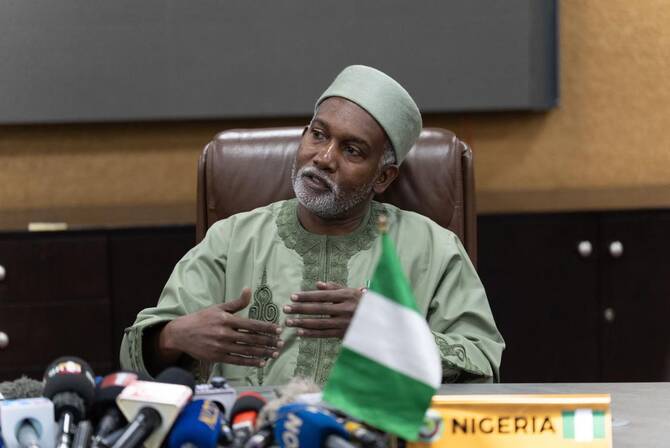
“It’s Nigeria that provided the intelligence,” the country’s foreign minister, Yusuf Tuggar, told broadcaster Channels TV, saying he was on the phone with US State Secretary Marco Rubio ahead of the bombardment.
Asked if there would be more strikes, Tuggar said: “It is an ongoing thing, and we are working with the US. We are working with other countries as well.”
Targets unclear
The Department of Defense’s US Africa Command, using an acronym for the Daesh group, said “multiple Daesh terrorists” were killed in an attack in the northwestern state of Sokoto.
US defense officials later posted video of what appeared to be the nighttime launch of a missile from the deck of a battleship flying the US flag.
Which of Nigeria’s myriad armed groups were targeted remains unclear.
Nigeria’s jihadist groups are mostly concentrated in the northeast of the country, but have made inroads into the northwest.
Researchers have recently linked some members from an armed group known as Lakurawa — the main jihadist group located in Sokoto State — to Islamic State Sahel Province (ISSP), which is mostly active in neighboring Niger and Mali.
Other analysts have disputed those links, though research on Lakurawa is complicated as the term has been used to describe various armed fighters in the northwest.
Those described as Lakurawa also reportedly have links to Al-Qaeda affiliated group for the Support of Islam and Muslims (JNIM), a rival group to ISSP.
While Abuja has welcomed the strikes, “I think Trump would not have accepted a ‘No’ from Nigeria,” said Malik Samuel, an Abuja-based researcher for Good Governance Africa, an NGO.
Amid the diplomatic pressure, Nigerian authorities are keen to be seen as cooperating with the US, Samuel told AFP, even though “both the perpetrators and the victims in the northwest are overwhelmingly Muslim.”
Tuggar said that Nigerian President Bola Tinubu “gave the go-ahead” for the strikes.
The foreign minister added: “It must be made clear that it is a joint operation, and it is not targeting any religion nor simply in the name of one religion or the other.”

Nigeria signals more strikes likely in ‘joint’ US operations
https://arab.news/rnk2h
Nigeria signals more strikes likely in ‘joint’ US operations
- Nigeria on Friday signalled more strikes against jihadist groups were expected after a Christmas Day bombardment by US forces against militants in the north of the country
Walk for peace: Buddhist monks arrive in Washington after 2,300-mile journey
- Monks started in Texas, walked through nine states
- Walkers trod daily through frigid winter weather
WASHINGTON: Draped in burnt-orange robes, two dozen Buddhist monks arrived in Washington, D.C., on Tuesday on a 2,300-mile “Walk for Peace,” a self-described spiritual journey across nine states that has been cheered on by crowds of thousands. “People want this,” said Joan Donoghue, 59, from Silver Spring, Maryland, who had come out with four of her friends on Tuesday to see the monks. “I went on Sunday in Virginia and I waited outside for a long time and I talked to so many people and they all said the same thing: that our country needs this. We feel divided and people want more kindness and more compassion and more peace.”
The monks began their walk in Texas more than three months ago, at times braving frigid winter temperatures, sometimes with bare feet, to raise “awareness of peace, loving kindness, and compassion across America and the world.” The marchers continued on despite a powerful winter storm that spread a paralyzing mix of heavy snow, sleet and freezing rain from the Ohio Valley and mid-South to New England, compounded by bitter, Arctic cold gripping much of the US Accompanied by Aloka, a rescue dog from India who has gained a following on social media as “the Peace Dog,” their journey comes at a time of growing tensions in the US President Donald Trump’s tough immigration policy has seen surges of immigration agents and National Guard troops deployed in some cities, with both American citizens and immigrants killed by federal agents.
“We walk not to protest, but to awaken the peace that already lives within each of us,” said Bhikkhu Pannakara, spiritual leader of the Walk for Peace. “The Walk for Peace is a simple yet meaningful reminder that unity and kindness begin within each of us and can radiate outward to families, communities, and society as a whole.”
They will spend Tuesday and Wednesday in Washington and end their journey in nearby Annapolis, Maryland on Thursday.
The walk has garnered support from millions of people on social media, with many sharing messages of support for the monks. Supporters have braved snow and rain to meet and offer flowers to the monks as they passed through their cities. In Washington, hundreds of people came out to see the monks as they walked along a road informally known as Embassy Row because of the high number of embassies and diplomatic residences.
Coleman O’Donoghue, 62, of Washington, caught the attention of many of those onlookers as he carried a large flag with the peace symbol on a sea of blue. Tuesday was the fourth time he and his wife, Bonnie, had seen the monks.
“They are beautiful distraction from the chaos that is taking place in the city, the country and in the world right now,” O’Donoghue said. “It gives everyone a second to pause and think about something that is not as stressful as what the chaos is creating.”
While they waited hours just to see the monks for less than a minute, many of the spectators said the camaraderie and good energy made the experience worthwhile.
Julie Segor, 58, of Washington, made friends with a couple she met while waiting. Carl, 61, and Christine Varner, 65, of Maryland, pooled their flowers and fruit with her to give to the monks as they passed.
“It was a shared common interest to see the monks on the peace walk and give them some fruit and flowers,” Christine said.
During their stop in North Carolina, the state’s governor, Josh Stein, thanked the monks for bringing hope to millions with their message of peace, equality, justice and compassion.
“You are inspiring people at a time when so many are in need of inspiration,” Stein said. The Walk for Peace has made stops in Texas, Louisiana, Mississippi, Alabama, Georgia, South Carolina, North Carolina and Virginia. The monks met with spiritual and other leaders after arriving in Washington. They also held an interfaith ceremony at the National Cathedral.
During the ceremony at the cathedral, Kimberly Bassett, the District of Columbia’s secretary of state, presented the monks with a proclamation honoring them on behalf of the Washington Mayor Muriel Bowser.
“Today may mark the end of a 2,300-mile walk but it is not the end of our journey for peace. Your pilgrimage has brought people together across cities, states and communities,” Bassett said.
Although the walk has been positive, it has not been without obstacles. While walking through Dayton, Texas, a truck struck the monks’ escort vehicle, injuring several people, according to local media. Two monks sustained serious injuries and one had his leg amputated.
Despite the accident, the group continued to trek across the US to honor not only their original message of peace but also their brothers.