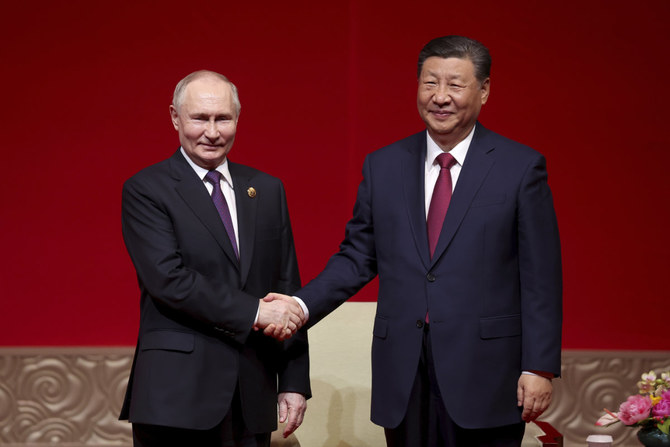


BEIJING: Russian President Vladimir Putin and Chinese leader Xi Jinping on Thursday reaffirmed their “no-limits” partnership that has deepened as both countries face rising tensions with the West, and they criticized US military alliances in Asia and the Pacific region.
At their summit in Beijing, Putin thanked Xi for China’s proposals for ending the war in Ukraine, which have been rejected by Ukraine and its Western supporters as largely following the Kremlin’s line.
Putin’s two-day state visit to one of his strongest allies and trading partners comes as Russian forces are pressing an offensive in northeastern Ukraine’s Kharkiv region in the most significant border incursion since the full-scale invasion began on Feb. 24, 2022.
China claims to take a neutral position in the conflict, but it has backed the Kremlin’s contentions that Russia was provoked into attacking Ukraine by the West, and it continues to supply key components needed by Moscow for weapons production.
China, which hasn’t criticized the invasion, proposed a broadly worded peace plan in 2023, calling for a ceasefire and for direct talks between Moscow and Kyiv. The plan was rejected by both Ukraine and the West for failing to call for Russia to leave occupied parts of Ukraine.
China also gave a rhetorical nod to Russia’s narrative about Nazism in Ukraine, with a joint statement Thursday that said Moscow and Beijing should defend the post-World War II order and “severely condemn the glorification of or even attempts to revive Nazism and militarism.”
Putin has cited the “denazification” of Ukraine as a main goal of the military action, falsely describing the government of Ukrainian President Volodymyr Zelensky, who is Jewish and lost relatives in the Holocaust, as neo-Nazis.
The largely symbolic and ceremonial visit stressed partnership between two countries who both face challenges in their relationship with the US and Europe.
“Both sides want to show that despite what is happening globally, despite the pressure that both sides are facing from the US, both sides are not about to turn their backs on each other anytime soon,” said Hoo Tiang Boon, who researches Chinese foreign policy at Singapore’s Nanyang Technological University.
While Putin and Xi said they were seeking an end to the war, they offered no new proposals in their public remarks.
“China hopes for the early return of Europe to peace and stability and will continue to play a constructive role toward this,” Xi said in prepared remarks to media in Beijing’s Great Hall of the People. His words echoed what China said when it offered a broad plan for peace.
Earlier, Putin was welcomed in Tiananmen Square with military pomp. After a day in Beijing, the Russian leader arrived in Harbin, where he was expected to attend a number of events on Friday.
On the eve of his visit, Putin said China’s proposal could “lay the groundwork for a political and diplomatic process that would take into account Russia’s security concerns and contribute to achieving a long-term and sustainable peace.”
Zelensky has said any negotiations must include a restoration of Ukraine’s territorial integrity, the withdrawal of Russian troops, the release of all prisoners, a tribunal for those responsible for the aggression and security guarantees for Ukraine.
After Russia’s latest offensive in Ukraine last week, the war is in a critical stage as Ukraine’s depleted military waits for new supplies of anti-aircraft missiles and artillery shells from the United States after months of delay.
The joint statement from China and Russia also criticized US foreign policy at length, hitting out at US-formed alliances, which the statement called having a “Cold War mentality.”
China and Russia also accused the US of deploying land-based intermediate range missile systems in the Asia-Pacific under the pretext of joint exercises with allies. They said that the US actions in Asia were “changing the balance of power” and “endangering the security of all countries in the region.”
The joint statement demonstrated China’s support to Russia.
China is “falling over themselves to give Russia face and respect without saying anything specific, and without committing themselves to anything,” said Susan Thornton, a former diplomat and a senior fellow at the Paul Tsai China Center at Yale Law School.
The meeting was yet another affirmation of the friendly “no-limits” relationship China and Russia signed in 2022, just before Moscow invaded Ukraine.
Since then, Russia has become increasingly dependent economically on China as Western sanctions cut its access to much of the international trading system. China’s increased trade with Russia, totaling $240 billion last year, has helped the country mitigate some of the worst blowback from sanctions.
Moscow has diverted the bulk of its energy exports to China and relied on Chinese companies for importing high-tech components for Russian military industries to circumvent Western sanctions.
“I and President Putin agree we should actively look for convergence points of the interests of both countries, to develop each’s advantages, and deepen integration of interests, realizing each others’ achievements,” Xi said.
US State Department deputy spokesperson Vedant Patel said that China can’t “have its cake and eat it too.
“You cannot want to have deepened relations with Europe … while simultaneously continuing to fuel the biggest threat to European security in a long time,” Patel said.
Xi congratulated Putin on starting his fifth term in office and celebrated the 75th anniversary of diplomatic relations between the former Soviet Union and the People’s Republic of China, which was established following a civil war in 1949. Putin has eliminated all major political opponents and faced no real challenge in the March election.
“In a famous song of that time, 75 years ago — it is still performed today — there is a phrase that has become a catchphrase: ‘Russians and Chinese are brothers forever,’” Putin said.
Russia-China military ties have strengthened during the war. They have held a series of joint war games in recent years.
China remains a major market for Russian military, while also massively expanding its domestic defensive industries, including building aircraft carriers and nuclear submarines.
Putin has previously said that Russia has been sharing highly sensitive military technologies with China that helped significantly bolster its defense capability.