

Ukraine braces for ‘heavy battles’ as Putin says Russia carving out Kharkiv buffer zone

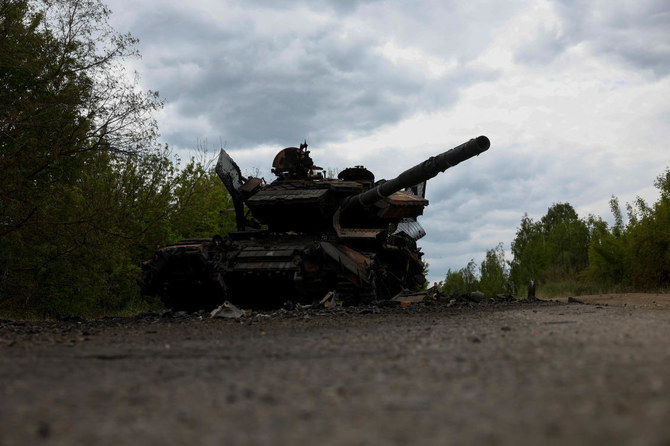
A destroyed tank is seen on a road in Kharkiv Region on May 16, 2024. (Reuters)
Short Url
Updated 17 May 2024
Follow

Ukraine braces for ‘heavy battles’ as Putin says Russia carving out Kharkiv buffer zone

  • Colonel-General Oleksandr Syrskyi said the attack had expanded the area of hostilities by around 70km
  • “We understand there will be heavy battles and that the enemy is preparing for that,” the head of the Ukrainian armed forces wrote on Telegram

KYIV: Ukraine’s top commander warned on Friday of “heavy battles” looming on the war’s new front in the northeastern Kharkiv region as Russian President Vladimir Putin said Moscow was carving out a “buffer zone” in the area.
Russian forces attacked the Kharkiv region’s north last Friday, making inroads of up to 10 kilometers (6 miles) and unbalancing Kyiv’s outnumbered troops who are trying to hold the line over a sprawling front nearly 27 months since the full-scale invasion.
Colonel-General Oleksandr Syrskyi said the attack had expanded the area of hostilities by around 70km and that Russia had launched its incursion ahead of schedule when “it noticed the deployment of our forces.”
“We understand there will be heavy battles and that the enemy is preparing for that,” the head of the Ukrainian armed forces wrote in a statement on the Telegram app.
Speaking during a state visit to China, Putin said Moscow’s forces were creating a “buffer zone” to protect Russian border regions, but that capturing the city of Kharkiv, Ukraine’s second largest, was not part of the current plan.
The Russian leader told a news conference the assault was a response to Kyiv’s shelling of Russian border regions such as Belgorod.
“Civilians are dying there. It’s obvious. They are shooting directly at the city center, at residential areas. And I said publicly that if this continues, we will be forced to create a security zone, a buffer zone. That is what we are doing,” Putin said.
Russian forces were able to advance 10 kilometers in one place, but Ukrainian forces have “stabilized” the front, President Volodymyr Zelensky told Ukrainian media outlets in comments published on Friday.

HEAVIEST ASSAULTS IN EAST
Moscow’s forces are mounting their heaviest assaults in the eastern Donetsk region, according to data compiled by the Ukrainian General Staff, which said the eastern Pokrovsk front had faced the most regular assaults in recent days.
In his comments, Syrskyi said Ukrainian forces were preparing their defensive lines for a possible new Russian assault on the Sumy region, which would mark another front more than a hundred kilometers to the north of Kharkiv.
Kyiv has warned that Russia has small units of forces near the Sumy region.
Volodymyr Artiukh, head of the Sumy region’s military administration, said Russian military activity along the northern Ukrainian region was at a high level.
“We note that the actions (of Russian forces) are systematic. Shelling continues, in fact, along the entire border, with an intensity of 200-400 explosions per day... The intensity of enemy sabotage groups has increased,” he said.


Geoeconomic confrontation tops global risks in 2026: WEF report

Updated 20 min 53 sec ago
Follow

Geoeconomic confrontation tops global risks in 2026: WEF report

  • Also armed conflict, extreme climate, public polarization, AI
  • None ‘a foregone conclusion,’ says WEF’s MD Saadia Zahidi

DUBAI: Geoeconomic confrontation has emerged as the top global risk this year, followed by state-based armed conflict, according to a new World Economic Forum report.

The Global Risks Report 2026, released on Wednesday, found that both risks climbed eight places year-on-year, underscoring a sharp deterioration in the global outlook amid increased international competition.

The top five risks are geoeconomic confrontation (18 percent of respondents), state-based armed conflict (14 percent), extreme weather events (8 percent), societal polarization (7 percent) and misinformation and disinformation (7 percent).

The WEF’s Managing Director Saadia Zahidi said the report “offers an early warning system as the age of competition compounds global risks — from geoeconomic confrontation to unchecked technology to rising debt — and changes our collective capacity to address them.

“But none of these risks are a foregone conclusion.”

The report assesses risks across three timeframes: immediate (2026); short-to-medium term (next two years); and long term (next 10 years).

Economic risks show the largest overall increase in the two-year outlook, with both economic downturn and inflation jumping eight positions.

Misinformation and disinformation rank fifth this year but rise to second place in the two-year outlook and fourth over the 10-year horizon.

The report suggests this reflects growing anxiety around the rapid adoption of artificial intelligence, with adverse outcomes linked to AI surging from 30th place in the two-year timeframe to fifth in the 10-year outlook.

Uncertainty dominates the global risk outlook, according to the report.

Surveyed leaders and experts view both the short- and long-term outlook negatively, with 50 percent expecting a turbulent or stormy global environment over the next two years, rising to 57 percent over the next decade.

A further 40 percent and 32 percent, respectively, describe the outlook as unsettled across the two- and 10-year timeframes, while just 1 percent anticipate a calm global outlook in either period.

Environmental risks ease slightly in the short-term rankings. Extreme weather fell from second to fourth place and pollution from sixth to ninth. Meanwhile, critical changes to Earth systems and biodiversity loss dropped seven and five positions, respectively.

However, over the next decade, environmental threats re-emerge as the most severe, with extreme weather, biodiversity loss, and critical changes to Earth systems topping the global risk rankings.

Looking ahead over the next decade, around 75 percent of respondents anticipate a turbulent or stormy environmental outlook, making it the most pessimistic assessment across all risk categories.

Zahidi said that “the challenges highlighted in the report underscore both the scale of the potential perils we face and our shared responsibility to shape what comes next.”

Despite the gloomy outlook, Zahidi signaled a positive shift in global cooperation.

 “It is also clear that new forms of global cooperation are already unfolding even amid competition, and the global economy is demonstrating resilience in the face of uncertainty.”

Now in its 21st year, the Global Risks Report highlights a core message: global risks cannot be managed without cooperation.

As competition intensifies, rebuilding trust and new forms of collaboration will be critical, with the report stressing that today’s decisions will shape future outcomes.

The report was released ahead of WEF’s annual meeting, which will be held in Davos from Jan. 19 to 23.