Zelensky says meeting with Trump to happen ‘in the near future’

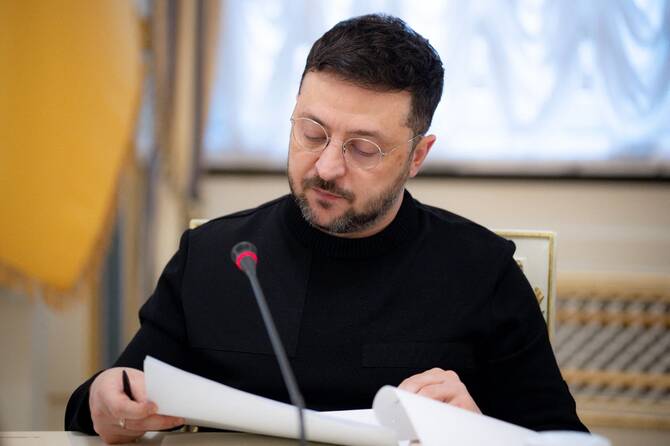
Ukraine's President Volodymyr Zelensky during a meeting with journalists in Kyiv, Ukraine. (Handout Presidential Office)
Short Url
Updated 26 December 2025
Follow

Zelensky says meeting with Trump to happen ‘in the near future’

  • Zelensky’s announcement came after he said Thursday he had a “good conversation” with US special envoy Steve Witkoff and Trump’s son-in-law Jared Kushner

KYIV: A meeting with US President Donald Trump will happen “in the near future,” Ukrainian President Volodymyr Zelensky said Friday, signaling progress in talks to end the nearly four-year war between Russia and Ukraine.
“We are not losing a single day. We have agreed on a meeting at the highest level – with President Trump in the near future,” Zelensky wrote on X.
“A lot can be decided before the New Year,” he added.
Zelensky’s announcement came after he said Thursday he had a “good conversation” with US special envoy Steve Witkoff and Trump’s son-in-law Jared Kushner.
Trump has unleashed an extensive diplomatic push to end the war, but his efforts have run into sharply conflicting demands by Moscow and Kyiv.
Zelensky said Tuesday he would be willing to withdraw troops from the country’s eastern industrial heartland as part of a plan to end the war, if Moscow also pulls back and the area becomes a demilitarized zone monitored by international forces.
Though Russian Foreign Ministry spokeswoman Maria Zakharova said Thursday that there had been “slow but steady progress” in the peace talks, Russia has given no indication that it will agree to any kind of withdrawal from land it has seized.
In fact, Moscow has insisted that Ukraine relinquish the remaining territory it still holds in the Donbas — an ultimatum that Ukraine has rejected. Russia has captured most of Luhansk and about 70 percent of Donetsk — the two areas that make up the Donbas.
On the ground, Russian drone attacks on the city of Mykolaiv and its suburbs overnight into Friday left part of the city without power.
Meanwhile, Ukraine said it struck a major Russian oil refinery Thursday using British-supplied Storm Shadow missiles.
Ukraine’s General Staff said its forces hit the Novoshakhtinsk refinery in Russia’s Rostov region. “Multiple explosions were recorded. The target was hit,” it wrote on Telegram.
Rostov regional Gov. Yuri Slyusar said a firefighter was wounded when extinguishing the fire.
Ukraine’s long-range drone strikes on Russian refineries aim to deprive Moscow of the oil export revenue it needs to pursue its full-scale invasion. Russia wants to cripple the Ukrainian power grid, seeking to deny civilians access to heat, light and running water in what Kyiv officials say is an attempt to “weaponize winter.”


Britain needs ‘AI stress tests’ for financial services, lawmakers say

Updated 20 January 2026
Follow

Britain needs ‘AI stress tests’ for financial services, lawmakers say

  • Lawmakers urge AI-specific stress tests for financial firms

LONDON: Britain’s financial watchdogs are not doing enough to stop artificial ​intelligence from harming consumers or destabilising markets, a cross-party group of lawmakers said on Tuesday, urging regulators to move away from what it called a “wait and see” approach.
In a report on AI in financial services, the Treasury Committee said the Financial Conduct Authority and the Bank of England should start running AI-specific stress tests to help firms prepare for market shocks triggered by automated systems.
The committee also called on the FCA to ‌publish detailed guidance ‌by the end of 2026 on how ‌consumer ⁠protection ​rules apply to ‌AI, and on the extent to which senior managers should be expected to understand the systems they oversee.
“Based on the evidence I’ve seen, I do not feel confident that our financial system is prepared if there was a major AI-related incident and that is worrying,” committee chair Meg Hillier said in a statement.

TECHNOLOGY CARRIES ‘SIGNIFICANT RISKS’

A race among banks to adopt agentic AI, which ⁠unlike generative AI can make decisions and take autonomous action, runs new risks for retail customers, the ‌FCA told Reuters late last year.
About three-quarters ‍of UK financial firms now use ‍AI. Companies are deploying the technology across core functions, from processing insurance claims ‍to performing credit assessments.
While the report acknowledged the benefits of AI, it warned the technology also carried “significant risks” including opaque credit decisions, the potential exclusion of vulnerable consumers through algorithmic tailoring, fraud, and the spread of unregulated financial advice through AI chatbots.
Experts ​contributing to the report also highlighted threats to financial stability, pointing to the reliance on a small group of US tech ⁠giants for AI and cloud services. Some also noted that AI-driven trading systems may amplify herding behavior in markets, risking a financial crisis in a worst-case scenario.
An FCA spokesperson said the regulator welcomed the focus on AI and would review the report. The regulator has previously indicated it does not favor AI-specific rules due to the pace of technological change.
The BoE did not respond to a request for comment.
Hillier told Reuters that increasingly sophisticated forms of generative AI were influencing financial decisions. “If something has gone wrong in the system, that could have a very big impact on the consumer,” she said.
Separately, Britain’s finance ‌ministry appointed Starling Bank CIO Harriet Rees and Lloyds Banking Group ‘s Rohit Dhawan as “AI Champions” to help steer AI adoption in financial services.