

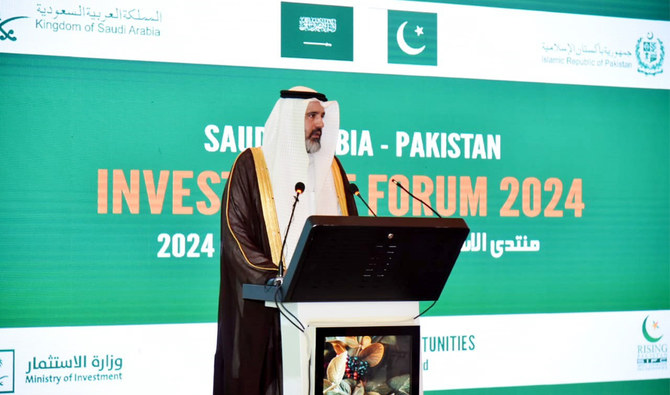

ISLAMABAD: Pakistani and Saudi Arabia will hold business-to-business talks today, Tuesday, as part of a Pakistan-Saudi Arabia investment conference being held in Islamabad amid a push by the South Asian nation to secure foreign financing.
A 50-member delegation led by the Kingdom’s Assistant Minister of Investment Ibrahim Al-Mubarak arrived in Pakistan on Sunday to attend a two-day investment conference, with representatives of some 30 Saudi firms from the fields of IT, telecom, energy, aviation, construction, mining, agriculture and human resource development, among others.
The conference comes as Pakistan and Saudi Arabia have been working closely to increase bilateral trade and investment deals after Pakistani Prime Minister Shehbaz Sharif met Saudi Crown Prince Mohammed bin Salman last month and the two leaders reaffirmed a commitment to expedite a previously discussed investment package of $5 billion.
Since then there have been a flurry of meetings and high-level visits, including of the Saudi foreign minister to Pakistan and of Sharif for a second time to Riyadh followed by the Saudi business delegation’s ongoing visit to Islamabad.
“B2B [business to business] interactions have been most productive,” Sharif said in his address at a dinner hosted for the Saudi delegates on Monday evening.
“I want to make it very clear that it is not the business of the government to do business. Our job is to offer policy frameworks. Our job is to act as a catalyst to make things happen and remove hurdles in the way for speedy achievement of our targets.”
At a press conference in Islamabad on Monday, Petroleum Minister Dr. Musadik Malik said 125 Pakistani companies would be meeting and negotiating with the Saudi companies who were visiting Islamabad.
“First, there were government-to-government agreements during the visit of the Saudi foreign minister [last month] and now there will be business-to-business agreements,” he said. “To facilitate the visiting Saudi companies, the Pakistani commerce ministry has affiliated one focal person with each Saudi company.”
INVESTMENT PUSH
The Saudi business delegation’s visit comes on the heels of one by Sharif to Riyadh from Apr. 27-30 to attend a special two-day meeting of the World Economic Forum (WEF).
On the sidelines of the WEF conference, the Pakistani PM met and discussed bilateral investment and economic partnerships with the crown prince and the Saudi ministers of finance, industries, investment, energy, climate, and economy and planning, the adviser of the Saudi-Pakistan Supreme Coordination Council and the presidents of the Saudi central bank and Islamic Development Bank.
This was Sharif’s second meeting with the crown prince in a month. Before that, he also met him when he traveled to the Kingdom on April 6-8. The Saudi foreign minister was also in Pakistan last month, a trip during which Pakistan pitched projects worth at least $20 billion to Riyadh, according to the Pakistani foreign ministry.
Pakistan and Saudi Arabia enjoy strong trade, defense, and cultural ties. The Kingdom is home to over 2.7 million Pakistani expatriates and serves as a top source of remittances to the cash-strapped South Asian country.
Cash-strapped Pakistan desperately requires foreign investment as it tries to navigate an economic crisis that has resulted in a chronic balance of payments crisis.
The South Asian country is also in talks with the International Monetary Fund (IMF) for a new bailout deal, for which it needs to signal that it can continue to meet requirements for foreign financing which has been a key demand in previous loan packages.


