

3 more Palestinians killed in Israeli strikes as tension rises

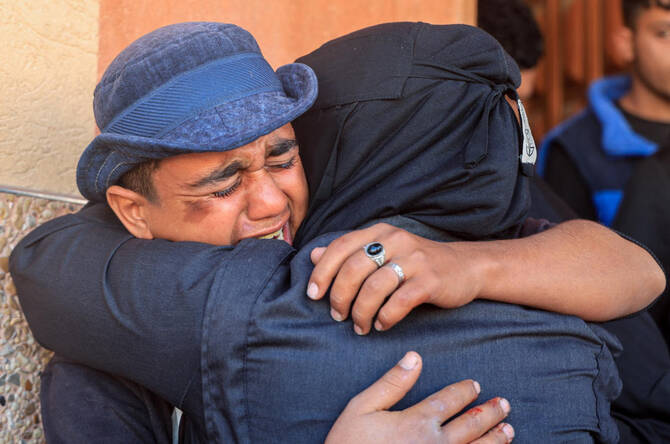
Mourners hug each other during the funeral of Palestinians who were killed in an Israeli strike on Sunday, at Nasser Hospital in Khan Younis, southern Gaza Strip, January 11, 2026. (Reuters)
Short Url
Updated 12 January 2026
Follow

3 more Palestinians killed in Israeli strikes as tension rises

  • Mediators urged to intervene to stop ‘daily killings that aim to derail the ceasefire deal’

CAIRO: Israeli fire killed at least three Palestinians in two separate raids across the enclave, local health authorities said, as tension rises over continued violence since an October ceasefire.
Medics said one Palestinian was killed in the Tuffah neighborhood in Gaza City, in an area under Palestinian control, ‌while two others ‌were killed in ‌southern ⁠Gaza ​in ‌the town of Bani Suhaila east of Khan Younis, an area Israel still occupies.

The Israeli military said forces fired at a “terrorist” who crossed into the area under their control in the northern ⁠Gaza Strip, posing an immediate threat. A hit ‌was identified, it added.
There was ‍no comment on ‍the incident south of the ‍enclave.
Fighting has largely abated since Israel and Hamas agreed to a ceasefire in October, two years into the ​war, but it has not stopped entirely. 
A Hamas official said on Sunday that the group urged mediators to intervene to stop “daily Israeli killings that aim to derail the ceasefire deal.”
More than 440 Palestinians, most of them civilians according to Gaza health officials, have been killed since the truce, ‌as well as three Israeli soldiers.
Hamas said it will dissolve its existing government in Gaza once a Palestinian technocratic leadership committee takes over the territory, as mandated under the US-brokered peace plan.
Hamas and the rival Palestinian Authority, the Palestinians’ internationally recognized representative, have not announced the names of the technocrats, who are not supposed to be politically affiliated, and it remains unclear if they will be cleared by Israel and the US.
The “Board of Peace,” an international body, is supposed to oversee the government and other aspects of the ceasefire that took effect on Oct. 10, including disarming Hamas and deploying an international security force. 
The ceasefire began with a halt in fighting and the release of hostages held in Gaza in exchange for thousands of Palestinians held by Israel. 
The deal is still in its first phase as efforts continue to recover the remains of the final hostage left in Gaza.
An Egyptian official said Hamas was sending a delegation to talks with Egyptian, Qatari, and Turkish officials about moving to the second phase.
Hazem Kassem, a Hamas spokesperson, called for speeding up the establishment of the technocratic committee.
The Egyptian official said Hamas will meet with other Palestinian factions this week to finalize the committee’s formation. The Hamas delegation will be chaired by top negotiator Khalil Al-Hayya, the official said.


The UN says Al-Hol camp population has dropped sharply as Syria moves to relocate remaining families

Updated 15 February 2026
Follow

The UN says Al-Hol camp population has dropped sharply as Syria moves to relocate remaining families

  • Forces of Syria’s central government captured the Al-Hol camp on Jan. 21 during a weekslong offensive against the SDF, which had been running the camp near the border with Iraq for a decade

DAMASCUS: The UN refugee agency said Sunday that a large number of residents of a camp housing family members of suspected Daesh group militants have left and the Syrian government plans to relocate those who remain.
Gonzalo Vargas Llosa, UNHCR’s representative in Syria, said in a statement that the agency “has observed a significant decrease in the number of residents in Al-Hol camp in recent weeks.”
“Syrian authorities have informed UNHCR of their plan to relocate the remaining families to Akhtarin camp in Aleppo Governorate (province) and have requested UNHCR’s support to assist the population in the new camp, which we stand ready to provide,” he said.
He added that UNHCR “will continue to support the return and reintegration of Syrians who have departed Al-Hol, as well as those who remain.”
The statement did not say how residents had left the camp or how many remain. Many families are believed to have escaped either during the chaos when government forces captured the camp from the Kurdish-led Syrian Democratic Forces last month or afterward.
There was no immediate statement from the Syrian government and a government spokesperson did not respond to a request for comment.
At its peak after the defeat of IS in Syria in 2019, around 73,000 people were living at Al-Hol. Since then, the number has declined with some countries repatriating their citizens. The camp’s residents are mostly children and women, including many wives or widows of IS members.
The camp’s residents are not technically prisoners and most have not been accused of crimes, but they have been held in de facto detention at the heavily guarded facility.
Forces of Syria’s central government captured the Al-Hol camp on Jan. 21 during a weekslong offensive against the SDF, which had been running the camp near the border with Iraq for a decade. A ceasefire deal has since ended the fighting.
Separately, thousands of accused IS militants who were held in detention centers in northeastern Syria have been transferred to Iraq to stand trial under an agreement with the US
The US military said Friday that it had completed the transfer of more than 5,700 adult male IS suspects from detention facilities in Syria to Iraqi custody.
Iraq’s National Center for International Judicial Cooperation said a total of 5,704 suspects from 61 countries who were affiliated with IS — most of them Syrian and Iraqi — were transferred from prisons in Syria. They are now being interrogated in Iraq.