

Pakistani, Bangladeshi officials reaffirm strong ties, discuss trade and regional issues

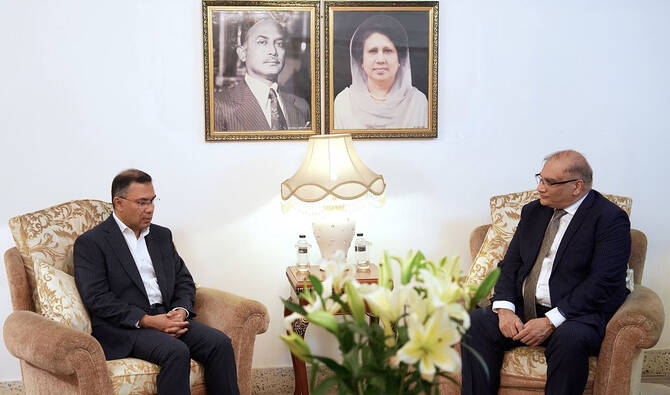
Pakistani and Bangladeshi foreign ministry officials hold a meeting in in Jeddah. (OIC)
Short Url
Updated 11 January 2026
Follow

Pakistani, Bangladeshi officials reaffirm strong ties, discuss trade and regional issues

  • The statement comes after Pakistani and Bangladeshi foreign ministry officials’ meeting in Jeddah on the sidelines of an OIC session
  • Pakistan, Bangladesh, which split in 1971, have moved closer since the ouster of former PM Sheikh Hasina, an India ally, in Aug. 2024

ISLAMABAD: Top Pakistani and Bangladeshi officials on Sunday reaffirmed the strength of their relations as they discussed bilateral, regional and global issues, the Pakistani foreign ministry said.

The statement came after a meeting between Pakistani Foreign Minister Ishaq Dar and Bangladesh’s Adviser on Foreign Affairs Touhid Hossain on the sidelines of an extraordinary session of the Organization of Islamic Cooperation (OIC) in Jeddah.

Pakistan and Bangladesh were part of the same country until Bangladesh’s secession following a bloody civil war in 1971, an event that long cast a shadow over bilateral ties. Both countries have moved closer since 2024, following the ouster of former premier Sheikh Hasina who was considered an India ally.

The two foreign ministry officials discussed a range of regional and global issues as well bilateral cooperation in diverse fields, according to a Pakistani foreign ministry statement.

“Both dignitaries expressed satisfaction over the robustness of Pakistan-Bangladesh relations,” the statement read. “They discussed bilateral relations in diverse fields, especially high-level exchanges, trade, and educational collaboration.”

Dar arrived in Saudi Arabia on Friday to attend the 22nd OIC Council of Foreign Ministers held in Jeddah on Jan. 10 to discuss Israel’s move last month to recognize Somaliland, a breakaway region of Somalia, as a separate nation. The act has drawn sharp criticism from Muslim nations worldwide.

Muslim countries, including Pakistan, believe the move could be part of Tel Aviv’s plan to forcibly relocate Palestinian Muslims to Somaliland. Several international news outlets last year reported that Israel had contacted Somaliland over the potential resettlement of Palestinians forcibly removed from Gaza.

“We believe that such recognition of an integral part of a sovereign state is not a diplomatic act, but an act of political aggression that sets a perilous precedent, threatening peace and security in the Horn of Africa, the Red Sea region, and beyond,” Dar told participants of the meeting in Jeddah.

The Pakistani foreign minister said Islamabad considers the move a flagrant violation of international law and a direct assault on the territorial integrity of Somalia. He called on all states to refrain from engaging with Somaliland authorities.


Pakistan PM calls for faster CPEC implementation, pledges security for Chinese workers

Updated 12 sec ago
Follow

Pakistan PM calls for faster CPEC implementation, pledges security for Chinese workers

  • Shehbaz Sharif pushes expanded cooperation in agriculture, IT and mining under CPEC phase two
  • Chinese envoy reaffirms Beijing’s support for Pakistan’s sovereignty and economic development

ISLAMABAD: Prime Minister Shehbaz Sharif on Friday called for speeding up projects under the China-Pakistan Economic Corridor (CPEC) and pledged stronger security guarantees for Chinese workers and investments, during a meeting with China’s ambassador in Islamabad.

Sharif made the remarks as the two countries strive to launch the second phase of CPEC, a multibillion-dollar infrastructure and energy initiative launched in 2015 as part of China’s Belt and Road Initiative (BRI).

CPEC’s first phase focused largely on power generation and transport infrastructure aimed at easing Pakistan’s chronic energy shortages and improving connectivity. The second phase seeks to expand cooperation into industrial development, with an emphasis on special economic zones and export-oriented growth.

“While highlighting the importance of accelerating ongoing CPEC projects, the Prime Minister stressed on the need to enhance cooperation in agriculture and IT and mining & minerals,” said a statement circulated by the PM Office after the meeting.

“He also underscored Pakistan’s resolve to provide a secure and conducive environment for Chinese personnel, investments, and institutions in Pakistan,” it added.

Chinese nationals and projects in Pakistan have faced security threats in the past, including attacks by militant groups targeting infrastructure sites and convoys. Islamabad has repeatedly vowed to tighten security and has deployed special protection units for Chinese workers.

China is Pakistan’s closest ally in the region and a key economic partner, with CPEC widely regarded by Islamabad as central to long-term economic growth.

During the meeting, the prime minister conveyed greetings to Chinese President Xi Jinping and Premier Li Qiang, particularly on the occasion of the Chinese New Year.

China’s Ambassador to Pakistan, Jiang Zaidong, reiterated Beijing’s support for Pakistan’s sovereignty and socioeconomic development, according to the statement. Both sides also exchanged views on regional and international issues and agreed to maintain close coordination.