

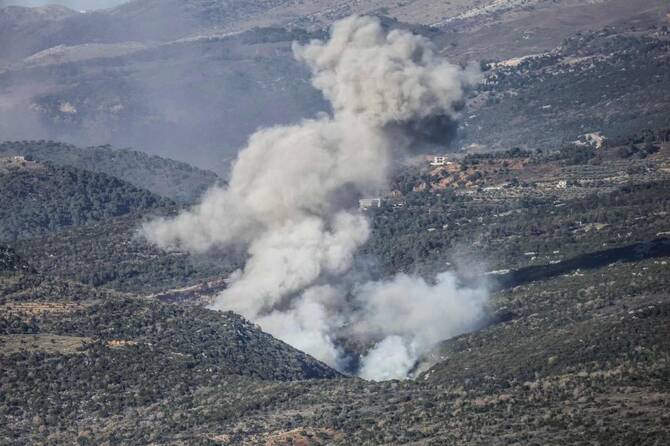

BEIRUT: Israeli warplanes on Sunday launched at least 43 airstrikes on valleys and mountains in southern Lebanon, north of the Litani River, an area that remains outside the Lebanese army’s current plan to consolidate weapons under state control.
Lebanon classified the attacks as violations of the ceasefire agreement.
Israeli army spokesman Avichai Adraee issued a warning to residents of a large residential complex in Kfar Hatta, instructing them to evacuate before its demolition.
BACKGROUND
Israel has kept up regular strikes in Lebanon despite a November 2024 cease- fire that sought to end more than a year of hostilities between it and Hezbollah.
Kfar Hatta is in the Sidon district, 8 km east of the coastal city of Sidon. To the south, it borders a large valley with numerous caves and the Siniq River.
In a post with a map of the compound, Adraee stated that the Israeli army “will attack, in the near future, Hezbollah’s military infrastructure in the village to counter its prohibited attempts to rebuild its activities there.”
Adraee addressed “the residents of the compound marked in red on the attached map and the buildings adjacent to it: You are located near a compound used by Hezbollah. For your safety, you are obliged to evacuate it immediately and move at least 300 meters away.”
The civilian residents of the compound and the town appealed to the Lebanese army command to inspect the site and ensure it was clear of any Hezbollah military structures.
Media reports indicated that the army contacted UNIFIL forces to request an inspection of the site to prevent it from being targeted. Meanwhile, Lebanese Civil Defense personnel blocked the road between Kfarhatta and Kfarmelki.
However, the Israeli army proceeded with its warnings and carried out a preliminary raid before launching a heavy bombardment of the compound (10 airstrikes), leaving dozens of families homeless.
The successive Israeli airstrikes (33 airstrikes), carried out in less than two hours, targeted the area between Wadi Barghaz, Mahmoudiya, and Al-Brij — the outskirts of Jbaa in the Iqlim Al-Tuffah region — as well as the Jabbour and Qatrani heights and the outskirts of Rihan.
These areas had already been targeted by Israeli airstrikes last week.
Israeli reconnaissance aircraft flew at low altitude over the entire Bekaa Valley, reaching as far as Hermel.
An Israeli source told media outlets that the Israeli army targeted six Hezbollah tunnels with 25 missiles.
Adraee claimed that the Israeli strikes were a response to Hezbollah’s violations of the ceasefire agreements, alleging that the army was attacking Hezbollah weapons depots in southern Lebanon.
He stated: “Over the past few months, Hezbollah activity has been observed at these sites. This activity at the targeted sites constitutes a violation of the understandings between Israel and Lebanon. The army will continue to work to eliminate any threat.”
The Israeli army stated that it “attacked tunnel entrances used to store weapons inside several Hezbollah military sites in southern Lebanon.”
On Friday, Israel escalated its aerial operations in Lebanon with a series of intense and simultaneous raids targeting various areas in the south and the Bekaa Valley, part of a broader effort to increase military pressure on Hezbollah, which refuses to relinquish its weapons north of the Litani River.
The escalation coincided with the Lebanese government’s announcement of the completion of the first phase of its plan to confine weapons south of the Litani River.
A subsequent plan to contain Hezbollah’s weapons north of this line is expected to be adopted as a preliminary step, given the vast area in which the Lebanese army is required to operate to complete the weapons confiscation plan.
The Israeli army expressed doubts about the Lebanese army’s ability to fulfill its mission.
The Ceasefire Monitoring Mechanism is scheduled to hold its next meeting in Ras Al-Naqoura on Jan. 17.
President Emmanuel Macron welcomed the “encouraging statements issued by the Lebanese authorities regarding the restoration of the state’s monopoly on weapons.”
He posted on X: “This process must be pursued resolutely. The second phase of the plan will be a crucial step. All parties must fully respect the cessation of hostilities agreement and restore Lebanon’s complete sovereignty.”
Macron affirmed that France, along with its partners, “remains fully committed to Lebanon and its army,” noting that “an international conference will be held soon in Paris to provide Lebanon and its army with the concrete means to guarantee this sovereignty.”


