

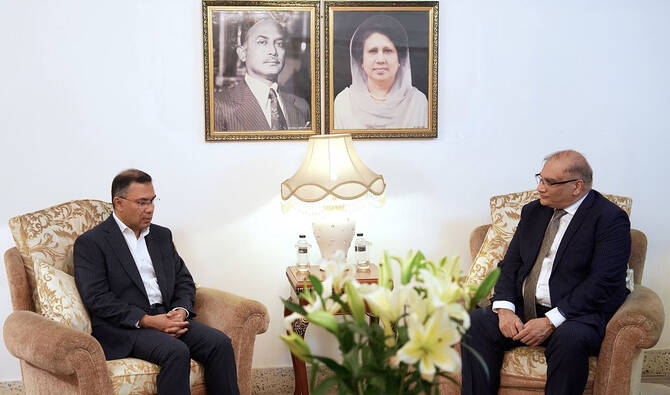

ISLAMABAD: Top Pakistani and Bangladeshi officials on Sunday reaffirmed the strength of their relations as they discussed bilateral, regional and global issues, the Pakistani foreign ministry said.
The statement came after a meeting between Pakistani Foreign Minister Ishaq Dar and Bangladesh’s Adviser on Foreign Affairs Touhid Hossain on the sidelines of an extraordinary session of the Organization of Islamic Cooperation (OIC) in Jeddah.
Pakistan and Bangladesh were part of the same country until Bangladesh’s secession following a bloody civil war in 1971, an event that long cast a shadow over bilateral ties. Both countries have moved closer since 2024, following the ouster of former premier Sheikh Hasina who was considered an India ally.
The two foreign ministry officials discussed a range of regional and global issues as well bilateral cooperation in diverse fields, according to a Pakistani foreign ministry statement.
“Both dignitaries expressed satisfaction over the robustness of Pakistan-Bangladesh relations,” the statement read. “They discussed bilateral relations in diverse fields, especially high-level exchanges, trade, and educational collaboration.”
Dar arrived in Saudi Arabia on Friday to attend the 22nd OIC Council of Foreign Ministers held in Jeddah on Jan. 10 to discuss Israel’s move last month to recognize Somaliland, a breakaway region of Somalia, as a separate nation. The act has drawn sharp criticism from Muslim nations worldwide.
Muslim countries, including Pakistan, believe the move could be part of Tel Aviv’s plan to forcibly relocate Palestinian Muslims to Somaliland. Several international news outlets last year reported that Israel had contacted Somaliland over the potential resettlement of Palestinians forcibly removed from Gaza.
“We believe that such recognition of an integral part of a sovereign state is not a diplomatic act, but an act of political aggression that sets a perilous precedent, threatening peace and security in the Horn of Africa, the Red Sea region, and beyond,” Dar told participants of the meeting in Jeddah.
The Pakistani foreign minister said Islamabad considers the move a flagrant violation of international law and a direct assault on the territorial integrity of Somalia. He called on all states to refrain from engaging with Somaliland authorities.


