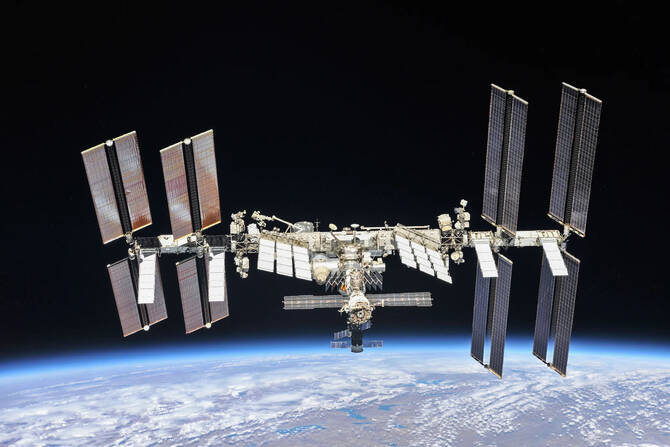
Jeddah Astronomical Society explores International Space Station’s legacy 

Short Url
Updated 11 January 2026
Follow

Jeddah Astronomical Society explores International Space Station’s legacy 

  • ISS ‘one of the most enduring achievements of the space age,’ society president says 
  • Structural pressures mount as space station nears end of 27-year mission

RIYADH: The International Space Station is nearing the end of its operational life, with NASA planning to conclude the station’s missions and deorbit it into the Pacific Ocean in early 2031. 

Jeddah Astronomical Society president Majed Abu Zahra said a US deorbit vehicle, under development by SpaceX, is expected to guide the ISS toward a controlled reentry over the Pacific Ocean after operations conclude in 2030. 

Since the launch of its first module in 1998, the ISS has been in continuous operation, a familiar sight in the night skies, and a landmark of human cooperation in space. 

Abu Zahra said the effort will signal a carefully managed end to an era that has shaped spaceflight and microgravity research, the Saudi Press Agency reported on Sunday. 

Over more than two decades, agencies from the US, Europe, Russia, Canada, and Japan have worked together, supporting crewed missions, maintaining systems, and conducting thousands of experiments in orbit. 

More than 260 astronauts from around the world, including several from Saudi Arabia, have visited the station, contributing to a legacy of global collaboration in science and exploration. 

Abu Zahra said that the ISS is now facing significant structural and financial pressures. 

The station has remained operational far beyond initial expectations. It was originally designed to operate for about 15 years, but has now been in orbit for 27 years. 

Mounting technical and maintenance challenges are affecting key systems on board, with some experiencing technical problems, while micrometeoroids have damaged outer surfaces and air leaks have appeared over time, he said. 

Abu Zahra added that annual expenses have risen to more than $3 billion, a major factor behind NASA’s decision to redirect resources toward other priorities, including programs focused on exploring the Moon and Mars. 

Abu Zahra said the farewell to the ISS should not be viewed solely as a scientific or technical milestone. 

Rather, it represents the end of a period of global human cooperation on an unprecedented scale, as space agencies have worked together for decades despite political differences — one of the most enduring achievements of the space age.


Makkah’s urban shift enhances city’s quality of life

Updated 18 min 25 sec ago
Follow

Makkah’s urban shift enhances city’s quality of life

  • By harmonizing religious heritage with modern urban development, Makkah proves that a city can honor its past while embracing the future

MAKKAH: Islam’s holiest city is at present witnessing a qualitative urban shift, one that seamlessly blends its spiritual sanctity with a modern, vibrant lifestyle.

By integrating cultural, educational, and entertainment initiatives, Makkah is redefining the visitor experience and significantly enhancing the quality of life for its residents, directly supporting the goals of Saudi Vision 2030.

The city’s transformation was recently highlighted by the success of the Makkah winter season. The event attracted approximately 400,000 visitors — more than 60 percent of whom were locals — demonstrating a strong domestic demand for high-quality public spaces. The season revitalized community interaction, driving a 35 per cent increase in visits to recreational sites and creating more than 1,200 temporary jobs for the local workforce.

Central to this urban renaissance is the Hira Cultural District. Since opening doors in January 2023 near the historic Mount Hira, the district has become a definitive landmark that bridges Islamic history with contemporary identity.

Far from being a static monument, the district has cultivated a thriving creative economy. Its craftsmanship program, which features over 100 artisans, has generated up to SR3 million ($800,269) in sales and attracted 130,000 visitors to live workshops. These interactive spaces allow visitors to engage directly with the region’s heritage, moving beyond passive observation to active participation.

Makkah’s Hira Cultural District has become a definitive landmark that bridges Islamic history with contemporary identity. (SPA photo)


A living legacy 

The shift extends to Makkah’s broader ecosystem of museums and cultural sites, which are now positioned as key pillars of cultural tourism. Facilities such as the Revelation Exhibition use cutting-edge technology and multilingual content to narrate the story of the Holy Quran’s revelation, offering an immersive experience that complements the spiritual journey of pilgrims.

These efforts align with the “Makkah: A Living Legacy” campaign, which seeks to document the city’s historical narrative and preserve its collective memory. Recent months have featured a surge in educational workshops for university students and tour guides, ensuring that the human element of Makkah’s history is conveyed with accuracy and depth.

City’s transformation recently highlighted by the success of the Makkah winter season. (SPA photo)
 

Economic and social impact 

The results of this integrated approach are tangible. Specialized museums and restored historic sites now attract up to 1.6 million visitors a year. This cultural enrichment is encouraging pilgrims to linger longer, increasing the average duration of stay by 18 percent.

By harmonizing its religious heritage with modern urban development, Makkah is proving that a city can honor its past while embracing the future, offering a holistic experience that nourishes the soul and the community.