Saudi universities shine at Geneva invention expo

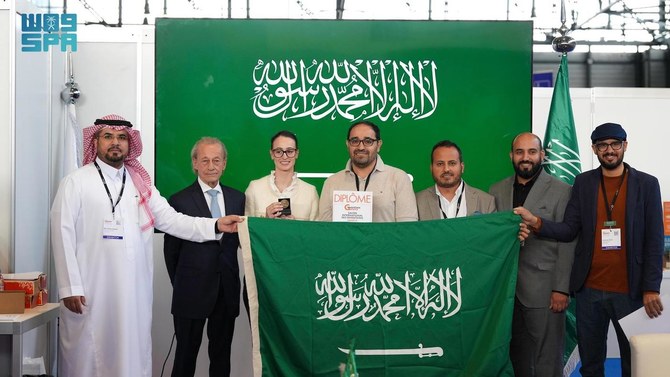
Qassim University won a silver medal for its system for desalinating water using halophytic plants. (SPA)
Short Url
Updated 21 April 2024
Follow

Saudi universities shine at Geneva invention expo

  • Between them, the 26 Saudi universities that entered displayed 113 inventions in the Kingdom’s pavilion
  • The Geneva exhibition is a major global event, drawing inventors, researchers, and innovators from around the world

JEDDAH: King Abdulaziz University won 17 awards and medals for its innovations at the Geneva International Exhibition of Inventions.

The 26 Saudi universities that entered — 19 public, two independent, and five private institutions — between them displayed 113 inventions in the Kingdom’s pavilion, with applications in various scientific, theoretical, medical and other fields.

Mosab bin Faleh Al-Harbi, spokesperson and director of the KAU media center, said that the competition boosts the importance of scientific research and innovation in academia.

He highlighted the university’s commitment to fostering innovation and research among students, and said that the university’s contributions came from the colleges of computer science, information technology, medicine, and engineering.

Among the awards won by KAU were the National Research Society of Thailand Prize for a date classification application, and the Malaysian Organization for Research Scientists Prize for a continuous monitoring invention.

Jeddah University also took part in the exhibition, winning two bronze awards. These were for a computer-vision-based smart building health inspection system, and a tool for detecting and preventing distributed denial of service attacks (malicious attacks on a network or server).

Qassim University won a silver medal for its system for desalinating water using halophytic plants, developed by a research team from the College of Agriculture and Food Sciences. The university also received a bronze medal for a project to use date palm waste in the production of pharmaceutical excipients in nano-sized tablets, presented by another research team.

Jazan University was awarded two gold medals. Asim Najmi from the College of Pharmacy received a medal for his work on derivatives of benzylidene 4, 2 thiazolidinones, and their use in diabetes treatment. Mohammed Mashiki from the College of Dentistry, meanwhile, won gold for his modification of a dental crown used in endodontic retreatment.

The university’s acting president, Mohammed Abu Rasin, said these achievements show the institution’s dedication to fostering innovation and promoting a culture of invention through consistent support for inventors.

The Geneva exhibition is a major global event, drawing inventors, researchers, and innovators from around the world. It was held from April 17 to 21, and attracted more than 1,000 innovations from over 50 countries.


Jeddah students get closer look at electric motorsport

Updated 24 January 2026
Follow

Jeddah students get closer look at electric motorsport

  • A PIF-linked initiative highlights technical and engineering careers behind electric racing events

JEDDAH: Students from local and international schools in Jeddah were introduced to STEM-related career pathways in electric motorsport this week, as part of an education program linked to the UIM E1 World Championship held on the Red Sea.

The sessions formed part of Driving Force Presented by the Public Investment Fund, an initiative run by Formula E and its electric racing series partners, to familiarize students aged eight to 18 with science, technology, engineering and mathematics through electric racing and sustainability-focused industries.

The sessions for students formed part of Driving Force Presented by the Public Investment Fund, an initiative run by Formula E and its electric racing series partners. (Supplied)

The programme took place alongside the 2026 E1 Jeddah GP and included workshops, school visits and trackside access designed to show how engineering, data, broadcast technology and event operations function within professional motorsport.

According to organisers, the initiative reached more than 60,000 students globally in 2025, with further expansion planned this year. 

HIGHLIGHTS

• The program took place alongside the 2026 E1 Jeddah GP and included workshops, school visits and trackside access.

• Students learned about E1 races and their technical and environmental dimensions and discussed the engineering and marine aspects of electric boats.

• According to organisers, the initiative reached more than 60,000 students globally in 2025, with further expansion planned this year. 

John Williams, managing director at E1, told Arab News: “The PIF is absolutely vital to everything we do here at the E1. They were crucial initial investment partner since the start of the championship and they continue to support us in a number of ways and more specifically around the Driving Force program.”

The sessions for students formed part of Driving Force Presented by the Public Investment Fund, an initiative run by Formula E and its electric racing series partners. (Supplied)

Elaborating more on the program, he said: “What we are doing is presenting and showing these students the available careers of science, technology, engineering and mathematics, as well as careers in sports, not only pilots but also engineers and mechanics.”

Williams added that the main key to the program was bringing a new generation to the mechanism of sport.

“We are introducing to these exciting new technologies around the race but it could be our technology on the boat or our broadcast products, as well as how to manage the event its self. There are a range of opportunities to show it to the children in addition to enjoying the excitement of the race and meeting the pilots.”

The program’s Jeddah activities began at King Abdulaziz University’s faculty of maritime studies, where students took part in a hands-on workshop focused on STEM careers in the motorsport and sustainability areas conducted by technology experts and famous water pilots such as Dani Clos, Emma Kimilainen and Patricia Pita.

Students learned about E1 races and their technical and environmental dimensions and discussed the engineering and marine aspects of electric boats.

They also enjoyed exclusive behind-the-scenes access at the E1 Jeddah GP, pilot meet-and-greets, and front-row seats to watch the RaceBird boats in action.