

UAE, Peru announce free trade talks

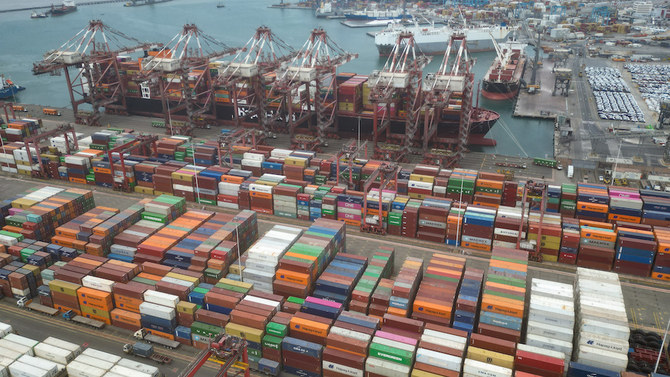
DP World, the UAE-based logistics company, operates key port installations in Peru and has invested more than $700 million there since 2018. (AFP)
Short Url
Updated 27 February 2024
Follow

UAE, Peru announce free trade talks

  • Announcement builds on Peru’s decision earlier this month to open embassy in Gulf state
  • Bilateral trade was just over $1bn last year

MONTEVIDEO, Uruguay: The UAE and Peru have announced that they will start talks for a free trade agreement later this year.  

The announcement came on the sidelines of a World Trade Organization meeting in Abu Dhabi, and builds on a decision by Peru earlier this month to open an embassy in the UAE. The two countries previously signed other agreements, including an aviation pact last year.

If the free trade agreement is reached, it would be a first for Peru with a country in the Middle East and North Africa, and the first for the UAE in the Americas.  

Bilateral trade was just over $1 billion last year, with Peru exporting $1.03 billion to the UAE — most of it gold — and importing $44 million from the Gulf state.

Peru’s government hopes a free trade agreement will help ramp up its exports. Its Foreign Trade and Tourism Ministry reported that the UAE, with a population of over 9 million, imports more than 90 percent of the food it consumes. Peru wants to fill part of that demand.

The country is the world’s top exporter of grapes, and among the world leaders in avocado and blueberry exports.

It is also a key fishing country, exporting fish for human consumption, as well as fishmeal and fish oil for industry. The ministry also sees opportunities for garments and other manufactured products.

Emirati exports to Peru are primarily petroleum-based products, with some manufactured goods such as lighting components.

DP World, the UAE-based logistics company, operates key port installations in Peru and has invested more than $700 million there since 2018.

A free trade agreement could be a stepping stone to larger markets for both countries. Peru has 19 such deals, including with China, the EU and the US.

It is actively negotiating a deal with India, with the last round held in mid-February. It was also negotiating with Turkey but talks have stalled.

The UAE has a limited number of free trade agreements outside its immediate geographic area, primarily through the Gulf Cooperation Council.

The GCC signed an agreement with South Korea in December, and one with Pakistan has been concluded. It is also negotiating with Britain, China and Japan.  

The GCC has few non-petroleum ties with Latin America and the Caribbean, but that could be changing.

It has made initial overtures for an agreement with the Southern Common Market, which includes Argentina, Brazil, Paraguay and Uruguay.

The UAE and Guyana, South America’s only English-speaking country, have been strengthening ties.

The UAE announced in November that it would open an embassy in Guyana’s capital Georgetown. Bilateral trade is close to $1 billion.

The deal with Peru would be through bilateral negotiation instead of with the GCC. The same is true for any potential deal with Guyana.


UAE, Uzbekistan expand economic cooperation with mining sector pact 

Updated 8 sec ago
Follow

UAE, Uzbekistan expand economic cooperation with mining sector pact 

JEDDAH: The UAE has signed an agreement to expand cooperation in Uzbekistan’s mining sector, as the two countries seek to scale investment, modernize infrastructure and deepen economic ties. 

The memorandum of understanding was signed by Mohamed Hassan Al-Suwaidi, UAE minister of investment, and Jamshid Khodjaev, Uzbekistan’s deputy prime minister, according to the Emirates News Agency, also known as WAM.

The agreement comes amid growing bilateral investment flows. UAE investments in Uzbekistan reached $1.3 billion in 2024, including about $700 million in renewable energy, with more than $4 billion in joint projects currently under development, WAM reported. 

Commenting on the MoU, Al-Suwaidi said that his country and Uzbekistan share a longstanding relationship built on mutual trust and strong economic cooperation. 

“Today’s signing reflects the UAE’s commitment to forging strategic international partnerships in sectors of mutual interest that support sustainable development and long-term economic value creation,” he said.

By working closely with Uzbekistan, he added, the UAE aims to unlock high-quality investment opportunities across the minerals value chain for the benefit of both nations.

The agreement focuses on the development and modernization of key supporting infrastructure, including power generation, renewable energy, grid enhancements, water systems, and logistics networks.

It also aims to advance sector digitalization, innovation, and responsible governance to reinforce long-term resilience and sustainability. 

Under the MoU, cooperation will span investment activities across the full mining value chain, from exploration and development through to downstream manufacturing. 

Khodjaev emphasized that the MoU marks an important step in strengthening cooperation between Uzbekistan and the Gulf state in the minerals sector. 

“Through collaboration on investment facilitation, governance, workforce development, and monitoring frameworks, we aim to support responsible mineral development and create sustainable industrial growth opportunities for both economies,” he said. 

According to WAM, the agreement establishes a collaboration framework involving government and regulatory authorities, state-owned investment companies and private sector partners, enabling the structuring of financing mechanisms such as foreign direct investment and public-private partnerships. 

Uzbekistan’s mining sector is a key economic driver, producing commodities such as gold, copper, uranium, coal, oil, and natural gas, according to the International Trade Administration of the US Department of Commerce. 

The sector is undergoing modernization as the government expands upstream-to-downstream capacity, attracts foreign investment, and upgrades infrastructure through state-owned enterprises while tapping international capital markets.