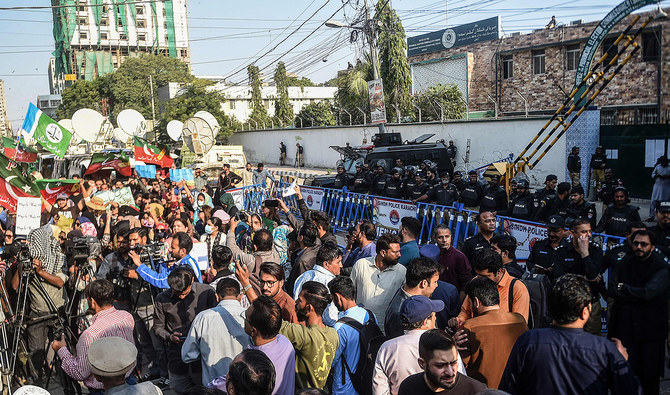
KARACHI: A Pakistani party, which has exercised considerable influence in the urban areas of southern Sindh province, said on Saturday no political faction in the country was in a position to form the country’s next administration without its support, though its leadership was still weighing its options.
The Muttahida Qaumi Movement-Pakistan (MQM-P), which played a crucial role in making and breaking central governments in the past, secured 17 National Assembly seats in Thursday’s elections in which no political party emerged with a clear majority.
Pakistan’s national polls were held on 265 general seats in the lower house of parliament in which more than 90 independent candidates backed by former prime minister Imran Khan’s Pakistan Tehreek-e-Insaf (PTI) party secured victory.
These candidates could not contest under the PTI banner after the country’s top court deprived the party of its election emblem of cricket bat for holding flawed intraparty polls. The PTI-backed candidates are followed by the country’s three-time premier Nawaz Sharif’s Pakistan Muslim League-Nawaz (PML-N) with 71 seats and Bilawal Bhutto-Zardari’s Pakistan Peoples Party (PPP) with 53.
The main battle in the elections was between the PML-N and PTI-backed candidates. Both Sharif and Khan declared victory separately, though they are both not in a position to form Pakistan’s next government on their own.
“We haven’t yet decided to align with any specific party at the center but no party can form a government without us,” Syed Aminul Haque, a senior MQM-P leader, told Arab News, adding his party would only support a faction that would promise to fulfil its demands related to the development of Karachi and Sindh’s other urban centers.
“The people of urban Sindh, especially Karachi, have placed immense trust in MQM-P by voting for it in large numbers and electing a record 15 members for the National Assembly and 25 for the provincial one,” he continued.
“Our primary objective is to safeguard their interests,” he added.
Political analysts agreed MQM-P was in a position to play a vital role in the making of the next government.
“I don’t think that without them this [the making of the new administration] can happen when even one or two seats are required [by other political parties],” Nadia Naqi, a Karachi-based analyst, said, though she maintained that MQM-P would not be able to get any concessions for Karachi.
“We all know that decisiveness doesn’t exist among its leaders who is always looking at their ring masters to determine what to do,” she added, citing the example of what the party did during the last elections when it accused the PTI of stealing its mandate before joining it in the federal government.
Majid Nizami, another analyst from Lahore, maintained there was only one realistic scenario for MQM-P.
“The MQM-P cannot afford to sit in the opposition,” he told Arab News. “It will only be able to play a decisive role by joining the PML-N and the independents in a coalition administration.”
He noted the party’s influence would reduce considerably if it supported the PPP and PTI-backed candidates.
“If the PPP and PTI’s independents join hands, they will not need the MQM-P, though the party may still join them,” Nizami said.
He maintained the PML-N, PPP and MQM-P could also form a federal government but described it as the “worst case scenario” since it would further narrow the space of the party to negotiate its terms.
“The MQM-P cannot join a government led by the PTI since its own position has become quite weak in recent years, and it cannot afford to annoy the security establishment,” he added.
Analyst Amir Zia said the MQM-P’s ability to get something for Karachi was already limited.
Acknowledging the fact that the party had performed well in Karachi in the recent elections, he said: “Even if urban Sindh gives 100 percent mandate to one political party, its leaders will not be able to resolve the issues of its constituents without the getting adequate cooperation from the provincial administration. This time again, the MQM-P is at odds with the PPP which has received a massive mandate from rural Sindh.”
“The PML-N is also in a fix since it will have to go for a coalition government in which the PPP may turn out to be an important player,” he continued, adding the country could witness another government like the one formed by the Pakistan Democratic Movement (PDM) alliance that ruled it ahead of the Feb. 8 polls.


![]()

Muttahida Qaumi Movement hopes to play central role in government formation amid election stalemate
Short Url
https://arab.news/yf7yp
Muttahida Qaumi Movement hopes to play central role in government formation amid election stalemate
- MQM-P has emerged as the largest party in Pakistan’s commercial capital Karachi with 15 out of 22 seats
- Analysts believe the party can wield maximum influence if it decides to join the PML-N and independents
Latest updates




© 2026 SAUDI RESEARCH & PUBLISHING COMPANY, All Rights Reserved And subject to Terms of Use Agreement.