


KYIV: Questions remained Thursday over the military plane crash that Russia said had killed dozens of captured Ukrainian soldiers ahead of a planned prisoner exchange, with Moscow and Kyiv trading accusations at the UN Security Council.
Russia has blamed Ukrainian forces for downing the IL-76 transport plane over the southern Belgorod region on Wednesday.
It said 65 captured Ukrainian soldiers were on board, as well as their escorts and the crew.
Videos on social media showed a large plane in the region plummeting from the sky on its side before crashing in a fireball, in what the Kremlin called a “monstrous act.”
Russia’s Investigative Committee, which probes major crimes, said it had opened a “terrorism” probe into the crash, saying the plane was downed by a “missile from the territory of Ukraine.”
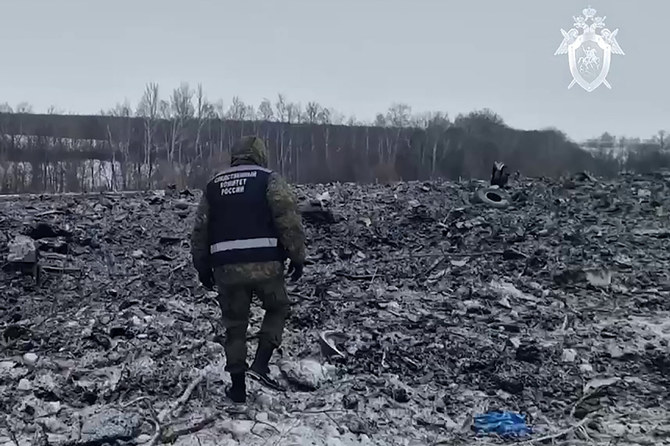
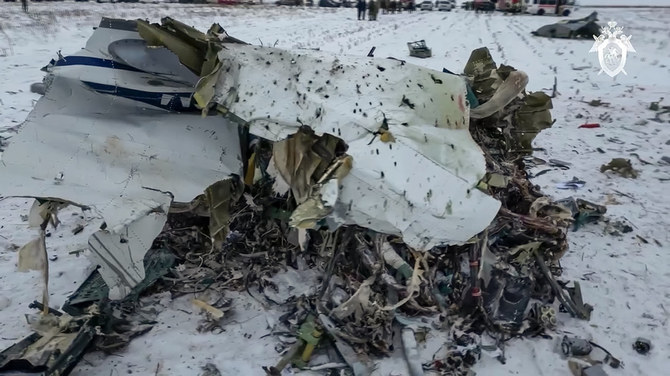
It released a 39-second video of the scene that mainly showed aerial shots of a large blackened stretch in a snow-covered field with some damaged trees.
The video also showed a block of twisted metal and wires, as well as a hand and an arm — though it was unclear if they were from one or two people. No other human remains were shown.
“Fragmented remains of people were found, as well as the flight recorders of the aircraft, which were sent for decoding,” the Investigative Committee said.
Ukraine’s SBU security service also announced it had opened a criminal probe into the downing, specifically into “violations of the laws and customs of war.”
Ukraine’s rights Ombudsman Dmytro Lubinets called for the United Nations and the International Committee of the Red Cross (ICRC) to be allowed to inspect the crash site.
The ICRC did not respond to Kyiv’s request, but it described the reports of the crash as “worrisome” in a statement to AFP.
“We will not make any comments or speculations at this stage, until facts are established,” it said.
At an emergency session of the UN Security Council Thursday evening, requested by Russia to discuss the downed plane, Moscow and Kyiv both sought to pin the blame on the other.
“All of the information that we have today shows that we are dealing with a premeditated, thought-through crime,” said Russia’s deputy ambassador to the UN, Dmitry Polyanskiy, adding that Ukraine’s leaders “knew the route very well, knew about the way the soldiers were going to be transported to the place of exchange.”
He accused Kyiv of sacrificing its own troops “to Western geopolitical interests.”
Ukraine’s deputy ambassador Khrystyna Hayovyshyn rejected the accusation, saying that “Ukraine was not informed about the number of vehicles, roads and means of transportation of the captives.”
“This alone may constitute intentional actions by Russia to endanger the lives and safety of the prisoners,” she said.
While Ukraine has not denied outright that it downed the plane, officials in Kyiv have questioned key aspects of Russia’s narrative, such as whether Ukrainian servicemen were killed.
Ukraine’s military intelligence said it had no “comprehensive information” detailing who was on the flight.
Kyiv has confirmed that an exchange had been scheduled for later Wednesday on the border between the two countries.
But the military intelligence unit said Moscow had not informed it in advance that the POWs would be transported by plane, as it had in the past.
In another carefully worded statement, Ukraine’s army pointed to heightened Russian military activity in the Belgorod region, pledging to continue attacking Russian military targets — again without specifically addressing Moscow’s claims.
Ukrainian media initially cited defense sources saying that the Ukrainian army had downed the plane, and that it had been carrying missiles. Those claims were quickly retracted.
President Volodymyr Zelensky has neither confirmed nor denied Moscow’s claims.
Russia was “playing with the lives of Ukrainian prisoners,” he said late Wednesday, calling for an international investigation.
Russian officials have rolled out a series of statements presenting their side of the story, but have not presented evidence that POWs were onboard.
Moscow has been much more circumspect over previous incidents.
It offered no comment, for example, when Kyiv claimed last week to have downed an A-50 Russian reconnaissance plane and damaged an Il-22 bomber over the Azov Sea.
In August, the plane carrying the leader of the Wagner mercenary group, Yevgeny Prigozhin, crashed on a flight from Moscow to Saint Petersburg.
Prigozhin died alongside his top aides in the incident, two months after they attempted to topple Russia’s military leadership, angering President Vladimir Putin.
Putin said the plane had crashed because passengers had detonated a grenade on board, but Moscow provided no evidence.
In July 2014, when Malaysia Airlines flight MH17 was shot down over eastern Ukraine with all 298 people on board killed, the Kremlin proposed a variety of explanations — sometimes contradictory.
In 2022, a Dutch court sentenced three men fighting among Kremlin-backed separatist forces to life in prison in absentia.
Separately, a Ukrainian security source told AFP on Thursday that Kyiv’s security services had orchestrated an overnight drone attack on an oil refinery in the southern Russian town of Tuapse.
Kyiv has ramped up strikes on Russian oil and gas facilities over the past two months, part of what it has called “fair” retaliation for Russian strikes on its own energy infrastructure.
Ukraine has claimed responsibility for a string of attacks on Russian energy infrastructure in the past two weeks, including a huge inferno at a depot in western Russia last Friday.
Russia also said Thursday that a drone attack killed a woman in the village of Lozovaya Rudka, which lies directly on the Ukraine border in the Belgorod region.


