

Pakistan says Azerbaijan’s SOCAR to finalize oil and gas investment next month

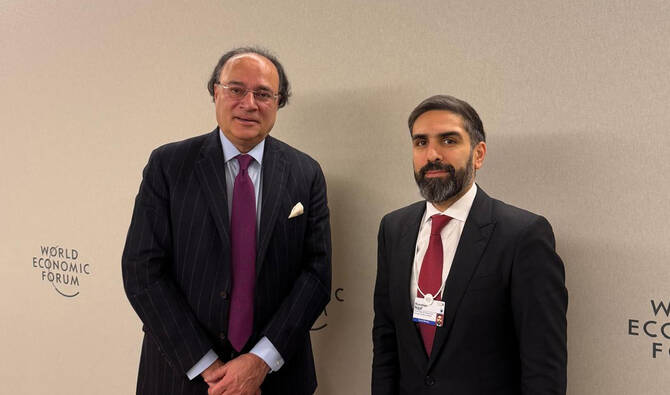
Pakistan’s Finance Minister, Muhammad Aurangzeb, meets the President of State Oil Company of the Republic of Azerbaijan (SOCAR), Rovshan Najaf (right), on the sidelines of the World Economic Forum Annual Meeting in Davos, Switzerland, on January 22, 2026. (Finance Ministry)
Short Url
Updated 22 January 2026
Follow

Pakistan says Azerbaijan’s SOCAR to finalize oil and gas investment next month

  • SOCAR signals February decision after Davos talks, citing Pakistan’s reform momentum
  • Existing LNG, fuel supply ties point to deeper Azerbaijan-Pakistan energy cooperation

ISLAMABAD: Pakistan’s finance ministry said on Thursday Azerbaijan’s state energy company SOCAR is set to finalize an investment in Pakistan’s oil and gas sector next month, following high-level engagements on the sidelines of the World Economic Forum in Davos.

The announcement came after a business roundtable chaired by Finance Minister Muhammad Aurangzeb, where SOCAR President Rovshan Najaf told Pakistani officials the company viewed Pakistan as a long-term energy partner, according to a statement from the finance ministry.

Pakistan has been seeking fresh foreign investment into its energy sector as part of broader economic reforms aimed at stabilizing supply, reducing costs and improving contractual transparency. The oil and gas sector, alongside mining and minerals, has been identified by Islamabad as central to energy security and industrial growth.

SOCAR already has a commercial footprint in Pakistan through SOCAR Trading, which supplies liquefied natural gas under a government-to-government framework with Pakistan LNG Limited. Under the arrangement, SOCAR can supply up to one LNG cargo per month without take-or-pay obligations, giving Pakistan greater flexibility in managing demand and pricing. The agreement has been extended into 2025, reflecting continued cooperation.

“SOCAR views Pakistan as a natural long-term energy partner,” Najaf said, according to the finance ministry statement, citing Pakistan’s “market depth, growing energy demand, and ongoing reform momentum in the oil and gas sector.”

He also highlighted SOCAR’s engagement with Pakistan State Oil on petroleum product supply and expressed interest in expanding cooperation across the broader oil and gas value chain as reforms advance.

Welcoming the planned investment, Aurangzeb reiterated the government’s commitment to attracting “strategic and commercially viable investment” in energy, saying reforms were focused on improving pricing transparency, contractual clarity and risk-sharing mechanisms, according to the statement.

SOCAR is a major state-owned energy company operating in more than 20 countries, with a workforce exceeding 66,000 employees and reported revenues of about $50.6 billion in 2024, the ministry said.

Pakistan and Azerbaijan have been deepening economic ties in recent years, with energy cooperation emerging as a key pillar alongside trade and investment discussions. Officials say the expected SOCAR investment would mark a significant step in strengthening bilateral energy links.


Pakistan top IT association backs $1 billion AI plan announced at Indus Summit

Updated 17 February 2026
Follow

Pakistan top IT association backs $1 billion AI plan announced at Indus Summit

  • Private sector pledges support for AI push, calls tech sector engine of future growth
  • Government to fund 1,000 AI PhDs, train one million professionals under digital strategy

KARACHI: Pakistan’s main software industry association on Tuesday backed the government’s plan to invest $1 billion in artificial intelligence by 2030, pledging private-sector support for what officials describe as a national push toward digital transformation.

The commitment was announced during Indus AI Week in Islamabad, held earlier this month, where Prime Minister Shehbaz Sharif outlined plans to fund artificial intelligence development, including scholarships and workforce training.

The Pakistan Software Houses Association (P@SHA), representing IT exporters and technology firms, said the private sector would play a central role in implementing the strategy.

“The IT sector is no longer merely a participant in Pakistan’s economy,” said Sajjad Syed, the association’s chairman, in a statement. “It is the fundamental engine of our future growth.”

“The commitments made at the Indus AI Summit provide a much-needed, evidence-based structural framework,” he added. “P@SHA, representing the collective strength of Pakistan’s software and tech enterprises, stands fully prepared to translate this policy into export-driven, practical realities.”

Syed said the integration of AI was no longer optional, describing it as a “matter of global survival and economic sovereignty.”

The government said the initiative includes funding for 1,000 PhD scholarships in artificial intelligence and a federal mandate to train one million non-IT professionals in advanced technology skills.

The Indus AI Week event drew participation from local and international technology companies, universities, and investors, according to organizers. It included technical bootcamps and industry panels aimed at accelerating AI adoption.

Pakistan’s IT exports reached $2.2 billion in July–December FY26, marking a 20 percent year-on-year increase, the statement said, as the country seeks to expand its technology sector to support foreign exchange earnings.

The AI push comes as Islamabad looks to modernize its digital infrastructure and attract technology investment while positioning the country as a competitive player in emerging technologies.