DAVOS, Switzerland: US President Donald Trump abruptly stepped back on Wednesday from threats to impose tariffs as leverage to seize Greenland, ruled out the use of force and suggested a deal was in sight to end a dispute over the Danish territory that risked the deepest rupture in transatlantic relations in decades.
Traveling in Davos, Switzerland, Trump backed down, for now, from weeks of rhetoric that shook the NATO alliance and risked a new global trade war. Trump had threatened at the weekend to impose rising tariffs on eight European countries’ US-bound exports.
But after meeting with NATO Secretary General Mark Rutte at the Swiss Alpine resort, Trump said Western Arctic allies could forge a new deal over the strategic island territory of 57,000 people that satisfies his desire for a “Golden Dome” missile-defense system and access to critical minerals while blocking Russia and China’s ambitions in the Arctic.
“It’s a deal that everybody’s very happy with,” Trump told reporters. “It’s a long-term deal. It’s the ultimate long-term deal. It puts everybody in a really good position, especially as it pertains to security and to minerals.”
“It’s a deal that’s forever,” he added.
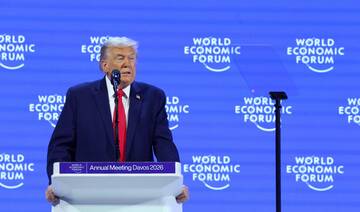
Trump earlier in the day had delivered more than an hour of scolding and dismissive threats aimed at countries already unnerved by his push to seize territory from a longtime US NATO ally. European diplomats said the president’s sudden shift in tone doesn’t resolve the dispute but helps defuse an open rift between allies as they work to sort out their differences in private.
It remained unclear what kind of agreement could meet Trump’s demands for outright “ownership” of a territory that its residents and leaders have said is not for sale. “Negotiations between Denmark, Greenland, and the United States will go forward aimed at ensuring that Russia and China never gain a foothold — economically or militarily — in Greenland,” a NATO spokesperson said.
No date or venue was provided for such negotiations. Trump said he had tasked Vice President JD Vance, Secretary of State Marco Rubio and envoy Steve Witkoff to take part in further discussions.
“What happens in Greenland is of absolutely no consequence to us,” said Russian President Vladimir Putin, quoted by Russian news agencies speaking to the country’s National Security Council.
Trump said on his Truth Social platform that the US and NATO had “formed the framework of a future deal with respect to Greenland and, in fact, the entire Arctic Region,” and that “based upon this understanding, I will not be imposing the Tariffs that were scheduled to go into effect on February 1st.”
It was the latest in a series of reversals of major policies or threats by Trump ahead of deadlines he has imposed during his second term in office.
Denmark said the issue should be handled through private diplomacy rather than on social media.
“What is crucial for us is that we get to end this with respect for the integrity and sovereignty of the kingdom (of Denmark) and the right of the Greenlandic people to self-determination,” Denmark’s Foreign Minister Lars Lokke Rasmussen told public broadcaster DR.
Rasmussen said he had spoken with Rutte but declined to provide details on what had been agreed.
Greenland’s government did not reply to a request for comment. Earlier in the day, the Republican US president acknowledged financial markets’ discomfort with his threats and ruled out force in a speech to global elites at the World Economic Forum annual meeting.
“People thought I would use force, but I don’t have to use force,” Trump said. “I don’t want to use force. I won’t use force.” The change in posture sparked buying on Wall Street. The S&P 500 index posted its biggest one-day percentage gain in two months, adding 1.16 percent for the day. Trump’s more hawkish comments on Greenland on Tuesday helped deliver the sharpest equities selloff in three months.
Trump’s Greenland comments dominated a whirlwind trip to Davos.
Emboldened after a year in office that saw major institutions and allies bend to his will, Trump chastised Europeans on their soil on issues ranging from wind power and the environment to immigration and geopolitics.
He cast himself as a defender of Western values. “We want strong allies, not seriously weakened ones,” Trump said. “I love Europe and I want to see Europe go good, but it’s not heading in the right direction.”
While he took the threat of force off the table for Greenland, Trump bragged about US military might, citing recent operations such as the shock ousting of Venezuela’s Nicolas Maduro earlier this month.
Calling Denmark “ungrateful,” the Republican US president played down the territorial dispute as a “small ask” over a “piece of ice” and said an acquisition would be no threat to the NATO alliance, which includes Denmark and the United States. “No nation or group of nations is in any position to be able to secure Greenland other than the United States,” said Trump, who four times during the speech mistakenly referred to Greenland as Iceland, another NATO member state. “You can say yes, and we will be very appreciative, or you can say no, and we will remember.” Trump also used his speech to settle scores on other grievances. He rounded on Britain over extracting insufficient oil from the North Sea, Switzerland over its trade surplus in goods with the US, France over its pharmaceutical policy, Canada for what he saw as its ingratitude and NATO for its unwillingness to conform to US interests.
His remarks drew uncomfortable looks and light laughter from the audience in Davos, but most were silent. His speech did notably less to address Trump’s top domestic political challenge, the low marks voters give his handling of cost-of-living issues. Though his aides had previewed an economic message, Trump was nearly an hour into the speech before he raised his newer initiatives to lower housing costs. Sources familiar with the situation have previously told Reuters that Trump’s push on Greenland is related to a legacy-building desire to expand the territory of the United States in the biggest way since Alaska and Hawaii became states in 1959.


![]()

Trump backs down on Greenland tariffs, says deal framework reached

Short Url
https://arab.news/8m7ap
Trump backs down on Greenland tariffs, says deal framework reached
- Trump changes tune on Danish territory
- US president has history of making threats, backing down

Latest updates


© 2026 SAUDI RESEARCH & PUBLISHING COMPANY, All Rights Reserved And subject to Terms of Use Agreement.