MOSCOW: Russia accused Ukraine on Wednesday of deliberately shooting down a Russian military transport plane carrying 65 captured Ukrainian soldiers to a prisoner exchange in what it called a barbaric act of terrorism that had killed a total of 74 people.
Ukraine called for full clarification of the circumstances of the incident and did not directly confirm it had shot down the plane.
Ukrainian President Volodymyr Zelensky, in his evening address said: “It is clear that the Russians are playing with the lives of Ukrainian prisoners, the feelings of their loved ones and the emotions of our society.”
The Russian defense ministry said six Russian crew members and three Russian soldiers had been on the Ilyushin Il-76 military transport plane shot down near the Russian city of Belgorod near the Ukrainian border.
After a long pause, the Ukrainian military said it would continue to destroy Russian military transport aircraft it believed were carrying missiles with which to strike Ukraine.
It said it had noticed more Russian military transport aircraft landing in Belgorod, something it linked to Russian missile strikes on Kharkiv and other Ukrainian cities.
Air Force Commander Mykola Oleshchuk accused Russia of trying to undermine international support for Ukraine.
“Ukraine has the right to defend itself and destroy the means of the aggressors’ aerial attack,” he said.
The Russian defense ministry said the exchange was to have taken place on Wednesday afternoon at the Kolotilovka border checkpoint and Ukraine knew a transport plane carrying captured Ukrainian soldiers was expected at the Belgorod airfield.
“By committing this terrorist act, the Ukrainian leadership has showed its true face. It disregarded the lives of its own citizens,” the ministry said in a statement.
Russian Foreign Minister Sergei Lavrov called for a meeting of the UN Security Council and said Russia sought to establish “the reasons behind the Ukrainian criminal act.”
A French spokesperson at the UN said the meeting would be held at 5 p.m. (2200 GMT) on Thursday.
Ukraine’s GUR military intelligence agency said Ukraine had not been asked to ensure airspace security around Belgorod unlike previous swaps and had not been informed about what means of transport would be used and which routes.
“On this basis, we may be talking about planned and deliberate actions by Russia to destabilize the situation in Ukraine and weaken international support for our state,” GUR said in a statement on Telegram.
Russia’s defense ministry said radar operators had detected the launch of two Ukrainian missiles at the time of the crash.
If the details are confirmed, it would be the deadliest incident of its kind inside Russia’s internationally recognized borders during the almost two-year-old war.
Ukraine’s intelligence agency confirmed a prisoner swap had been planned for Wednesday and said the captured Russian servicemen had been delivered to the agreed exchange point on time and were safe.
“Landing a transport plane in a 30-km combat zone cannot be safe and in any case must be discussed by both sides, because otherwise it jeopardizes the entire exchange process,” it said.
It had no reliable information about who was on the downed plane, it added.
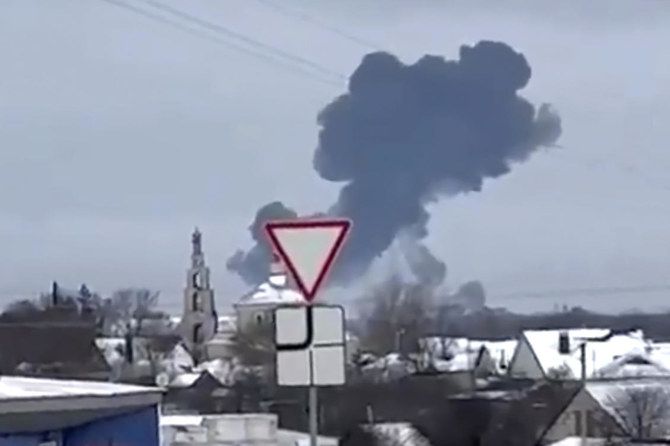
Video footage posted on Telegram by Baza, a channel linked to Russian security services, and verified by Reuters, showed a large aircraft falling to the ground near the village of Yablonovo in Belgorod region and exploding in a fireball.
Andrei Kartapolov, a member of Russia’s parliament and a retired general, told the SHOT news outlet it was impossible for operators of Ukrainian surface-to-air missile systems to mistake transport planes for military planes or helicopters as targets.
“It was done deliberately to sabotage the prisoner exchange,” said Kartapolov, saying a second Russian Il-76 transport plane carrying around 80 Ukrainian soldiers to the exchange had managed to turn around.
Kartapolov, who has close links to the Russian defense ministry, said the plane had been downed by three missiles of either US or German manufacture.
Reuters could not immediately verify details of who was on board the downed plane, but Moscow and Kyiv have regularly swapped prisoners since Russia began what it calls its “special military operation” in Ukraine in February 2022.
The Belgorod region, which borders Ukraine, has come under frequent attack from Ukraine in recent months, including a December missile strike which killed 25 people.

Russia accuses Ukraine of killing 65 of its own POWs by shooting down plane
https://arab.news/cg9uh
Russia accuses Ukraine of killing 65 of its own POWs by shooting down plane
- Ukrainian president: Russia “playing with the lives” of POWs
- Russia says 74 killed after military plane shot down
Funerals for people slain in Australian antisemitic mass shooting begin as suspected gunman charged
- All of those killed by the gunmen who have been identified so far were Jewish
SYDNEY: A suspected gunman in Sydney’s Bondi Beach massacre was charged with 59 offenses including 15 charges of murder on Wednesday, as hundreds of mourners gathered in Sydney to begin funerals for the victims.
Two shooters slaughtered 15 people on Sunday in an antisemitic mass shooting targeting Jews celebrating Hanukkah at Bondi Beach, and more than 20 other people are still being treated in hospitals. All of those killed by the gunmen who have been identified so far were Jewish.
Police said that Naveed Akram, the 24-year-old suspected shooter, was charged on Wednesday after waking from a coma in a Sydney hospital, where he has been since police shot him and his gunman father at Bondi. His 50-year-old father Sajid Akram died at the scene.
The charges include one count of murder for each fatality and one count of committing a terrorist act.
Akram was also charged with 40 counts of causing harm with intent to murder in relation to the wounded and with placing an explosive near a building with intent to cause harm.
Police said the Akrams’ car, which was found at the crime scene, contained improvised explosive devices.
Funerals began as a country reeling from its deadliest hate-fueled massacre of modern times turned to searching questions, growing in volume since the attack, about how it was able to happen. As investigations unfold, Australia faces a social and political reckoning about antisemitism, gun control and whether police protections for Jews at events such as Sunday’s were sufficient for the threats they faced.
First, however, was a day of anguish for families from Sydney’s close-knit Jewish community who gathered, one after another, to begin to bury their dead. The victims of the attack ranged in age from a 10-year-old girl to an 87-year-old Holocaust survivor.
A father of 5 who ministered in prisons is buried
The first farewelled was Eli Schlanger, 41, a husband and father of five who served as the assistant rabbi at Chabad-Lubavitch of Bondi and organized Sunday’s Chanukah by the Sea event where the attack unfolded. The London-born Schlanger also served as chaplain in prisons across New South Wales state and in a Sydney hospital.
“After what happened, my biggest regret was — apart from, obviously, the obvious – I could have done more to tell Eli more often how much we love him, how much I love him, how much we appreciate everything that he does and how proud we are of him,” said Schlanger’s father-in-law, Rabbi Yehoram Ulman, who sometimes spoke through tears.
“I hope he knew that. I’m sure he knew it,” Ulman said. “But I think it should’ve been said more often.”
Funerals draw heavy police presence
Outside the funeral, not far from the site of the attack, the mood was hushed and grim, with a heavy police presence. Jews are usually buried within 24 hours from their deaths, but funerals have been delayed by coronial investigations.
One mourner, Dmitry Chlafma, said as he left the service that Schlanger was his longtime rabbi.
“You can tell by the amount of people that are here how much he meant to the community,” Chlafma said. “He was warm, happy, generous, one of a kind.”
Among others killed were Boris and Sofia Gurman, a husband and wife aged in their 60s who were fatally shot as they tried to disarm one of the gunmen when he got out of his car to begin the attack. Another Jewish man in his 60s, Reuven Morrison, was gunned down by one shooter while he threw bricks at the other, his daughter said.
Many children attended the Hanukkah event, which featured face painting, treats and a petting zoo. The youngest killed was Matilda, 10, whose parents urged attendees at a vigil on Tuesday night to remember her name.
“It stays here,” said Matilda’s mother, who identified herself only as Valentyna, pressing her hand over her heart. “It just stays here and here.”
Authorities are probing a suspected connection to the Daesh group
Authorities believe that the shooting was “a terrorist attack inspired by Islamic State,” Australia’s federal police commissioner Krissy Barrett said Wednesday.
The authorities have said that Naveed Akram came to the attention of the security services in 2019 but have supplied little detail of their previous investigations. Now authorities will probe what was known about the men.
That includes examining a trip the suspects made to the Philippines in November. The Philippines Bureau of Immigration confirmed Tuesday that the two suspected shooters traveled to the country from Nov. 1 to Nov. 28, giving the city of Davao as their final destination.
Groups of Muslim separatist militants, including Abu Sayyaf in the southern Philippines, once expressed support for IS and have hosted small numbers of foreign militants from Asia, the Middle East and Europe in the past. Philippine military and police officials say there has been no recent indication of any foreign militants in the country’s south.
The younger suspect was Australian-born. Indian police on Tuesday said the older suspect was originally from the southern city of Hyderabad, migrated to Australia in 1998 and held an Indian passport.
Leader pledges action on guns and antisemitism
The news that the suspects were apparently inspired by DAESH provoked more questions about whether Australia’s government had done enough to stem hate-fueled crimes, especially directed at Jews. In Sydney and Melbourne, where 85 percent of Australia’s Jewish population lives, a wave of antisemitic attacks has been recorded in the past year.
After Jewish leaders and survivors of Sunday’s attack lambasted the government for not heeding their warnings of violence, Prime Minister Anthony Albanese vowed Wednesday to take whatever government action was needed to stamp out antisemitism.
Albanese and the leaders of some Australian states have pledged to tighten the country’s already strict gun laws in what would be the most sweeping reforms since a shooter killed 35 people in Port Arthur, Tasmania, in 1996. Mass shootings in Australia have since been rare.
Albanese announced plans to further restrict access to guns, in part because it emerged the older suspect had amassed six weapons legally. Proposed measures include restricting gun ownership to Australian citizens and limiting the number of weapons a person can hold.
Australians come together to grieve
Meanwhile, Australians seeking ways to make sense of the horror settled on practical acts. Hours-long lines were reported at blood donation sites and at dawn on Wednesday, hundreds of swimmers formed a circle on the sand, where they held a minute’s silence. Then they ran into the sea.
Not far away, part of the beach remained behind police tape as the investigation into the massacre continued, shoes and towels abandoned as people fled still strewn across the sand.
One event that would return to Bondi was the Hanukkah celebration the gunmen targeted, which has run for 31 years, Ulman said. It would be in defiance of the attackers’ wish to make people feel like it was dangerous to live as Jews, he added.
“Eli lived and breathed this idea that we can never ever allow them not only to succeed, but anytime that they try something we become greater and stronger,” he said.
“We’re going to show the world that the Jewish people are unbeatable.”


