

Islamabad says Nestlé to invest $60 million in Pakistan, expand operations

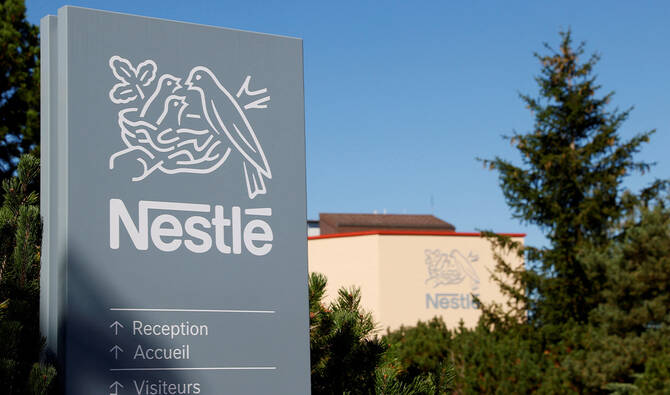
he Nestle research centre at Vers-chez-les-Blanc in Lausanne, Switzerland, August 20, 2020. (Reuters/File)
Short Url
Updated 22 January 2026
Follow

Islamabad says Nestlé to invest $60 million in Pakistan, expand operations

  • Pakistan finance minister chairs roundtable conference featuring CEOs, leaders of various multinationals at Davos
  • Nestlé official says company intends to use Pakistan as regional export, manufacturing hub, Pakistan Finance Division says

ISLAMABAD: Global food and beverage company Nestlé has announced it would invest $60 million in Pakistan and expand its operations in the country, Pakistan’s Finance Division said in a statement on Thursday. 

The development took place in Davos at the sidelines of the World Economic Forum summit in Davos. Finance Minister Muhammad Aurangzeb chaired a high-level Business Roundtable featuring various chief executive officers and senior leaders of global corporations to discuss Pakistan’s reform trajectory, investment climate and growth potential. 

“A major highlight of the discussion was the announcement by Mr. Remy Ejel, Executive Vice President and Chief Executive Officer for Asia, Oceania, and Africa at Nestlé, of an additional investment of USD 60 million in Pakistan,” the Finance Division said.

“Mr. Ejel stated that Nestlé will undertake a robust expansion of its operations in the country, reaffirming its long-term commitment to Pakistan.”

Ejel further announced that Nestlé intends to use Pakistan as a regional manufacturing and export hub, exporting products to 26 countries from here, the statement said. 

In August last year, a high-level Nestlé delegation met Aurangzeb and outlined the company’s strategy centered on localization, advanced manufacturing, sustainability and agricultural transformation in the country. 

Ejel noted that Pakistan’s demographic profile, growing nutrition needs and “underpenetrated value-added food segments” closely mirror successful growth trajectories seen in Southeast Asia, the Finance Division said. 

The Pakistan finance minister welcomed Nestlé’s announcement, describing it as a “strong vote of confidence” in the country’s economic reforms and formalization drive. 

“He reaffirmed the Government’s commitment to strengthening the tax ecosystem, ensuring policy consistency, and facilitating responsible long-term investment through continued engagement with the private sector, including via the Tax Policy Office established within the Finance Division,” the statement said. 


Pakistan approves sale of 500,000 tons of wheat at revised prices after failed bids

Updated 6 sec ago
Follow

Pakistan approves sale of 500,000 tons of wheat at revised prices after failed bids

  • Move comes as IMF-backed reforms push Pakistan to cut food subsidy and storage costs
  • Wheat pricing shifts closely watched for impact on inflation, fiscal deficit and rural incomes

ISLAMABAD: Pakistan’s Economic Coordination Committee (ECC) on Tuesday approved the sale of 500,000 metric tons of wheat at revised reserve prices after an earlier attempt to offload the stock failed due to insufficient bids, according to a statement issued by the Finance Division.

The move comes as the government seeks to reduce mounting wheat inventories held by the Pakistan Agricultural Storage and Services Corporation (PASSCO) and cut associated storage and financing costs amid fiscal consolidation under a $7 billion International Monetary Fund (IMF) stabilization program. Wheat pricing is politically sensitive in Pakistan, where flour is a staple commodity and closely linked to inflation.

Managing excess procurement stocks has become a balancing act for policymakers, who are attempting to control food inflation while limiting subsidy pressures and budget deficits.

“The Committee was informed that an earlier attempt to sell the wheat at previously approved reserve prices could not be finalized due to lower bids received,” the Finance Division said in its statement.

The ECC approved the disposal of wheat through competitive bidding on a First-In-First-Out (FIFO) basis at revised reserve prices of Rs4,150 ($14.8) per 40 kilograms for locally procured wheat and Rs3,800 ($13.6) per 40 kilograms for imported wheat.

Pakistan is one of the world’s largest wheat producers and consumers, and government procurement and pricing decisions often ripple through domestic markets, affecting food inflation, rural incomes and fiscal spending. The country’s wheat policy has been closely scrutinized in recent years after bumper crops, fluctuating import decisions and subsidy adjustments created volatility in local markets.

For international investors and multilateral lenders, inventory management and subsidy rationalization are seen as critical elements of Pakistan’s broader economic reform agenda. Large public stockpiles carry financing and storage costs that add to fiscal pressure, particularly at a time when Islamabad is seeking to narrow budget deficits and stabilize its external accounts.

Pakistan has also faced periodic wheat supply disruptions in recent years, prompting emergency imports that strained foreign exchange reserves. The current decision signals an effort to clear accumulated stock while recalibrating price expectations in the domestic market.

Separately, the ECC approved a technical supplementary grant of Rs536 million ($1.9 million) for projects under Pakistan’s Public Sector Development Programme (PSDP), the federal government’s main infrastructure and development funding framework. 

The allocation relates to projects previously overseen by the now-defunct Pakistan Public Works Department (Pak-PWD), whose functions were recently transferred to provincial authorities as part of administrative restructuring and fiscal rationalization measures. The funds will be transferred to the governments of Punjab and Khyber Pakhtunkhwa in accordance with relevant legal provisions.

In addition, a summary by the Petroleum Division regarding a fact-finding report on a deed of settlement with Cnergyico PK Limited, one of Pakistan’s largest oil refining and marketing companies, was tabled. 

The matter concerns delayed payments of petroleum levy, a key federal revenue source collected on fuel sales that contributes significantly to Pakistan’s budget financing. The ECC returned the summary with directions for a more comprehensive presentation at a subsequent meeting.