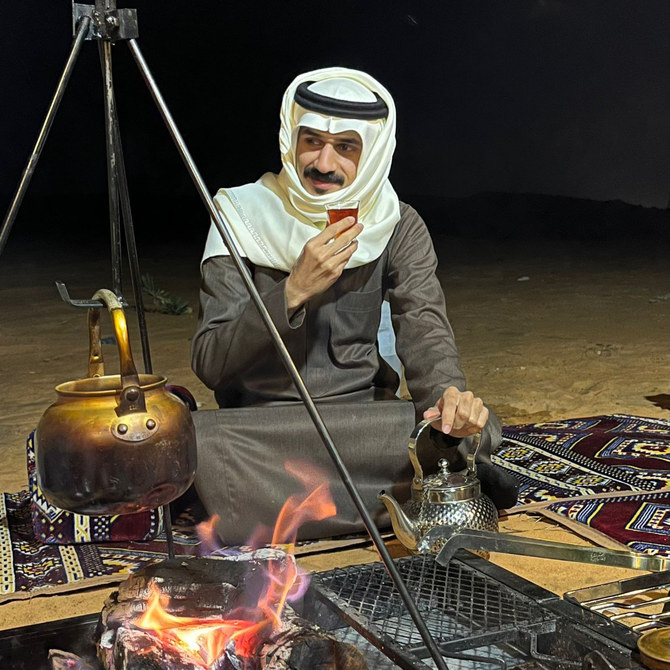
Saudi influencer highlights Kingdom’s cultural heritage by showcasing beverages

A Saudi influencer is showcasing the Kingdom’s culture of hospitality by highlight the many beverages associated with the country. (Supplied)
Short Url
Updated 25 January 2024
Follow

Saudi influencer highlights Kingdom’s cultural heritage by showcasing beverages

  • Saudis, despite their simple life in the desert, countryside, or distant villages, are always keen to provide hospitality services with all authentic aspects and methods

MAKKAH: A Saudi influencer is showcasing the Kingdom’s culture of hospitality by highlight the many beverages associated with the country.

From Arabic coffee and tea as a daily staple, to karak tea and ginger milk for cold winters in some Saudi cities, Talal Al-Issa can suggest a drink for most occasions.

He told Arab News: “Each season has its own drink which is served in various ways to adapt to the changing weather conditions.”

The diversity of Saudi beverages came from the geographical and cultural variations of each region, and the social aspect of preparing and sharing drinks helped visitors and tourists to understand the nation’s history, Al-Issa said.

“Saudis, despite their simple life in the desert, countryside, or distant villages, are always keen to provide hospitality services with all authentic aspects and methods. Coffee is our culture and a great pride to hold onto,” he added.

Al-Issa noted that Saudi coffee had become a focal point of local hospitality and traditions, highlighting the culture and identity of regions.

He pointed out that Saudis looked forward to serving drinks to others as a symbol of hospitality, Arabism, generosity, and manners, passed down through generations.

“Coffee and tea form a bridge of communication between peoples.

They are also a symbol of our culture as Saudis. Each country has its own way of serving coffee and tea. However, Saudis are creative in serving their heritage,” he said.

The welcome often given to visitors to Saudi Arabia had “deepened the positive feelings among them and increased their admiration and appreciation for this great country,” he added.

Al-Issa said: “What often catches the attention of visitors to the Kingdom are the various ways in which Saudis prepare coffee and tea.

“Each region of the Kingdom has its own characteristics, which is considered a cultural diversity of the Saudi community. This diversity indicates the deep roots of Saudi Arabia which are considered an extension of the fathers’ and ancestors’ culture and represents a legacy they hold on to despite the rapid development and growth of civilization,” he added.

When serving drinks, Al-Issa usually dresses in traditional clothes to represent local culture.

He said non-Saudis sometimes held stereotypical views regarding clothing, food, and drink in the country, but he felt perceptions were changing.

“This was clearly shown in some films and series due to the lack of channels broadcasting the correct image to people.

“We can now see Saudi elegance reaching all continents, theaters, and fashion shows which are presenting the true Saudi personality and reflecting its elegance, details, and charisma, as it deserves,” he added.


Local ZUMI thermos bottle has heritage-inspired design

Updated 5 sec ago
Follow

Local ZUMI thermos bottle has heritage-inspired design

  • References Zamzam and Hajar’s search for water
  • Helps to tell Kingdom’s story, says firm Teeb Made

ZUMI, a thermos bottle unveiled this month by Saudi Arabia brand Teeb Made, has a design referencing local memory, ritual and place, according to its producers.

“We believe meaningful design can influence how people live, feel, and connect,” said Abeer Alessa, CEO of The Bold Group and co-founder of Teeb Made.

“ZUMI draws from our heritage yet speaks to a global audience seeking intention and authenticity in the objects they choose.”

Developed under The Bold Group, ZUMI reflects a growing movement within Saudi Arabia’s creative sector to translate cultural narratives into tangible products.

Rather than following global design trends, the team focused on grounding the product in a story that resonates locally while remaining accessible internationally.

Above, the team behind Zumi.

The name ZUMI is inspired by Hajar’s call, “Zummi, zummi,” meaning “gather, gather,” during her search for water for her son Ismail between the hills of Safa and Marwah.

That moment led to the emergence of Zamzam water, a source revered for centuries and deeply embedded in Islamic and Saudi identity. For the creators, this origin story became the philosophical core of the product.

“Culture starts with a story,” Alessa explained. “With Teeb Made, we wanted to tell our story not only through communication, but through a product you can touch, live with, and keep close to you.”

Visually, ZUMI draws inspiration from the dorag, the historical vessel used by the Zamazmah men of Makkah to serve Zamzam water to pilgrims for more than 1,400 years.

Traditionally utilitarian, the dorag carried spiritual weight through its purpose rather than ornamentation. Teeb Made reinterpreted this form into a minimal, contemporary silhouette suited for modern lifestyles.

“We wanted ZUMI to be a vessel of meaning, not just water,” said Mohamad Baalbaki, executive creative director of The Bold Group and co-founder of Teeb Made.

“Its form, its patented base, and its simplicity all serve one purpose: to create something that feels familiar, timeless, and deeply personal.”

“We believe meaningful design can influence how people live, feel, and connect,” said Abeer Alessa, CEO of The Bold Group and co-founder of Teeb Made. (Supplied)

The design process was extensive. Translating a historical silhouette into a thermos bottle required more than 18 months of research and development.

The final product received a patented design certification from the Saudi Ministry of Culture, marking a milestone in original Saudi intellectual property within product design.

One of ZUMI’s most talked-about features is that it does not stand upright. This decision was entirely intentional.

“We wanted people to carry it, not leave it on a table,” Baalbaki said. “It’s a statement piece, but more importantly, it’s a personal object that invites interaction and conversation.”

Color selection further reinforces the connection to place. The launch collection features hues inspired by Saudi landscapes, including tin (mud), forest, and matar (rain), reflecting the Kingdom’s environmental diversity and grounding the product visually in its origins.

“ZUMI is a product with a Saudi story that is scalable and built to last,” said Souad Merheb, general manager of Teeb Made. “Our vision is to create intellectual property that can live long, grow as a brand, and carry these stories to new generations without losing their meaning.”

“Teeb Made is, at its core, a product design company,” Merheb added. “Our expertise lies in design and creativity, and ZUMI is a reflection of that focus, a piece of IP developed with intention, patience, and depth.”

“There are many rich and insightful stories in Saudi Arabia that remain untapped,” Alessa said. “With ZUMI, this is just the beginning.”

Beyond the product itself, ZUMI aligns with broader national efforts to elevate Saudi culture through the creative economy.

Teeb Made has engaged with several government entities and cultural platforms that recognize the value of culturally rooted products in shaping global perceptions of the Kingdom.

“Today, every Saudi has a role in telling our story to the world,” Alessa said. “For us, it is an honor to contribute to that narrative through design.”

ZUMI also signals the beginning of a wider design ecosystem under Teeb Made, with future editions and complementary accessories already in development.

According to the team, this is only the first chapter in a larger effort to revive untapped cultural stories through modern design.

ZUMI is available at www.zumibottle.com and on Instagram @zumibottle.