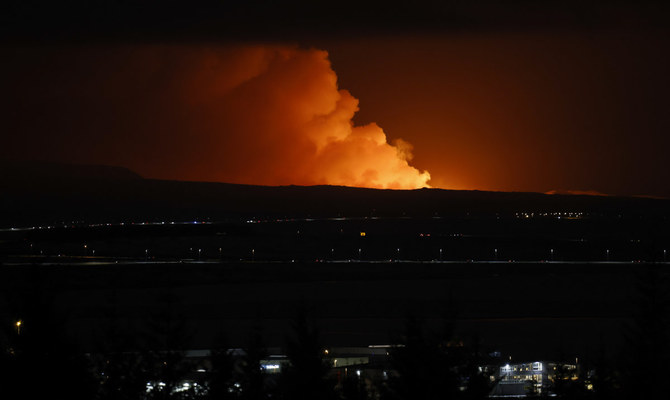
OSLO: The Reykjanes volcano in southwest Iceland erupted on Monday, spewing lava and smoke into the air, after weeks of intense earthquake activity, the country’s Meteorological Office said.
Fearing a significant outbreak on the Reykjanes peninsula, authorities last month evacuated the nearly 4,000 inhabitants of the fishing town of Grindavik and closed the nearby Blue Lagoon geothermal spa.
“Warning: Eruption has started north of Grindavik by Hagafell,” the Met Office said on its website.
Images and a livestream broadcast by Reuters showed molten rock spewing like fountains from fissures in the ground, their bright-yellow and orange colors set in sharp contrast against the dark night sky.
Icelandic police said they had raised their alert level as a result of the outbreak and the country’s civil defense warned the public not to approach the area while emergency personnel assessed the situation.
A coast guard helicopter was going to be in the air shortly to confirm the exact location and size of the eruption, the Met Office said.
Reykjavik’s international airport, which is located nearby, remained open.
“At the moment, there are no disruptions to arrivals or departures at Keflavík Airport,” it said on its website.
The Reykjanes peninsula in recent years saw several eruptions in unpopulated areas, but the latest outbreak could pose a risk to the Grindavik town, authorities have said.
The area had seen thousands of earthquakes in the last two months but the magnitudes had declined in recent week, leading some experts to think risk of an eruption had abated.
Reykjanes is a volcanic and seismic hot-spot southwest of the capital Reykjavik. In March 2021, lava fountains erupted spectacularly from a 500-750-meter-long (1,640-2,460-foot-long) fissure in the ground in the Fagradalsfjall volcanic system.


Iceland volcano erupts after weeks of quake activity
https://arab.news/rbkb7
Iceland volcano erupts after weeks of quake activity

- Reykjanes is a volcanic and seismic hot-spot southwest of the capital Reykjavik


Bomb attacks on Thailand petrol stations injure 4: army
- Authorities did not announce any arrests or say who may be behind the attacks
BANGKOK: Assailants detonated bombs at nearly a dozen petrol stations in Thailand’s south early Sunday, injuring four people, the army said, the latest attacks in the insurgency-hit region.
A low-level conflict since 2004 has killed thousands of people as rebels in the Muslim-majority region bordering Malaysia battle for greater autonomy.
Several bombs exploded within a 40-minute period after midnight on Sunday, igniting 11 petrol stations across Thailand’s southernmost provinces of Narathiwat, Pattani and Yala, an army statement said.
Authorities did not announce any arrests or say who may be behind the attacks.
“It happened almost at the same time. A group of an unknown number of men came and detonated bombs which damaged fuel pumps,” Narathiwat Governor Boonchauy Homyamyen told local media, adding that one police officer was injured in the province.
A firefighter and two petrol station employees were injured in Pattani province, the army said.
All four were admitted to hospitals, none with serious injuries, a Thai army spokesman told AFP.
Thailand’s Prime Minister Anutin Charnvirakul told reporters that security agencies believed the attacks were a “signal” timed with elections for local administrators taking place on Sunday, and “not aimed at insurgency.”
The army’s commander in the south, Narathip Phoynok, told reporters he ordered security measures raised to the “maximum level in all areas” including at road checkpoints and borders.
The nation’s deep south is culturally distinct from the rest of Buddhist-majority Thailand, which took control of the region more than a century ago.
The area is heavily policed by Thai security forces — the usual targets of insurgent attacks.


