

Eruption of Eurasia’s tallest active volcano sends ash columns above a Russian peninsula

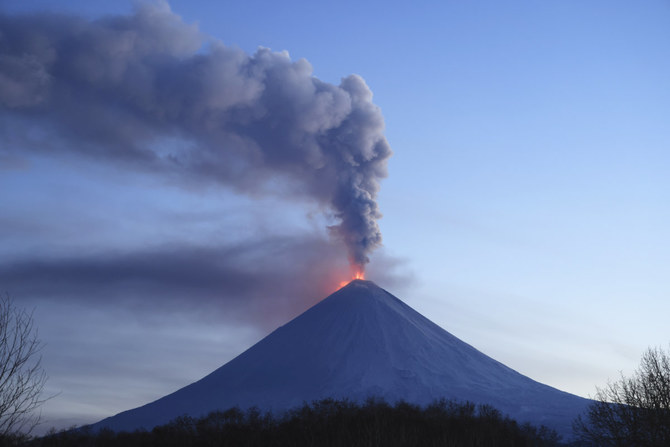
The Klyuchevskoy volcano erupts in Russia's northern Kamchatka Peninsula, Russian Far East, on Oct. 29, 2023. Huge ash columns erupted from Eurasia's tallest active volcano on Wednesday, Nov. 1, 2023, forcing authorities to close schools in two towns in the region. (AP Photo/Yuri Demyanchuk)
Short Url
Updated 02 November 2023
Follow

Eruption of Eurasia’s tallest active volcano sends ash columns above a Russian peninsula

MOSCOW: Huge ash columns erupted from Eurasia’s tallest active volcano Wednesday, forcing authorities to close schools in two towns on Russia’s sparsely populated Kamchatka Peninsula.
The eruptions from the Klyuchevskaya Sopka volcano sent ash as high as 13 kilometers (8 miles) above sea level, officials said.
There were no reports of injuries, but officials ordered schools in Ust-Kamchatsk and Klyuchy closed as a precaution. Each town has a population of about 5,000. Klyuchy is located about 30 kilometers (20 miles) from the volcano and Ust-Kamchatsk 50 kilometers (30 miles) away.
The 4,650-meter (15,255-foot) stratovolcano has been active in recent years and released lava in June.
The Kamchatka Peninsula, which extends into the Pacific Ocean about 6,700 kilometers (4,100 miles) east of Moscow, is noted for its array of active and dormant volcanoes, geysers and geothermal springs.


Pakistan cold wave to persist into February as more snow forecast in north

Updated 6 sec ago
Follow

Pakistan cold wave to persist into February as more snow forecast in north

  • Cold wave to last until Feb 1 nationwide, longer in northern regions
  • Authorities urge tourists to avoid unnecessary travel during snowfall

ISLAMABAD: Pakistan’s ongoing cold wave is expected to persist across much of the country until the end of the month, with freezing conditions likely to continue into mid-February in mountainous northern regions as more rain and snowfall are forecast, a senior meteorological official said on Tuesday.

The warning comes as a fresh western weather system is set to bring intermittent rain and light-to-moderate snowfall to parts of Khyber Pakhtunkhwa, Gilgit-Baltistan, Kashmir and northern Punjab, raising concerns over travel disruptions and road safety in mountainous areas.

“The cold wave in the country will continue until February 1, but in Murree, the Galyat region, and other hilly areas, this wave will persist until February 15,” Anjum Nazir Zaigham, Deputy Director at the Met Department, told Arab News.

The Galyat region refers to a cluster of hill resorts and mountain towns in northern Pakistan, straddling parts of Murree and Abbottabad districts in Punjab and Khyber Pakhtunkhwa.

“This season, 102 inches of snow were recorded in Malam Jabba, 67 inches in Kalam, 37 inches in Babusar, and 30 inches in Murree,” he added.

Pakistan has experienced one of its harsher winter spells this season, with heavy snowfall recorded at several popular hill stations, prompting authorities to restrict vehicle movement in vulnerable areas and deploy additional personnel to manage traffic and emergency response, particularly in tourist destinations such as Murree.

In an advisory issued Tuesday afternoon, the Met Office said westerly winds were likely to bring further intermittent rain and snowfall over areas including Chitral, Dir, Swat, Kalam, Shangla, Kohistan, Battagram, Mansehra, Abbottabad, Buner, Murree, the Galyat region, Kashmir and Gilgit-Baltistan over the next few hours.

Authorities have also urged tourists to avoid unnecessary travel during snowfall, while local administrations have been coordinating snow clearance, traffic diversions and emergency services.

Tens of thousands of tourists flock to Pakistan’s scenic north every winter to witness snowfall, often neglecting warnings from disaster management authorities.

In January 2022, at least 21 people, including children, died after they were stuck in freezing temperatures during a snowstorm in the Pakistani hill station of Murree.