

Pakistan, Saudi Arabia discuss strengthening strategic partnership, regional security

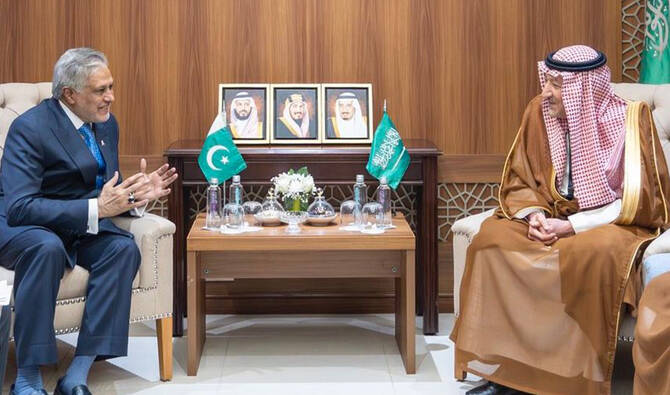
Pakistan’s Deputy Prime Minister Ishaq Dar meeting Saudi Deputy Foreign Minister Waleed Bin Abdulkarim Al-Khereiji in Jeddah on January 11, 2026. (MoFA)
Short Url
Updated 11 January 2026
Follow

Pakistan, Saudi Arabia discuss strengthening strategic partnership, regional security

  • Pakistan Deputy PM meets Saudi Deputy Foreign Minister Waleed bin Abdulkarim Al-Khereiji in Jeddah
  • Ishaq Dar attends OIC’s Council of Foreign Ministers meeting to discuss Israel’s recognition of Somaliland

ISLAMABAD: Pakistan’s Deputy Prime Minister Ishaq Dar met Saudi Deputy Foreign Minister Waleed Bin Abdulkarim Al-Khereiji on Sunday to discuss the strategic partnership between the two countries, reaffirming close cooperation for regional security and peace, the Pakistani foreign ministry said.

Dar, who is also Pakistan’s foreign minister, met Al-Khereiji on the sidelines of the Organization of Islamic Cooperation’s 22nd Council of Foreign Ministers (CFM) meeting in Jeddah. The CFM was organized to discuss Muslim states’ response to Israel’s recognition of Somaliland. 

“Both sides discussed strengthening Pakistan–Saudi strategic partnership and reaffirmed close cooperation within the OIC for peace, stability and security in the region,” the Pakistani foreign ministry said in a statement. 

Dar also met OIC Secretary General Hissein Brahim Taha at the sidelines of the conference. The Pakistani minister highlighted Pakistan’s strong condemnation of Israel’s recognition of Somaliland and its unwavering support for the sovereignty, unity and territorial integrity of Somalia, the foreign office said. 

“DPM/FM also urged SG to step up his efforts for the realization of the right to self-determination of Kashmiri people,” the statement added. 

Pakistan and Saudi Arabia enjoy cordial ties that date back decades and include cooperation in several sectors such as defense, trade, economy, agriculture, livestock and minerals. 

Saudi Arabia is the largest source of foreign remittances to Pakistan, with over two million Pakistani expats residing in the Kingdom. 

The two countries also signed a landmark strategic partnership agreement in September 2025, according to which an act of aggression against one country will be seen as an attack on both. 


Pakistan consults banks on financial stability as Middle East conflict rattles global markets

Updated 5 sec ago
Follow

Pakistan consults banks on financial stability as Middle East conflict rattles global markets

  • Finance minister says government monitoring global supply chains, energy markets amid regional tensions
  • Banks pledge coordination with government and central bank to ensure uninterrupted financial services

KARACHI: Pakistan’s finance minister held consultations with the country’s banking sector on Wednesday to review potential economic risks from the escalating Middle East conflict and ensure financial stability, according to a government statement.

The virtual meeting between Finance Minister Muhammad Aurangzeb and senior representatives of the Pakistan Banks’ Association (PBA) came as tensions involving the United States, Israel and Iran have driven volatility in global oil and financial markets, raising concerns for import-dependent economies such as Pakistan.

Islamabad has already faced pressure from rising fuel prices and potential supply disruptions in energy markets, prompting officials to closely monitor global developments and assess possible impacts on inflation, external accounts and broader macroeconomic stability.

“The discussion focused on the evolving economic and financial situation in light of prevailing regional developments and the importance of close coordination between the government, the State Bank of Pakistan, and the banking sector to ensure financial stability and uninterrupted financial services,” the finance ministry said in a statement after the minister's meeting with PBA officials. 

Aurangzeb told banking leaders the government had established a high-level coordination mechanism involving key economic ministries and institutions to continuously review developments in global markets, particularly in supply chains and energy.

He said authorities were conducting regular scenario analysis to evaluate possible implications for inflation, external accounts and overall economic stability while ensuring the continuity of essential supplies.

“The government remains engaged with relevant stakeholders and international partners as part of its efforts to safeguard the country’s economic interests,” the minister said, according to the statement.

Aurangzeb also emphasized the importance of coordinated decision-making and operational resilience within the financial sector during periods of uncertainty, encouraging banks to continue supporting businesses and customers while maintaining responsible risk management.

PBA Chairman Zafar Masud briefed the finance minister on the banking sector’s internal consultations and preparedness measures in response to the evolving situation, the statement said. 

Masud said the banking industry had set up a coordination framework for timely consultation and information sharing among financial institutions, aimed at ensuring the smooth functioning of financial services and payment systems.

He added that banks would remain in close engagement with the State Bank of Pakistan and other stakeholders while maintaining regular consultations within the industry to monitor developments and support financial market stability.