LONDON: Amid a humanitarian situation described as “apocalyptic” by UN human rights chief Volker Turk, nearly 2 million Palestinians in Gaza face a grim fate after the US vetoed on Friday a UN resolution calling for an immediate ceasefire.
The vote came after UN Secretary-General Antonio Guterres sounded the alarm on Wednesday, invoking Article 99 of the UN Charter. The article allows the UN chief to “bring to the attention of the Security Council any matter which in his opinion may threaten the maintenance of international peace and security.”
During a recent virtual media briefing, officials from aid organizations active in Gaza said they had run out of words to describe the humanitarian crisis and the horrors unfolding in the embattled enclave.
The meeting was held by the NGOs Action Against Hunger, Amnesty International, Doctors of the World, Medecins Sans Frontieres France, Humanity and Inclusion – Handicap International, Norwegian Refugee Council, Oxfam, Refugees International, and Save the Children.
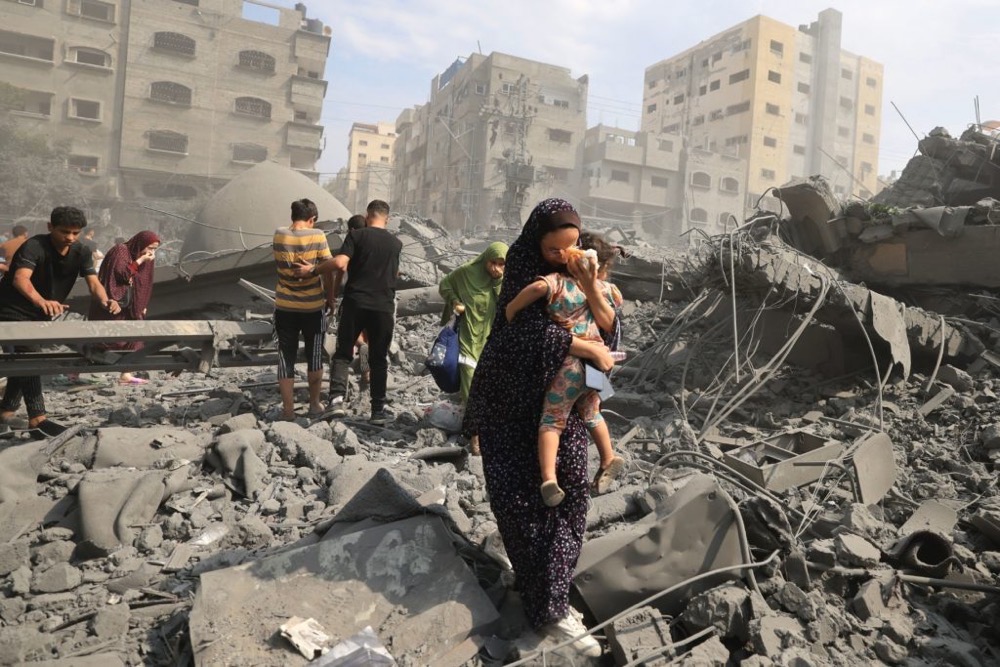
Officials from aid organizations active in Gaza said they had run out of words to describe the humanitarian crisis. (AFP)
The renewed hostilities following the end of the truce, which lasted for six days after it was reached on Nov. 24, have seen Israel expand its ground offensive deeper into southern Gaza, previously declared by the Israeli military as a “safe” area. To date, over 1.8 million Palestinians have been displaced.
Officials of the Hamas-run Health Ministry in Gaza say more than 17,700 Palestinians, including over 7,000 children, have been killed by the Israeli bombardment since Oct. 7.
On that day, the Israel Defense Forces launched a military campaign in Gaza in retaliation for an attack by Hamas in which more than 1,440 Israelis and foreigners were killed or taken hostage.
As of Sunday, the IDF and Hamas militants were locked in combat in several parts of Gaza, including the main city in the south, Khan Younis, whose residents had been earlier asked to evacuate via an “urgent appeal.”
Describing the humanitarian conditions in southern Gaza, Alexandra Saieh, head of humanitarian policy and advocacy at Save the Children, said at Thursday’s media briefing: “People are in overcrowded shelters, in makeshift tents, with no access to clean water and crumbling sanitation facilities.
“We have heard of children starving in the so-called safe zone of Al-Mawasi.”
Al-Mawasi, a kilometer-wide patch of desert along the coastline of southern Gaza, was touted by Israel as a “safe space” in October.
Approximately 770,000 internally displaced people have sought refuge in 133 shelters, while others in the south have sheltered with host families or slept on the streets, according to Shaina Low, communications adviser at the Norwegian Refugee Council.
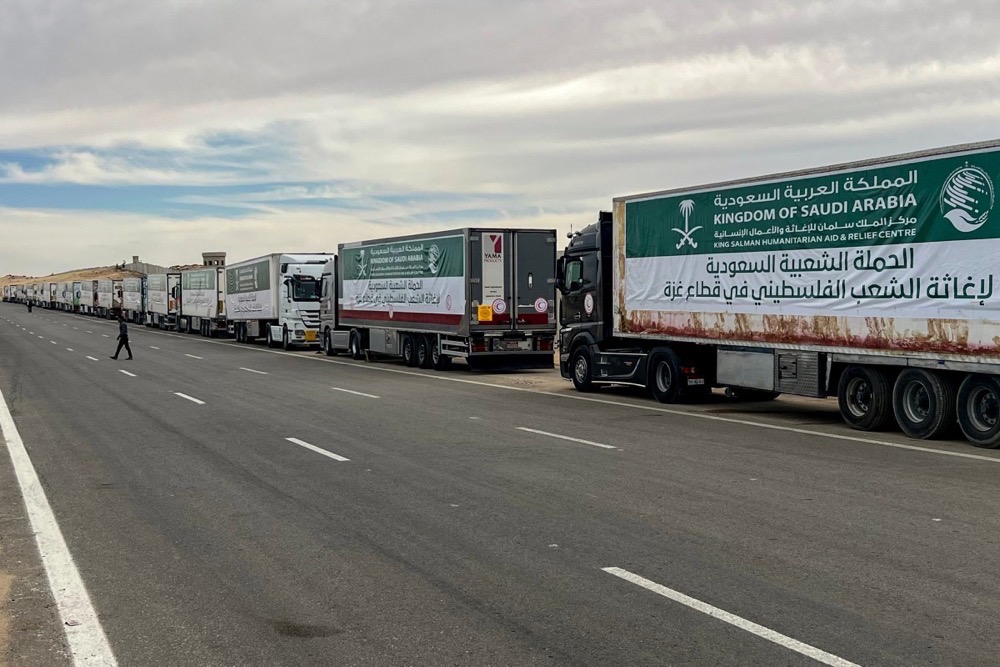
Saudi aid trucks near the Rafah border crossing. (SPA)
Aid workers have not been spared the chaos. Low added that some of the NRC’s staff members, along with their infants, are “sleeping on the streets because they have nowhere safe to seek refuge.”
“Amid relentless air, land and sea attacks, Israel is forcing families to relocate from one perilous zone to another,” she said. “The influx of people into southern Gaza has surged as hundreds of thousands fled from northern Gaza.”
Save the Children’s Saieh recounted colleagues’ accounts of “hundreds of children lining up for a single toilet in the south, children and families roaming the streets of what has not been flattened, with no food, nowhere to go and nothing to survive on.”
“Our teams are telling us of maggots being picked from wounds, and children undergoing amputations without anesthetic. More than a million children, practically all of the child population of Gaza, are left with nowhere to go.”
Opinion
This section contains relevant reference points, placed in (Opinion field)
Sandrine Simon, advocacy and health director at Doctors of the World, warned that the current conditions in southern Gaza “are leading to the outbreak of epidemics.”
She said there has been a significant increase in cases of diarrhea, acute respiratory infections, and skin infections, adding that “soon, famine and epidemics will kill even more surely than bombing.”
The World Health Organization has recorded over 70,000 acute respiratory infections and at least 44,000 cases of diarrhea, half of which are among children under the age of 5. However, actual figures are expected to be significantly higher.
“Diarrhea is a leading cause of child mortality globally,” said Chiara Saccardi, the Middle East’s head of operations at Action Against Hunger, during the media briefing.
She attributed the high number of sick children in Gaza and the looming specter of a health crisis to “the total collapse of the water and sanitation infrastructure in Gaza.”

“There are no bathrooms; people are digging holes in the sand to use as toilets,” Saccardi said. “Some basic essential hygiene items, like (diapers), wipes, and detergent are no longer available.”
Isabelle Defourny, president of MSF, said medical needs in Gaza “have never been as high, but the healthcare system is on the ground.”
Owing to a 16-year Israeli blockade, Gaza’s healthcare system was on the verge of collapse even before the current escalation in hostilities. The WHO said that today, the health system in the devastated strip was “on its knees.”
The IDF has laid siege to several hospitals in Gaza, claiming that Hamas was running command centers in — or underneath — those facilities. Hamas has denied the allegation.
Defourny said MSF staff have witnessed “how hospitals in the north of Gaza were turned into morgues and ruins,” adding that the health facilities are being bombed, shot at by Israeli tanks and guns, encircled, and raided, and that patients and medical staff are being killed.
“Some doctors have had to leave patients behind after facing the unimaginable choice between their lives and those of their patients,” she said. “In the north of the Gaza Strip today, there is no more access to surgery, no more surgical services.”
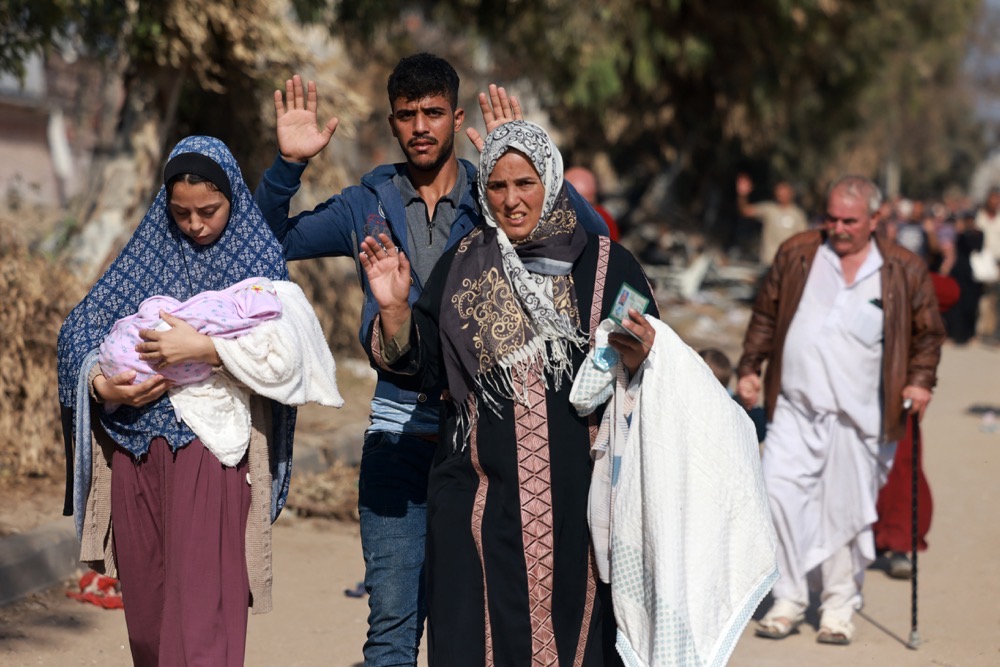
None of Gaza’s 2.3 million inhabitants can find sufficient food and clean water. (AFP)
MSF’s international team in Gaza is now operating in the central area, namely in Al-Aqsa Hospital, and in the south in Al-Nasser Hospital in Khan Younis.
Defourny said the MSF team had to flee Al-Nasser Hospital on Monday evening “due to the intensity of bombardment” around it.
“Today, 65,000 people (in Gaza) are injured,” said Simon of Doctors of the World, stressing that “some will die in excruciating pain for lack of treatment anesthetic” and “thousands more will not have access to surgery and early rehabilitation needed to avoid permanent disability.”
Even humanitarian workers have been unable to access vital healthcare services. Simon said that when one of her colleagues was wounded in a tank attack on a school in which he had taken refuge, it took him hours to reach the hospital.
“And there, hundreds of patients lie on the ground, stepped over by exhausted, traumatized nurses.”
For over 60 days, aid workers in Gaza have faced a multitude of barriers. Today, none of Gaza’s 2.3 million inhabitants can find sufficient food and clean water, according to a statement issued on Dec. 6 by 27 NGOs operating in Gaza.
“Aid delivery has faced severe challenges due to the closures of key crossings like Karem Shalom, and our overstretched teams are also facing death in Gaza,” said Bushra Khalidi, Oxfam’s head of policy for the occupied Palestinian Territories, adding that the situation in Gaza might have “irreversible consequences on Palestinian people.”
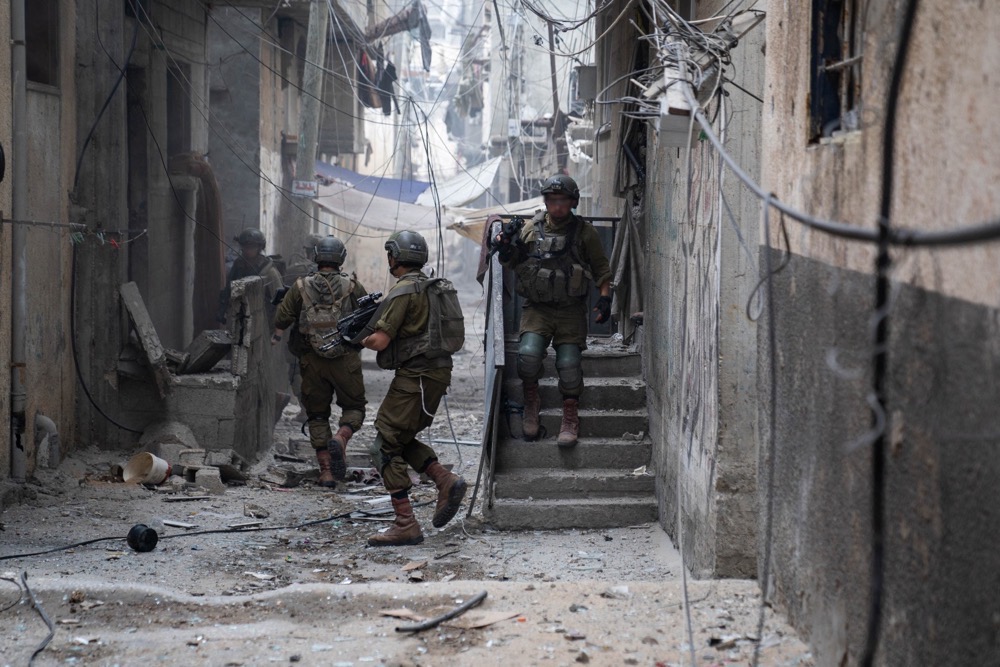
The IDF and Hamas militants are locked in combat in several parts of Gaza. (AFP)
“Our colleagues on the ground faced extreme risks in distributing aid, with even basic necessities like water sparking desperate struggles and tensions,” she said. “The scarcity of aid has led to desperate struggles over water, tearing at our social fabric.”
The World Food Programme has estimated that each person in northern Gaza has access to an average of 1.8 liters of safe drinking water per day, while in the south, it is 2 liters.
“(The) human body cannot survive with such a small quantity of water,” said Saccardi of Action Against Hunger.
Saieh lamented that “with the intensity of the government of Israel’s offensive, coupled with the ongoing siege, the ability to provide any humanitarian assistance has been undermined.”
“We are unable to do our job effectively. People have been squeezed into the tiniest areas, cut off from basic necessities and cut off from the basics to survive,” she said.
Officials at Thursday’s briefing called for an immediate international intervention — to prevent further civilian deaths, stop the deepening of the humanitarian crisis, and avert a complete breakdown of the situation on the ground.
Amanda Klasing, national director for government relations at Amnesty International US, called for “a comprehensive UN Security Council arms embargo on Israel, Hamas, and other Palestinian armed groups until there’s no longer substantial risk that arms could be used to commit violations, and that there are effective accountability mechanisms in place.”
In the absence of a Security Council arms embargo, Klasing called on countries, particularly the US, to “immediately impose their own suspensions.”
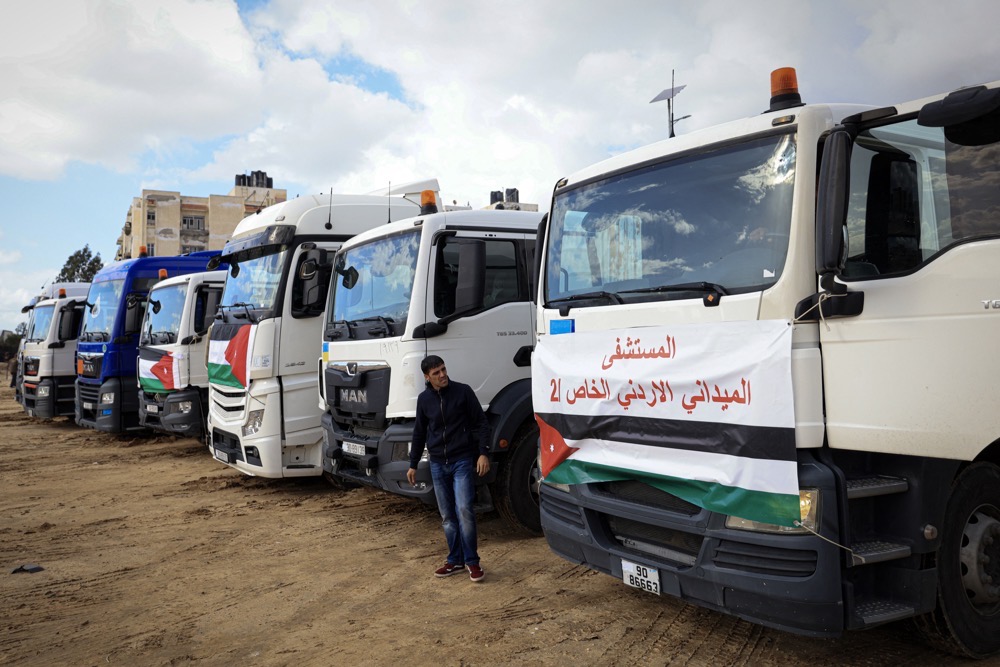
Aid workers in Gaza have faced a multitude of barriers. (AFP)
She said: “Our overall analysis is that violations of international humanitarian law and potential war crimes continue unabated, and therefore the US should suspend arms transfers to Israel.”
Saying that their teams were steadfast in continuing their humanitarian operations in the Gaza Strip despite the obstacles, the participants in the media briefing asserted that only a permanent and definitive ceasefire would allow for an effective humanitarian response.
Unless the violence ceased entirely, they warned the cost would be the lives of more children.