

Outbreak of new controversies continues to plague international cricket

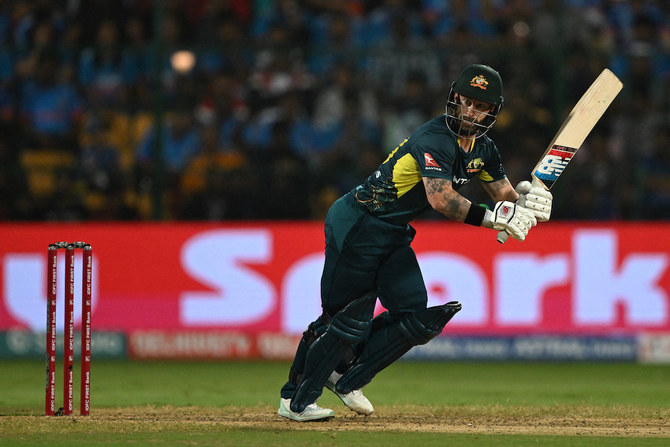
Australia’s captain Matthew Wade plays a Twenty20 international match against India in Bengaluru on Dec. 3, 2023. Australian cricket fans will need to have a Prime Video subscription if they wish to watch Australia’s men’s and women’s teams playing in ICC competitions. (AFP)
Short Url
Updated 07 December 2023
Follow

Outbreak of new controversies continues to plague international cricket

  • Two recent controversial developments have done little to improve the image of the game in Australia and Pakistan

All of a sudden cricket has been impacted by an outbreak of controversies. Amongst them have been a fierce dispute between former colleagues in the Australian men’s team, the loss of free-to-air viewing rights in Australia and the appointment of a disgraced Pakistani cricketer as an advisor on national selection.

On Dec. 4, the International Cricket Council announced that Amazon Prime had been awarded the broadcast rights in Australia for all ICC tournaments for the next four years, starting on Jan. 1, 2024.

This means that Australian cricket fans will need to have a Prime Video subscription if they wish to watch Australia’s men’s and women’s teams playing in ICC competitions, including Under-19 World Cup events. There are 11 of them up to the end of 2027. None of the tournaments will be held in Australia. This has provided an opportunity for the ICC and Amazon Prime to avoid so-called Australian anti-siphoning rules.

Unsurprisingly, the establishment of a paywall has been greeted with outrage. The CEO of Free TV Australia, the industry body which represents all free-to-air Australian TV networks, condemned the move, saying that “all Australians deserve the right to share our great sporting moments for free, and that right is in serious jeopardy.”

That view seems to be shared by the federal communications minister, Michelle Rowland, who has recently introduced a bill to parliament that updates anti-siphoning laws. Once in law, free-to-air services must be offered first refusal for important sporting events.

This measure may not go far enough. The Broadcasting Services (Events) Notice, as the anti-siphoning legislation is known, was first introduced in 1992 when the concern was related to subscription TV securing sports rights. The protective provisions apply to senior Australian cricket teams playing in Test, one day and T20 matches in Australia, New Zealand and the UK between Australia and England. Discussion has been reawakened as to whether this geographical coverage should or can be expanded.

It is too late for the timescale of the ICC/Prime deal. Social media comments have been quick to blame the minister and Cricket Australia for this to happen. Neither has any involvement or power in the broadcast deals which the ICC arranges. However, the introduction of Prime, as the fourth major broadcaster of cricket in Australia and the first which is entirely on-line, has added to the melange of cricket viewing options for Australian audiences.

They have been used to a 15-year long joint venture for ICC tournaments between Foxtel and Channel Nine, which ended with this years ODI Final. Cricket Australia’s domestic broadcast rights have been held by a partnership between free-to-air broadcaster Seven and pay TV channel Foxtel since 2018, when Channel Nine lost out after forty years of dominance. A new seven-year domestic rights deal was signed in January 2023 by Seven and Foxtel.

They, along with Foxtel’s video streaming subscription service, Kayo, will broadcast Australian men’s Tests and all women’s internationals on home soil. They will also show both the men’s and women’s Big Bash. Fox Cricket and Kayo broadcast Australian men’s limited-overs internationals on home soil, non-Ashes Australian men’s internationals and women’s outside of Australia.

The once dominant Channel Nine has the rights to broadcast the England v Australia Ashes series scheduled to played in England in 2027 and 2031. Domestic men’s and women’s competitions are broadcast by Cricket Australia’s Live app and cricket.com.au, with selected matches shown on Fox and Kayo. At least for the next four years, the broadcasting landscape for Australian audiences looks stable if not wholly acceptable, given the new loss of free-to-air.

This means that audiences will have to pay for all international limited-overs cricket played by Australia’s men’s and women’s teams. The next ICC event scheduled to be hosted in Australia is the T20 World Cup in 2028, after the timeframe of the Amazon deal. The battle is on to preserve an Australian way of life — the opportunity for all to enjoy free TV coverage of iconic sporting events,

Alongside this development, two former colleagues in the Australian men’s team have locked horns. Mitchell Johnson, who retired in November 2015, has criticized the decision of opening batter David Warner to choreograph his retirement. Warner announced his plans on June 3, 2022, targeting the third test against Pakistan in Sydney in January as his Test swansong.

Johnson thinks it wrong that a player can attempt to influence team selectors in this way. He argues that Warner’s recent performances do not justify his selection. Furthermore, Johnson has rekindled the tensions over Warner’s involvement in a ball-tampering incident in South Africa in 2018 over which Johnson feels that Warner displayed insufficient contrition.

Current colleagues have come to Warner’s defense and former players have commented that the affair paints a bad image for Australian cricket. Johnson also criticized the chair of selectors for being too close to the players, implying that this is a contributory factor to Warner’s continuing presence in the team. When Warner made his original announcement, it did appear to be rather presumptuous. Johnson has a point, but he could have expressed it in a less vituperative manner. It seems that he may have been prompted into action by a text which he received from Warner on another issue.

In Pakistan, those who replaced the leaders of the men’s team in the 2023 World Cup caused an embarrassment by appointing a former captain, Salman Butt, as a selection consultant. Butt received a five-year ban from cricket and served a seven-month prison sentence for spot-fixing in Test in 2010. A wave of criticism from commentators, journalists and ex-players, caused the chief selector to reverse his poorly judged appointment after one day.

Two of the three controversies are not good for the image of two countries — Australia and Pakistan. Whether the ICC’s broadcasting rights deal will damage its image will take longer to be emerge. No doubt, the ICC will be happy with the undisclosed funds it has generated, but incurring the wrath of Australians, seemingly without consultation, may have unintended consequences.


The perils of comparing T20 franchise cricket leagues

Updated 05 February 2026
Follow

The perils of comparing T20 franchise cricket leagues

  • By most criteria, major cricket outlets consider the IPL the top league, but elsewhere factors such as entertainment and viability play a role in the rankings

LONDON: On occasion, I am asked to compare the franchised cricket leagues — a subjective exercise, given there are no agreed criteria on which to base such analysis.

It was interesting, therefore, to discover last week that The Cricketer magazine has published its own ranking of the leagues. It is not the first to do so — in August 2025, the BBC produced an assessment under the heading “Which franchise league is most entertaining?”

There is an understandable tendency for such rankings to focus on the biggest leagues. According to the World Cricketers Association, there are just short of 50 active short-form cricket leagues around the world. The Cricketer drew up its rules of engagement to include leagues that it judged to be “franchise-style,” excluding the T20 Blast in England and Wales which features the same county clubs that compete in other forms of domestic cricket. Only men’s leagues were included, whilst competitions that were not the biggest within a certain country or territory were excluded. This meant, for example, that the ILT20 was chosen as the UAE's primary league rather than the Abu Dhabi T10.

This pruning reduced the number of leagues under consideration to 10. Three criteria were set: the quality of cricket, entertainment value and viability.

The quality criterion related to the on-field spectacle, including the standard of players on show and the competitiveness of the league. Entertainment related to crowd engagement and spectator experience, both in-ground and through the league's broadcast. Viability focussed on whether each league was likely to not only survive, but tthrive in the long run.

In order to truly apply these criteria, a range of relevant metrics needs to be available. They vary in sufficient quantity and quality, breadth and depth. The BBC analysis did adopt imaginative metrics to create an entertainment index, based on data from CricViz. These included the average number of fours and sixes per game, dot-ball percentage, the impact of home advantage, average strike-rate, the style of bowling taking the wickets and how many games went down to the last over or even the last ball.

The whole ethos of T20 cricket is that it should be entertaining. My observations are that spectators respond most enthusiastically to six-hitting, followed by spectacular catching, the sight of ball breaking wicket and close finishes. One of the criticisms of T20 cricket is that it has become weighted too much in favor of batters, encouraged by the provision of pitches and balls which offer little help to bowlers, along with restrictions on the number of boundary fielders. No bowler likes being hit for six, so they have had to hone new skills in their attempts to reduce the incidence. These attempts may have gone unnoticed by those who only wish to see sixes hit.

This comes back to how should the quality of cricket be defined. Instinctively, it might be assumed that it equates with the quality of the players. Both The Cricketer and the BBC place the Indian Premier League first on this metric. The Cricketer focussed on the IPL’s commercial might and its lasting ability to pull spectators and viewers in over eight long weeks. It is difficult to distinguish whether its attraction is the quality of cricket, the charisma of the players or the entertainment value.

All of India’s best players and emerging talent are available for the whole IPL. Four overseas players are allowed per playing XI. No Pakistanis are invited and, in 2026, no Bangladeshis. It could be argued that their exclusion means that the IPL does not maximize its quality. If an inclusivity criterion were added then the IPL’s rating would be negatively affected.

The BBC’s assessment of quality, as distinct from entertainment levels, focussed on the quality of player in each league, based on international caps across all formats. This was expressed as the average number of international caps held by the starting XIs in each game. Significant variation exists. The IPL had 335 but was behind ILT20 with 423 and the Pakistan Super League with 351. Australia’s Big Bash League was way below with an average of 145. There are structural reasons for these differences.

During the BBL, in which teams are allowed three overseas players in a playing XI, Australia’s best cricketers play an international series. Their unavailability was a factor in the BBC’s seventh placed ranking for the BBL, compared with third place by The Cricketer. Conversely, the PSL was ranked sixth by The Cricketer and third by the BBC. This is despite the challenges which it has faced in its 10 years. One of those challenges is its scheduling in relation to international commitments and other franchise leagues, with which it competes for players.

In 2026, it runs from March 26 until May 3, overlapping with the IPL. Its need for international players has increased with its expansion from eight to 10 teams. In recent days, several high-profile players have announced that they have reversed their original intention to participate, citing personal reasons.

In the ILT20, nine overseas players, one of whom must be from an associate country, are allowed per XI, with the other two places mandated for UAE players. The league had a salary cap of $2.5 million per franchise in its first three seasons, the highest outside of the IPL. In the recent fourth edition, the salary cap was reduced to $2 million, plus $250,000 for two wildcards. Other factors now come into a player’s decision making, such as the length of tournament and being in one place for its duration.

South Africa’s SA20 has a secure base in high quality local talent and a strong base in spectator attendance and involvement. ILT20 does not have that, yet, and it will take time to build up. It was this factor that was influential in The Cricketer placing SA20 second in its overall ranking and ILT20 in eighth place. The panel also downrated ILT20 in terms of its viability. This was based on its reliance on a broadcast deal with an Indian TV company and its dependency on overseas players, suggesting that UAE players “hardly feature beyond fielding.” In the most recent tournament, a UAE player scored the second highest number of runs and another took 13th spot. Two UAE bowlers were in the top four leading wicket-takers.

ILT20 has a clear strategy to develop local talent and has domestic structures in place to underpin this. On the surface, franchise leagues may look as if they have only one goal — to make money and achieve self-sufficiency for the national board. What is not so readily apparent is their investment in talent-hunt programs. Cricket South Africa was quite open about its reasons for introducing SA20. It was in serious financial difficulty and deliberately prioritized the franchise league to address not only that problem but also reawaken interest in the game and uncover new talent. In the last two years the performance of its national team has improved dramatically. Perhaps an additional criterion for ranking franchise leagues should be their success in contributing towards domestic cricket development.

There has been no space to discuss the Caribbean Premier League, The Hundred, the US’s Major League Cricket, the Lanka Premier League or the Bangladesh Premier League. The Cricketer ranked them fourth, fifth, seventh, ninth and 10th, whereas the BBC placed The Hundred at four and the CPL at five. It did not consider the leagues in the US, Sri Lanka or Bangladesh. These variations reflect the use of different criteria and the subjective nature of the assessments. However, by available criteria, it is obvious to all that the IPL is the top league. Until a more rigorous set of criteria is developed, the debate about the relative positions of other leagues will occupy many a cricket conversation.