


Fallout from the 2023 World Cup continues. Some Indians have been enraged by pictures of an Australian player resting his leg on the trophy, labeling him disrespectful.
One supporter has lodged an official complaint to high level authorities calling for the player to be banned from playing in India. Needless to say, Australians have retorted by accusing Indians of being poor losers.
On the Indian cricket analysis sites which I access, reactions to India’s loss have ranged from highly emotional — one bizarrely suggesting a link between change of sponsor and failure to win trophies — to a recognition that Australia’s tactical plan was perfectly executed.
A form of redemption for India has come in the shape of winning the first two of five matches in a T20 series with Australia in India. This has come hard on the heels of the World Cup final and features few of the players who competed in that match.
Currently, New Zealand are playing a two-match test series against Bangladesh, England embark on a ODI and T20 series in the West Indies on Sunday, Pakistan travel to Australia for three tests before going to New Zealand, India will visit South Africa, all before the end of the year. Women’s cricket also has a busy schedule. England visit India, as do Australia, while Pakistan go to New Zealand and Bangladesh to South Africa in the next four weeks.
Those who wish to see the game grow and expand will be heartened by these schedules. Others are not so sure. In England, the Professional Cricketers’ Association has reacted to the 2024 domestic schedule as “unrelenting, involving dangerous travel windows and a feeling from the player body that the game is prioritizing commercial revenue over player welfare.”
Australia’s all-conquering captain, Pat Cummins, puts a different spin on it in saying that “realistically, the word rest and rotated gets thrown around a lot but you never miss a test if you are fully fit.”
Perhaps there is a different perspective on life in the domestic and international circuits.
There is another aspect to the substantial growth that has taken place in cricket, which is driven by the different formats and the expansion of women’s cricket.
As COP28 opens in the UAE, the England and Wales Cricket Board confirmed on Monday it is joining the UN Sports for Climate Action Framework. It is the first national cricketing governing body to do so and joins two English county clubs, Gloucestershire and Surrey. Marylebone Cricket Club has also signed up, along with Melbourne Cricket Club and the ILT20 franchise, Desert Vipers.
Signatories are encouraged to embed environmental thinking into their decision-making, along with targets of halving greenhouse emissions by 2030 and reaching net zero by 2040.
Prima facie, the list of signatories within cricket is short. The sport is not only a victim of climate change but also a contributor. Examples of measures taken to reduce contribution by those who have signed up include reducing direct emissions, especially electricity consumption, improving operational processes and increasing amounts of recycling.
At Surrey, one stand has had solar panels installed on the rooftop and measures to reduce the significant proportion of emissions generated by external sources have been introduced. Similar concerns have been addressed at Edgbaston, Birmingham, which has no direct metro stop. The number of car parking spaces at the ground has been reduced and for big match days a shuttle bus service has been initiated. Changing people’s habits in this way is not an easy task.
At the recreational level, the ECB has made funding available to encourage water management and energy saving, including the use of electric mowers and rollers. It introduced extreme heat regulations after such conditions occurred in 2022, while assistance is available to alleviate the impact of drought, storms and floods, for which reparations have become increasingly costly.
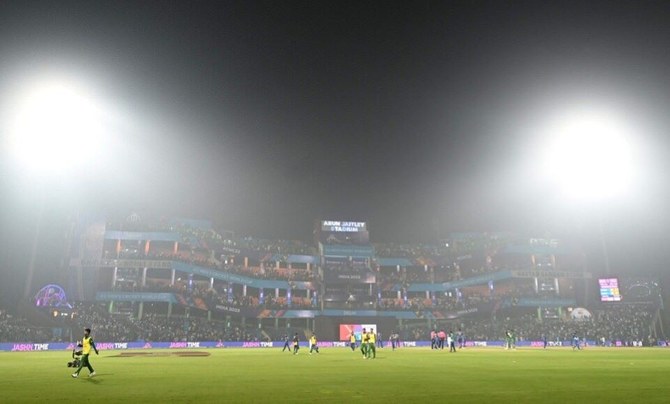
Air quality is another issue. Anyone who attended World Cup matches in Delhi, as did your columnist, cannot have failed to have noticed or been affected by the appalling air quality. Training was canceled for the Sri Lankan and Bangladesh teams on Nov. 5 and there was talk of the match being canceled.
On match day, Delhi’s air quality index exceeded 400, officially hazardous. A representative of the International Cricket Council said it was monitoring the situation. Separately, India’s captain and England’s Joe Root expressed public concerns. Root commented that in Mumbai it was difficult to “get your breath.” A former West Indian captain, Daren Ganga has urged administrators to adopt measures to ensure player protection. He also called on them to be more explicitly concerned about the game’s environmental footprint.
Unless the ICC, the game’s governing body, displays leadership in this respect, addressing the issues will be left to local initiatives. There is no systematic approach across cricket. Indeed, there are actions which pull in the other direction. One is the amount of air travel generated by international cricket.
In this respect, it has been eye-opening to learn about the strategy of the Desert Vipers in the DP World ILT20. The franchise is the only one not owned by Indian interests. Its owners and leaders have placed sustainability at the heart of its operations. They seek to promote sustainability within the UAE and the broader cricketing community. Their motivation derives from awareness of climate change, pollution and natural resource depletion.
In 2018, the Climate Coalition reported that cricket would be the pitch sport most impacted by climate change. Five years on more evidence of this is apparent. As such, cricket has the potential, some would say responsibility, to acknowledge the relationship between environmental, social, economic and technological factors and address them for the long-term viability of the game. Slowly, very slowly, in the face of powerful, dissenting voices, parts of cricket’s ecosystem are waking up.


