The Gaza Strip: Tiny, cramped and as densely populated as London

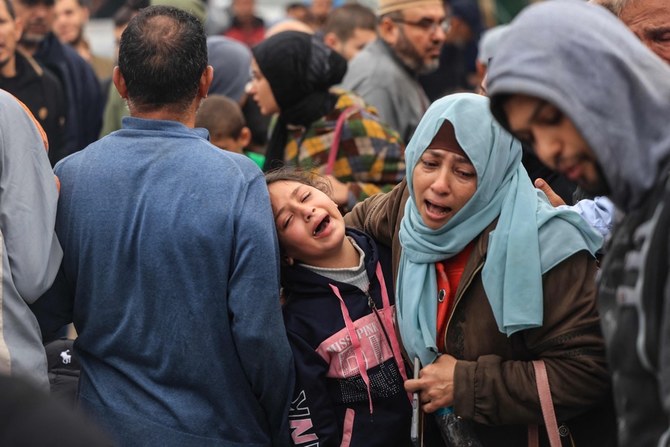
Gaza’s density is even tighter in its urban cores like Gaza City or Khan Younis. (AFP)
Short Url
Updated 06 December 2023
Follow

The Gaza Strip: Tiny, cramped and as densely populated as London

  • Gaza has a population density of about 5,500 per square kilometer

GAZA: The war between Israel and Hamas has seen fierce Israeli bombardment that has flattened broad swaths of the Gaza Strip. Thousands of people have been killed and hundreds of thousands have been displaced.
And all that is happening in a tiny, densely populated coastal enclave.
Gaza is tucked among Israel, Egypt and the Mediterranean Sea. The strip is 25 miles (40 kilometers) long by some 7 miles (11 kilometers) wide. It has 2.3 million people living in an area of 139 square miles (360 square kilometers), according to the CIA Factbook.

That’s about the same land size as Detroit, a city that has a population of 620,000, according to the US Census Bureau. It’s about twice the size of Washington and 3½ times the size of Paris.
Gaza has a population density of about 14,000 people per square mile (5,500 per square kilometer). That’s about the same as London, a city brimming with high-rise buildings, but also many parks. Gaza has few open spaces, especially in its cities, due to lack of planning and urban sprawl.
Gaza’s density is even tighter in its urban cores like Gaza City or Khan Younis, where tens of thousands are packed into cramped neighborhoods and where density rates become more comparable to certain cities in highly populated Asia.
An Israeli-Egyptian blockade, imposed after the Hamas militant group seized power in 2007, has greatly restricted movement in and out of Gaza, adding to the sense of overcrowding.


Algeria inaugurates strategic railway to giant Sahara mine

President Tebboune attended an inauguration ceremony in Bechar. (AFP file photo)
Updated 02 February 2026
Follow

Algeria inaugurates strategic railway to giant Sahara mine

  • The mine is expected to produce 4 million tons per year during the initial phase, with production projected to triple to 12 million tons per year by 2030
  • The project is financed by the Algerian state and partly built by a Chinese consortium

ALGEIRS: Algerian President Abdelmadjid Tebboune on Sunday inaugurated a nearly 1,000-kilometer (621-mile) desert railway to transport iron ore from a giant mine, a project he called one of the biggest in the country’s history.
The line will bring iron ore from the Gara Djebilet deposit in the south to the city of Bechar located 950 kilometers north, to be taken to a steel production plant near Oran further north.
The project is financed by the Algerian state and partly built by a Chinese consortium.
During the inauguration, Tebboune described it as “one of the largest strategic projects in the history of independent Algeria.”
This project aims to increase Algeria’s iron ore extraction capacity, as the country aspires to become one of Africa’s leading steel producers.
The iron ore deposit is also seen as a key driver of Algeria’s economic diversification as it seeks to reduce its reliance on hydrocarbons, according to experts.
President Tebboune attended an inauguration ceremony in Bechar, welcoming the first passenger train from Tindouf in southern Algeria and sending toward the north a first charge of iron ore, according to footage broadcast on national television.
The mine is expected to produce 4 million tons per year during the initial phase, with production projected to triple to 12 million tons per year by 2030, according to estimates by the state-owned Feraal Group, which manages the site.
It is then expected to reach 50 million tons per year in the long term, it said.
The start of operations at the mine will allow Algeria to drastically reduce its iron ore imports and save $1.2 billion per year, according to Algerian media.