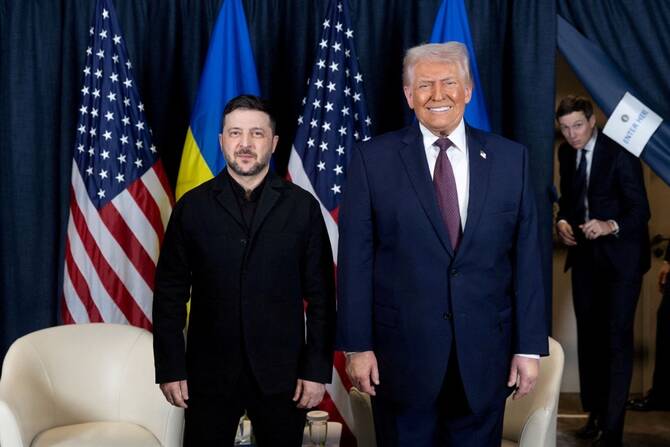
Ukrainian President Volodymyr Zelensky said Kyiv had sought to back US peace proposals to end the war with Russia as President Donald Trump seeks to resolve the conflict before November mid-term elections.
Zelensky, in an interview published by The Atlantic on Thursday, said Kyiv was willing to hold both a presidential election and a referendum on a deal, but would not settle for an accord that was detrimental to Ukraine’s interests.
“The tactic we chose is for the Americans not to think that we want to continue the war,” Zelensky told the US-based publication. “That’s why we started supporting their proposals in any format that speeds things along.”
He said Ukraine was “not afraid of anything. Are we ready for elections? We’re ready. Are we ready for a referendum? We’re ready.”
Zelensky has sought to build good relations with Washington since an Oval Office meeting in February 2025 descended into a shouting match with Trump and US Vice President JD Vance.
But he said he had rejected a proposal, reported this week by the Financial Times, to announce the votes on February 24, the fourth anniversary of Russia’s invasion. A ceasefire and proposed US security guarantees against a future invasion had not yet been settled, he said.
“No one is clinging to power,” The Atlantic quoted him as saying. “I am ready for elections. But for that we need security, guarantees of security, a ceasefire.”
And he added: “I don’t think we should put a bad deal up for a referendum.”
Russian President Vladimir Putin has said Zelensky is not a legitimate negotiating partner because he has not faced election since coming to power in 2019.
Zelensky has said in recent weeks that a document on security guarantees for Ukraine is all but ready to be signed.
But, in his remarks, he acknowledged that details remained unresolved, including whether the US would be willing to shoot down incoming missiles over Ukraine if Russia were to violate the peace.
“This hasn’t been fixed yet,” Zelensky said. “We have raised it, and we will continue to raise these questions...We need all of this to be written out.”

Ukraine’s Zelensky: We have backed US peace proposals to get a deal done
Short Url
https://arab.news/ptu48
Ukraine’s Zelensky: We have backed US peace proposals to get a deal done
- “The tactic we chose is for the Americans not to think that we want to continue the war,” Zelensky told The Atlantic
Vatican offers dialogue with breakaway Latin Mass traditionalist group, but with a catch
- The Society of St. Pius X has been a thorn in the side of the Holy See for four decades
- SSPX first broke with Rome in 1988 after its founder consecrated four bishops without papal consent
ROME: The Vatican warned a breakaway traditionalist Catholic group on Thursday that it risked going into schism if it goes ahead with plans to consecrate new bishops without papal consent, setting a hard line against a big doctrinal challenge facing Pope Leo XIV.
Cardinal Víctor Manuel Fernandez, head of the Vatican’s doctrine office, issued the warning during a meeting Thursday with the superior general of the Society of St. Pius X, the Rev. Davide Pagliarani, the Vatican said. The meeting was scheduled after the Swiss-based society, which celebrates the traditional Latin Mass but isn’t in communion with Rome, announced plans to consecrate new bishops July 1 without papal consent.
Fernandez offered a new round of theological talks to regularize the SSPX’s status, but only if it calls off the planned ceremony.
Pagliarani, for his part, defended the new consecrations but said he would take the Vatican proposal to his counselors for a final decision, which is expected in a few days, the SSPX said in a statement.
The SSPX has been a thorn in the side of the Holy See for four decades, founded in opposition to the modernizing reforms of the 1960s Second Vatican Council, which among other things allowed Mass to be celebrated in the vernacular.
The SSPX first broke with Rome in 1988, after its founder, Archbishop Marcel Lefebvre, consecrated four bishops without papal consent, arguing that it was necessary for the survival of the church’s tradition. The Vatican promptly excommunicated Lefebvre and the four other bishops, and the group today still has no legal status in the Catholic Church.
But in the decades since that original break with Rome, the group has continued to grow, with schools, seminaries and parishes around the world and branches of priests, nuns and lay Catholics who are attached to the pre-Vatican II traditional Latin Mass.
Growth of a parallel church
According to SSPX statistics, it counts two bishops, 733 priests, 264 seminarians, 145 religious brothers, 88 oblates and 250 religious sisters representing 50 nationalities, a Catholic reality that poses a real threat to Rome because of the specter of the growth of a parallel church.
For the Vatican, papal consent for the consecration of bishops is a fundamental doctrine, guaranteeing the lineage of apostolic succession from the time of Christ’s original apostles. As a result, the consecration of bishops without papal consent is considered a grave threat to church unity and a cause of schism, since bishops can ordain new priests. Under church law, a consecration without papal consent incurs an automatic excommunication for the person who celebrates it and the purported new bishop.
Pagliarani has said in comments on the SSPX website, and in the SSPX statement, that the consecrations of new bishops are necessary for the society’s survival, because the remaining two are getting old and are increasingly unable to tend to the needs of SSPX members around the world.
Offer of dialogue, with a catch
During the talks Thursday at the Vatican, Fernandez offered to open a theological dialogue with the SSPX to address concerns that they have outlined to the Vatican starting in 2017, especially concerning Catholic relations with other religions.
The aim, according to the Vatican statement, would be to identify the minimum points of agreement necessary to bring the SSPX back into communion with the Holy See and outline a legal status so it could exist within the church.
But it warned that such a dialogue would require the suspension of the planned bishop consecrations. Going ahead with them, the Vatican warned, “would imply a decisive break in the ecclesial communion (schism) with grave consequences for the Fraternity.”
Pagliarani justified the ordination of new bishops as both “realistic and reasonable,” given the number of people who attend SSPX Masses.
Long history of dialogue
The Vatican has tried for years to reconcile with the SSPX. Pope Benedict XVI in 2009 lifted the excommunications of the surviving bishops and relaxed restrictions on celebrating the old Latin Mass.
While offering some gestures to the SSPX, Francis reversed Benedict’s reform that allowed greater celebration of the old Latin Mass, arguing it had become a source of division in the church.
Catholic traditionalists say Francis’ crackdown had the result of pushing more faithful who were in communion with Rome into the arms of the breakaway SSPX, since they couldn’t find Latin Masses that were permitted by Rome.
Leo has acknowledged the tensions and sought to pacify the debate, expressing an openness to dialogue and allowing exceptions to Francis’ crackdown.
The Vatican, for example, said that Leo had explicitly approved Thursday’s encounter, which it described as “cordial and sincere.”
Cardinal Víctor Manuel Fernandez, head of the Vatican’s doctrine office, issued the warning during a meeting Thursday with the superior general of the Society of St. Pius X, the Rev. Davide Pagliarani, the Vatican said. The meeting was scheduled after the Swiss-based society, which celebrates the traditional Latin Mass but isn’t in communion with Rome, announced plans to consecrate new bishops July 1 without papal consent.
Fernandez offered a new round of theological talks to regularize the SSPX’s status, but only if it calls off the planned ceremony.
Pagliarani, for his part, defended the new consecrations but said he would take the Vatican proposal to his counselors for a final decision, which is expected in a few days, the SSPX said in a statement.
The SSPX has been a thorn in the side of the Holy See for four decades, founded in opposition to the modernizing reforms of the 1960s Second Vatican Council, which among other things allowed Mass to be celebrated in the vernacular.
The SSPX first broke with Rome in 1988, after its founder, Archbishop Marcel Lefebvre, consecrated four bishops without papal consent, arguing that it was necessary for the survival of the church’s tradition. The Vatican promptly excommunicated Lefebvre and the four other bishops, and the group today still has no legal status in the Catholic Church.
But in the decades since that original break with Rome, the group has continued to grow, with schools, seminaries and parishes around the world and branches of priests, nuns and lay Catholics who are attached to the pre-Vatican II traditional Latin Mass.
Growth of a parallel church
According to SSPX statistics, it counts two bishops, 733 priests, 264 seminarians, 145 religious brothers, 88 oblates and 250 religious sisters representing 50 nationalities, a Catholic reality that poses a real threat to Rome because of the specter of the growth of a parallel church.
For the Vatican, papal consent for the consecration of bishops is a fundamental doctrine, guaranteeing the lineage of apostolic succession from the time of Christ’s original apostles. As a result, the consecration of bishops without papal consent is considered a grave threat to church unity and a cause of schism, since bishops can ordain new priests. Under church law, a consecration without papal consent incurs an automatic excommunication for the person who celebrates it and the purported new bishop.
Pagliarani has said in comments on the SSPX website, and in the SSPX statement, that the consecrations of new bishops are necessary for the society’s survival, because the remaining two are getting old and are increasingly unable to tend to the needs of SSPX members around the world.
Offer of dialogue, with a catch
During the talks Thursday at the Vatican, Fernandez offered to open a theological dialogue with the SSPX to address concerns that they have outlined to the Vatican starting in 2017, especially concerning Catholic relations with other religions.
The aim, according to the Vatican statement, would be to identify the minimum points of agreement necessary to bring the SSPX back into communion with the Holy See and outline a legal status so it could exist within the church.
But it warned that such a dialogue would require the suspension of the planned bishop consecrations. Going ahead with them, the Vatican warned, “would imply a decisive break in the ecclesial communion (schism) with grave consequences for the Fraternity.”
Pagliarani justified the ordination of new bishops as both “realistic and reasonable,” given the number of people who attend SSPX Masses.
Long history of dialogue
The Vatican has tried for years to reconcile with the SSPX. Pope Benedict XVI in 2009 lifted the excommunications of the surviving bishops and relaxed restrictions on celebrating the old Latin Mass.
While offering some gestures to the SSPX, Francis reversed Benedict’s reform that allowed greater celebration of the old Latin Mass, arguing it had become a source of division in the church.
Catholic traditionalists say Francis’ crackdown had the result of pushing more faithful who were in communion with Rome into the arms of the breakaway SSPX, since they couldn’t find Latin Masses that were permitted by Rome.
Leo has acknowledged the tensions and sought to pacify the debate, expressing an openness to dialogue and allowing exceptions to Francis’ crackdown.
The Vatican, for example, said that Leo had explicitly approved Thursday’s encounter, which it described as “cordial and sincere.”
© 2026 SAUDI RESEARCH & PUBLISHING COMPANY, All Rights Reserved And subject to Terms of Use Agreement.