

Italy approves new migration bill including powers to impose ‘naval blockades’ on migrant ships

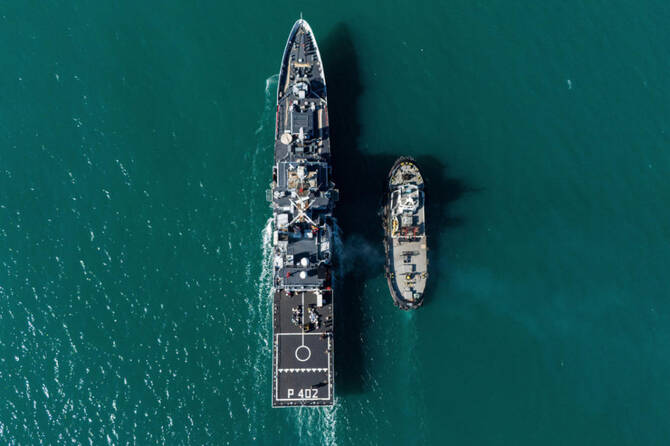
The Italian navy ship Libra, carrying migrants, arrives in Shengjin, Albania, in April 2025. Italy is tightening rules to stem the flow of migrants. (AP/File)
Short Url
Updated 13 February 2026
Follow

Italy approves new migration bill including powers to impose ‘naval blockades’ on migrant ships

  • Package includes new powers that would enable Italian authorities to impose a naval blockade on migrant ships trying to enter Italy’s territorial waters

ROME: Italy’s conservative government led by Premier Giorgia Meloni on Wednesday approved a bill introducing new measures aimed at fighting illegal immigration, including a so-called “naval blockade” for migrant ships trying to reach Italian shores.

A cabinet meeting in the late afternoon gave the go-ahead to the bill, which now needs to be discussed and approved in both chambers of parliament before becoming effective.

Italy’s new migration package — which also includes stricter surveillance at borders and cooperation with European agencies — comes a day after the approval of the new EU pact on migration and asylum, which Rome plans to implement swiftly.

The package includes new powers that would enable Italian authorities to impose a naval blockade on migrant ships trying to enter Italy’s territorial waters, under certain conditions.

Authorities can ban the crossing into Italian waters for up to 30 days, in cases in which the migrant ship poses “serious threats to public order or national security,” as in the concrete risk of terrorist acts or terrorist infiltration, the bill says. The blockade is extendable up to a maximum of six months.

It would also be possible to stop the ships from entering Italian waters in the case of a drastic influx in migrants that could jeopardize the secure management of borders.

Those violating the rules would face fines of up to 50,000 euros ($59,400) and would see their boats confiscated in the case of repeated violations, a measure that seems to target humanitarian rescue ships.

In those cases, the intercepted migrants could be “transported to third countries other than their country of origin, with which Italy has entered into specific agreements,” the bill says.

Under those rules, the Meloni government aims at restarting offshore processing hubs similar to the two controversial ones created in Albania, which have been substantially inactive for about two years due to legal hurdles.

These centers — a major effort by the Meloni government to manage migration flows — have constantly sparked debates about their legality and efficacy, raising strong opposition from humanitarian groups.

The Italian bill’s approval comes after European lawmakers on Tuesday voted to approve new immigration policies that allow nations to deny asylum and deport migrants because they either hail from a country designated safe or could apply for asylum in a country outside the 27-nation bloc.

Italy’s Foreign Minister Antonio Tajani hailed the new rules on Tuesday, saying the confirmation from the European Parliament on the list of safe countries “proves Italy right.”

US Justice Department official eyes cases against Cuba leaders as Trump floats ‘friendly takeover’

Updated 07 March 2026
Follow

US Justice Department official eyes cases against Cuba leaders as Trump floats ‘friendly takeover’

  • “Working group” formed to build cases against people connected to the Cuban government
  • Trump’s has increasingly displayed aggressive stance against Cuba’s communist leadership

MIAMI: The top Justice Department prosecutor in Miami is considering criminal investigations of Cuban government officials, according to people familiar with the matter. The inquiry comes as President Donald Trump has raised the possibility of a “friendly takeover” of the communist-run island.
Jason Reding Quiñones, the US attorney for the Southern District of Florida, has created a “working group” that includes federal prosecutors and officials from the Drug Enforcement Administration and other agencies to try to build cases against people connected to the Cuban government and its Communist Party, according to one of the people. They spoke on the condition of anonymity because they were not authorized to publicly discuss the effort.
It was not immediately clear which Cuban officials the office is targeting or what criminal charges prosecutors may be looking to bring.
The Justice Department said in a statement Friday that “federal prosecutors from across the country work every day to pursue justice, which includes efforts to combat transnational crime.”
The effort is taking place against the backdrop of Trump’s increasingly aggressive stance against Cuba’s communist leadership.
Emboldened by the US capture of Cuba’s close ally, Venezuelan President Nicolás Maduro, Trump last month said his administration was in high-level talks with officials in Havana to pursue “a friendly takeover” of the country. He repeated those claims this week, saying his attention would turn back to Cuba once the war with Iran winds down.
“They want to make a deal so bad,” Trump said of Cuba’s leadership.
While Cuba has faded from Washington’s radar as a major national security threat in recent decades, it remains a priority in the US Attorney’s office in Miami, whose political, economic and cultural life is dominated by Cuban-American exiles.
The FBI field office has a dedicated Cuba group that in 2024 was instrumental in the arrest of former US Ambassador Victor Manuel Rocha on charges of serving as a secret agent of Cuba stretching back to the 1970s.
In recent weeks, several Miami Republicans, in addition to Florida Sen. Rick Scott, have called on the Trump administration to reopen its criminal investigation into the 1996 shootdown of four planes operated by anti-communist exiles.
In a letter to Trump on Feb. 13, lawmakers including Reps. Maria Elvira Salazar and Carlos Gimenez highlighted decades-old news reports indicating that former President Raúl Castro — the head of Cuba’s military at the time — gave the order to shoot down the unarmed Cessna aircraft.
“We believe unequivocally that Raúl Castro is responsible for this heinous crime,” lawmakers wrote. “It is time for him to be brought to justice.”
While no indictment against Castro has been announced, Florida’s attorney general said this week that he would open a state-level investigation into the crime.
The Trump administration has also accused Cuba of not cooperating with American counterterrorism efforts, adding it alongside North Korea and Iran to a select few nations the US considers state sponsors of terrorism.
The designation stems from Cuba’s harboring of US fugitives and its refusal to extradite several Colombian rebel leaders while they were engaged in peace talks with the South American nation.