

Israeli hostage families angry after meeting with Netanyahu

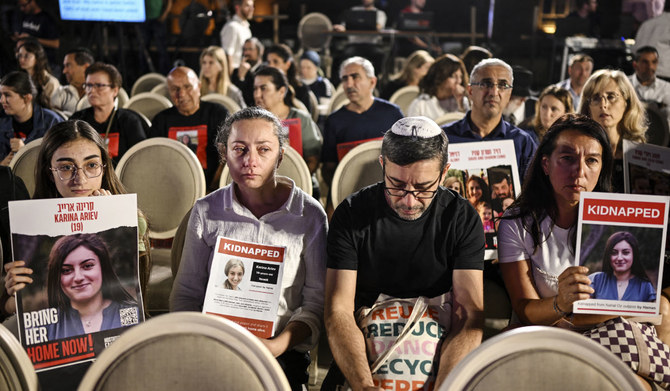
A group representing hostage families issued a series of unnamed quotes it said were taken from remarks made by some of the former hostages at the meeting. (AFP)
Short Url
Updated 06 December 2023
Follow

Israeli hostage families angry after meeting with Netanyahu

  • “They say ‘we’ve done this, we’ve done that.’ (Hamas’ Gaza leader Yahya) Sinwar is the one who returned our people, not them
  • Several of the relatives who attended the meeting left bitterly critical of the government

JERUSALEM: Israeli Prime Minister Benjamin Netanyahu met families of returned hostages on Tuesday in an encounter that some of those present described as loud and angry.
The meeting came as fighting has resumed in the Gaza Strip following a seven-day pause that saw the return of more than 100 hostages from the enclave. The fate of 138 captives who remained behind is still open.
“I heard stories that broke my heart, I heard about the thirst and hunger, about physical and mental abuse,” Netanyahu said at a news conference. “I heard and you also heard, about sexual assault and cases of brutal rape unlike anything.”
Several of the relatives who attended the meeting left bitterly critical of the government.
Dani Miran, whose son Omri was taken hostage on Oct. 7 by Hamas gunmen along with around 240 other Israelis and foreigners, said he felt his intelligence had been insulted by the meeting and had walked out in the middle of it.
“I won’t go into the details of what was discussed at the meeting but this entire performance was ugly, insulting, messy,” he told Israel’s Channel 13, saying the government had made a “farce” out of the issue.
“They say ‘we’ve done this, we’ve done that.’ (Hamas’ Gaza leader Yahya) Sinwar is the one who returned our people, not them. It angers me that they say that they dictated things. They hadn’t dictated a single move.”
The meeting had been intended as a forum for released hostages to tell ministers of their experience in captivity. A group representing hostage families issued a series of unnamed quotes it said were taken from remarks made by some of the former hostages at the meeting.
The quotes told of mistreatment meted out to the captives by Hamas but the encounter was overshadowed by the emotions of families worried by the fate of relatives still being held.
“It was a very turbulent meeting, many people yelling,” said Jennifer Master, whose partner Andrey is a hostage.
Israel says a number of women and children remain in Hamas hands, while families with adult male relatives in captivity have been calling for them not to be forgotten.
“We are all trying to make sure our loved ones get home. There are those who want the women who are left or the children who are left, and those who say we want the men,” Master told Israel’s Channel 12.


UN rights chief Shocked by ‘unbearable’ Darfur atrocities

Updated 18 January 2026
Follow

UN rights chief Shocked by ‘unbearable’ Darfur atrocities

  • Mediation efforts have failed to produce a ceasefire, even after international outrage intensified last year with reports of mass killings, rape, and abductions during the RSF’s takeover of El-Fasher in Darfur

PORT SUDAN: Nearly three years of war have put the Sudanese people through “hell,” the UN’s rights chief said on Sunday, blasting the vast sums spent on advanced weaponry at the expense of humanitarian aid and the recruitment of child soldiers.
Since April 2023, Sudan has been gripped by a conflict between the army and the paramilitary Rapid Support Forces that has left tens of thousands of people dead and around 11 million displaced.
Speaking in Port Sudan during his first wartime visit, UN Human Rights commissioner Volker Turk said the population had endured “horror and hell,” calling it “despicable” that funds that “should be used to alleviate the suffering of the population” are instead spent on advanced weapons, particularly drones.
More than 21 million people are facing acute food insecurity, and two-thirds of Sudan’s population is in urgent need of humanitarian aid, according to the UN.
In addition to the world’s largest hunger and displacement crisis, Sudan is also facing “the increasing militarization of society by all parties to the conflict, including through the arming of civilians and recruitment and use of children,” Turk added.
He said he had heard testimony of “unbearable” atrocities from survivors of attacks in Darfur, and warned of similar crimes unfolding in the Kordofan region — the current epicenter of the fighting.
Testimony of these atrocities must be heard by “the commanders of this conflict and those who are arming, funding and profiting from this war,” he said.
Mediation efforts have failed to produce a ceasefire, even after international outrage intensified last year with reports of mass killings, rape, and abductions during the RSF’s takeover of El-Fasher in Darfur.
“We must ensure that the perpetrators of these horrific violations face justice regardless of the affiliation,” Turk said on Sunday, adding that repeated attacks on civilian infrastructure could constitute “war crimes.”
He called on both sides to “cease intolerable attacks against civilian objects that are indispensable to the civilian population, including markets, health facilities, schools and shelters.”
Turk again warned on Sunday that crimes similar to those seen in El-Fasher could recur in volatile Kordofan, where the RSF has advanced, besieging and attacking several key cities.
Hundreds of thousands face starvation across the region, where more than 65,000 people have been displaced since October, according to the latest UN figures.