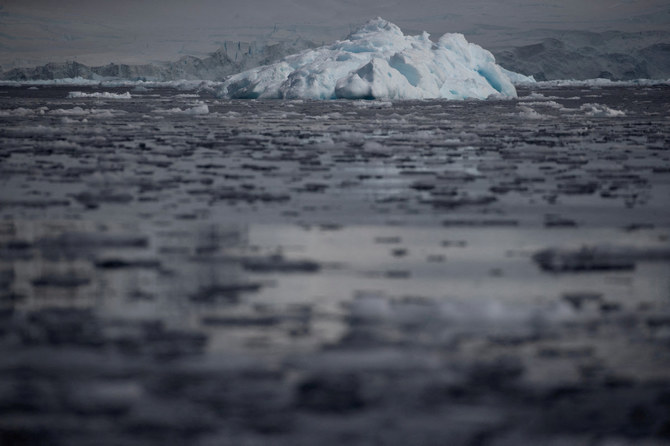
BRUSSELS: Around 40 percent of Antarctica’s ice shelves have significantly shrunk over the last 25 years, scientists said on Thursday, in findings the European Space Agency said were “alarming.”
The melting saw 71 of Antarctica’s 162 ice shelves lose mass from 1997 to 2021 — of which 68 posted a “statistically significant” reduction, according to the study published in the journal Science Advances on Thursday.
Scientists said the losses went beyond the ice shelves’ normal fluctuations and added to evidence of how human-caused climate change is affecting Antarctica.
“We expected most ice shelves to go through cycles of rapid, but short-lived shrinking, then to regrow slowly. Instead, we see that almost half of them are shrinking with no sign of recovery,” said lead author Benjamin Davison, research fellow at the University of Leeds.
During the studied period, the scientists found 29 ice shelves gained mass and 62 did not change significantly.
The scientists said 48 of the ice shelves had lost more than 30 percent of their mass during the 25-year period. A key driver of the melting was ocean currents and winds on Antarctica’s western side, pushing warm water under the ice shelves.
Ice shelves are floating platforms of ice that surround the Antarctic continent, helping to protect and stabilize the region’s glaciers by slowing their flow into the ocean.
Large ice shelf melts unleash freshwater into the ocean — which could have knock-on effects on ocean circulation, said the European Space Agency, whose satellite radar images were used in the study.
Initial data published last month showed sea ice that packs the ocean around Antarctica has hit record low levels this winter, adding to scientists’ fears that the impact of climate change at the southern pole is ramping up.

Scientists track ‘alarming’ melt in Antarctic ice shelves
https://arab.news/ptngx
Scientists track ‘alarming’ melt in Antarctic ice shelves
- Scientists said the losses went beyond the ice shelves’ normal fluctuations and added to evidence of how human-caused climate change is affecting Antarctica
Indian teacher who created hundreds of learning centers wins $1 million Global Teacher Prize
- Nagi is the 10th teacher to win the award, which the foundation began handing out in 2015
DUBAI: An Indian teacher and activist known for creating hundreds of learning centers and painting educational murals across the walls of slums won the $1 million Global Teacher Prize on Thursday.
Rouble Nagi accepted the award at the World Governments Summit in Dubai in the United Arab Emirates, an annual event that draws leaders from across the globe.
Her Rouble Nagi Art Foundation has established more than 800 learning centers across India. They aim to have children who never attended school begin to have structured learning. They also teach children already in school.
Nagi also paints murals that teach literacy, science, math and history, among other topics.
The prize is awarded by the Varkey Foundation, whose founder, Sunny Varkey, established the for-profit GEMS Education company that runs dozens of schools in Egypt, Qatar and the UAE.
“Rouble Nagi represents the very best of what teaching can be – courage, creativity, compassion, and an unwavering belief in every child’s potential,” Varkey said in a statement posted to the Global Teacher Prize website. “By bringing education to the most marginalized communities, she has not only changed individual lives, but strengthened families and communities.”
Nagi plans to use the $1 million to build an institute that offers free vocational training.
Stefania Giannini, UNESCO Assistant Director-General for Education, said Nagi’s prize “reminds us of a simple truth: teachers matter.”
In comments carried on the prize website, Giannini said UNESCO was “honored to join the Global Teacher Prize in celebrating teachers like you, who, through patience, determination, and belief in every learner, help children into school — an act that can change the course of a life.”
Nagi is the 10th teacher to win the award, which the foundation began handing out in 2015.
Past winners of the Global Teacher Prize have included a Kenyan teacher from a remote village who gave away most of his earnings to the poor, a Palestinian primary school teacher who teaches her students about non-violence and a Canadian educator who taught a remote Arctic village of Inuit students. Last year’s winner was Saudi educator Mansour Al-Mansour, who was known for his work with the poor in the kingdom.
GEMS Education, or Global Education Management Systems, is one of the world’s largest private school operators and is believed to be worth billions. Its success has followed that of Dubai, where only private schools offer classes for the children of the foreigners who power its economy.


