

Impact of global warming on Pakistan’s mountain regions ‘unprecedented, largely irreversible’ — report 

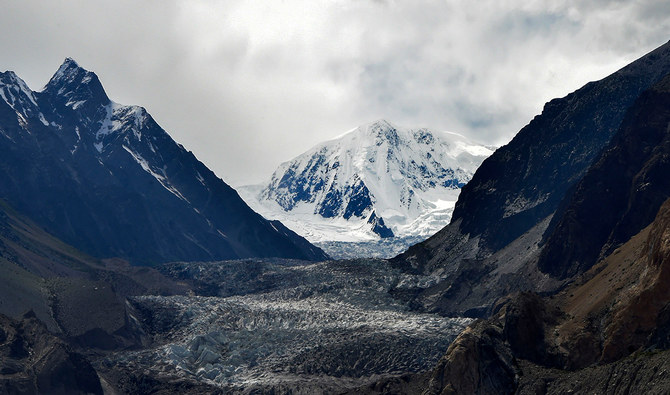
This aerial picture taken on June 10, 2022, shows Passu glacier near Passu village in Pakistan's Gilgit-Baltistan region. (AFP/File)
Short Url
Updated 21 June 2023
Follow

Impact of global warming on Pakistan’s mountain regions ‘unprecedented, largely irreversible’ — report 

  • Report says glaciers in Hindu Kush Himalayan (HKH) region could lose up to 80 percent of current volume by end of century 
  • Says floods, landslides in region, including Pakistan, are projected to increase over coming decades, with slow-onset hazards 

ISLAMABAD: The impact of global warming on glaciers, snow, and permafrost of the Hindu Kush Himalayan (HKH) region, including mountains in Pakistan, is “unprecedented and largely irreversible,” a new assessment report by an eight-nation environmental conservation organization revealed on Tuesday. 

Published by the International Center for Integrated Mountain Development (ICIMOD), the report drew on recent scientific advances to map for the first time the links between the cryosphere — the frozen parts of the planet — water, biodiversity and society in the region. 

It charted the impacts of rapid changes in glaciers and snow on people and nature. According to the ICIMOD, the report is based on the “most accurate assessment” of changes to the Asia high mountain cryosphere to date. 

“[It] finds that glaciers in the HKH [including in Pakistan] could lose up to 80 percent of their current volume by the end of the century, on current emissions trajectories,” the report said. 

“Snow cover is projected to fall by up to a quarter under high emissions scenarios – drastically reducing freshwater for major rivers such as the Amu Darya, where it contributes up to 74 percent of river flow, the Indus (40 percent), and Helmand (77 percent).” 

The report said that floods and landslides in the HKH region, including Pakistan, are projected to increase over the coming decades, with slow-onset hazards such as sedimentation and erosion, and fast-onset hazards such as glacial lake outburst floods (GLOFs), occurring often concurrently in the same catchments. 

“Two hundred glacier lakes across the HKH are deemed dangerous, and the region could see a significant spike in GLOF risk by the end of the century,” it said. 

“Coupled with increased population growth and economic activity in the region, exposure to these hazards poses the risk of increased loss and damage, including population displacement.” 

Pakistan last year faced one of the worst impacts of climate change in its history as around 33 million people across the country were affected by torrential monsoon rains and floods. The deluges killed more than 1,700 Pakistanis and destroyed infrastructure, homes and agricultural lands. 

The ICIMOD report found that the effects of the changing cryosphere on fragile mountain habitats are particularly acute, with cascading impacts in most ecosystems affecting most inhabitant species. 

“Species decline and extinction have already been reported, along with range shift of species to higher elevations, ecosystem degradation, decrease in habitat suitability, and invasion of alien species,” it read. 

“With 67 percent of the HKH’s ecoregions and 39 percent of the four global biodiversity hotspots located in the HKH remaining outside protected areas, nature is particularly vulnerable to climate impacts.” 


Pakistan nears $1.5 billion deal to supply weapons, jets to Sudan

Updated 09 January 2026
Follow

Pakistan nears $1.5 billion deal to supply weapons, jets to Sudan

  • Deal may include drones, air defense systems and Karakoram-8 aircraft, with possible JF-17 fighters
  • The sale is expected to bolster Sudan’s army in the ongoing civil war with the Rapid Support Forces

ISLAMABAD: Pakistan is in the final phases of striking a $1.5-billion deal to supply weapons and jets to Sudan, a former top air force official and three sources said, promising a major boost for Sudan’s army, battling the paramilitary Rapid Support Forces.

Their conflict has stoked the world’s worst humanitarian crisis for more than 2-1/2 years, drawing in myriad foreign interests, and threatening to fragment the strategic Red Sea country, a major gold producer.

The deal with Pakistan encompasses 10 Karakoram-8 light attack aircraft, more than 200 drones for scouting and kamikaze attacks, and advanced air defense systems, said two of the three sources with knowledge of the matter, who all sought anonymity.

It was a “done deal,” said Aamir Masood, a retired Pakistani air marshal who continues to be briefed on air force matters.

Besides the Karakoram-8 jets, it includes Super Mushshak training aircraft, and perhaps ‌some coveted JF-17 ‌fighters developed jointly with China and produced in Pakistan, he added, without giving figures ‌or ⁠a delivery ‌schedule.

Pakistan’s military and its defense ministry did not immediately respond to requests for comment.

A spokesman for Sudan’s army did not immediately respond to a message requesting comment.

Assistance from Pakistan, especially drones and jets, could help Sudan’s army regain the air supremacy it had toward the start of its war with the RSF, which has increasingly used drones to gain territory, eroding the army’s position.

PAKISTAN’S DEFENSE AMBITIONS

The deal is another feather in the cap for Pakistan’s growing defense sector, which has drawn growing interest and investment, particularly since its jets were deployed in a conflict with India last year.

Last month, Islamabad struck a weapons deal worth more than $4 billion with the Libyan National Army, officials said, for one of the South Asian nation’s largest arms sales, which includes JF-17 fighter jets and training aircraft.

Pakistan has also held talks with Bangladesh on a defense deal that could includes the Super Mushshak training jets and JF-17s, as ties improve ties with Dhaka.

The government sees Pakistan’s burgeoning industry as a catalyst to secure long-term economic stability.

Pakistan is now in a $7-billion IMF program, following a short-term ‌deal to avert a sovereign default in 2023. It won IMF support after Saudi Arabia and other Gulf allies provided financial and deposit rollovers.