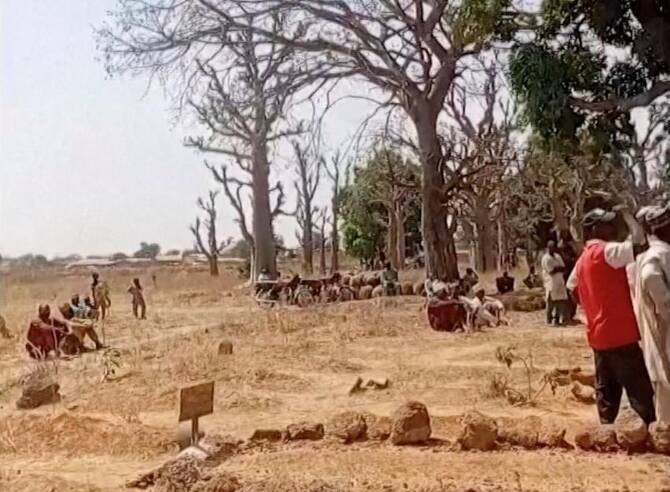
JOS, Nigeria: Nigeria’s President Bola Ahmed Tinubu deployed an army battalion to a troubled state after gunmen killed as many as 162 people in one of the country’s deadliest attacks in recent months.
The attack late Tuesday on Woro village in Kwara State came after the military recently carried out operations in the area against what it called “terrorist elements.”
Gunmen burned shops and a traditional ruler’s home and wounded people fled into the bushes, Babaomo Ayodeji, Kwara State secretary of the Red Cross, said.
“Reports said that the death toll now stands at 162, as the search for more bodies continues,” Ayodeji said.
The attack was confirmed by police who did not give a casualty figure.
Earlier, a local lawmaker Sa’idu Baba Ahmed gave an initial toll of 35-40 dead but said more bodies would be found as many wounded people had fled into the bush. The governor of the west-central state AbdulRahman AbdulRazaq gave a toll of 75 dead.
Conflicting accounts often emerge after attacks in rural areas.
No group claimed responsibility, but the state government blamed “terrorist cells” and Tinubu blamed the attack on Boko Haram jihadists.
Parts of Nigeria are plagued by armed gangs who loot villages and kidnap for ransom, as well as intercommunal violence in central states and jihadist groups that are active in the north.
Ordering a battalion to secure the area, Tinubu condemned the “beastly attack” that he said was carried out against villagers who had rejected the jihadists’ ideology.
“President Tinubu expressed rage that the attackers killed the community members who rejected their obnoxious attempt at indoctrination,” a presidential statement said.
The gunmen invaded Woro at around 6:00 p.m. (1700 GMT) on Tuesday and set “shops and the king’s palace ablaze,” said lawmaker Ahmed.
In a separate attack Tuesday in northern Katsina state, bandits were suspected of killing 23 civilians in reprisal for air force operations which killed 27 “militants,” according to a security report prepared for the United Nations.
Military campaign
In Woro, Ahmed said the traditional king’s whereabouts were unknown. The king was named by the Red Cross official as AlHajji Salihu Umar.
Nigeria has many traditional kings, emirs and rulers who hold no political office but wield great local and cultural influence.
The Nigerian military has intensified operations against jihadists and the armed bandits. Last month, the military said it had launched “sustained coordinated offensive operations against terrorist elements” in Kwara state.
Local media reported that the army had “neutralized” 150 bandits.
“Troops also stormed remote camps hitherto inaccessible to security forces where several abandoned camps and logistics enablers were destroyed significantly degrading the terrorists,” the military said in a January 30 statement.
Jihadist attacks intensified last year in Nigeria. The powerful Al-Qaeda affiliated Group for the Support of Islam and Muslims (JNIM) claimed responsibility for its first attack in Nigeria, in Kwara state.
JNIM operates across Nigeria’s northern border in Niger.
Researcher Brant Philip said the latest raid occurred very near the site JNIM attacked last October, suggesting a “direct overlap” between JNIM and Boko Haram, with the groups appearing to have a “loose alliance.”
In response to the latest security woes, Kwara state imposed curfews in certain areas and closed schools for several weeks before ordering them to reopen on Monday.
Insecurity in Africa’s most populous country has been under intense scrutiny in recent months since US President Donald Trump alleged a “genocide” of Nigerian Christians.
The claim has been rejected by the government and many independent experts, who say Christians and Muslims have been killed in the country’s violence, often without distinction.


![]()

Nigeria president deploys army after new massacre
Short Url
https://arab.news/5ypmn
Nigeria president deploys army after new massacre
- The attack late Tuesday on Woro village in Kwara State came after the military recently carried out operations in the area
- The governor of the west-central state AbdulRahman AbdulRazaq gave a toll of 75 dead


Latest updates


© 2026 SAUDI RESEARCH & PUBLISHING COMPANY, All Rights Reserved And subject to Terms of Use Agreement.