

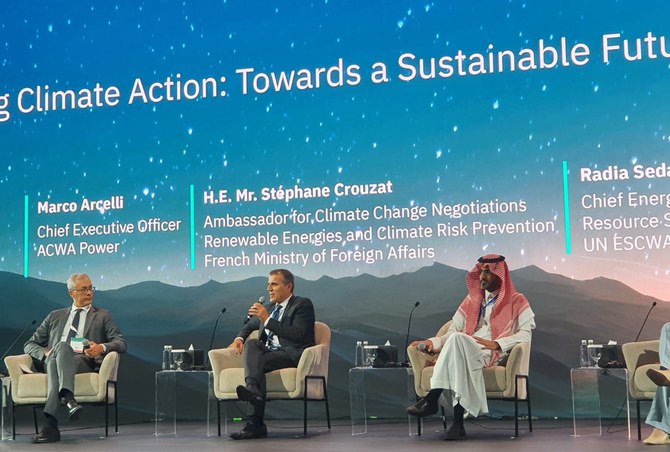

RIYADH: Saudi Arabia can lead by example when it comes to tackling climate change, as the oil-rich Kingdom pushes for net zero carbon emissions by 2060, France’s climate ambassador has insisted.
Speaking to Arab News on the sidelines of the Middle East and North Africa Climate Week, Stéphane Crouzat talked up the important role the Kingdom has in helping the world reach its emission-reduction targets.
Crouzat warned that countries are not moving fast enough when it comes to reforming their energy production and consumption, meaning the target of limiting the global temperature rise to 1.5 degrees Celsius is set to be missed.
His remarks came as policymakers, activists and scientists met in Riyadh for the event — organized in collaboration with the UN’s Framework Convention on Climate Change — to discuss ways to effectively and sustainably reduce the effects of climate change.
Reflecting on the Kingdom’s place in the fight against the warming up of the world, Crouzat said: “As an oil country, Saudi Arabia can lead by example, becoming a benchmark for all fossil fuel-dependent countries facing the need to accelerate the transition, by making new commitments in line with the IPCC (Intergovernmental Panel on Climate Change) recommendations.
“Saudi Arabia, as a member of the G20, is one of the top 20 emitters of greenhouse gasses. We must be ambitious, focusing on the source of these emissions and the least use. We need to set oil exit dates as part of the 2050 trajectory. We all need to prepare for the end of oil.”
MENA Climate Week, running from Oct. 8 to 12, is seen as a key event ahead of the upcoming UN climate change conference in Dubai in November.
The closeness of the events only seeks to emphasize the need for urgent action, and Crouzat said: “We are not moving fast enough, at a time when extreme events are multiplying.
“The first global assessment of the Paris Agreement expected at COP28 will be very important. It must be a response to this lack of action. Every day that passes shows us that it is very difficult to move this huge liner that is the world economy to an alternative way of working. That is why we must be as proactive as possible to accelerate emission reductions. And everyone must take part in the collective effort.”
He added: “This visit was an opportunity to discuss international climate negotiations on the eve of COP28 and to study together the ways to advance these negotiations crucial for the future of our planet. I have had constructive discussions with H.E. Adel Jubeir, as well as with Saudi Arabian Chief Negotiator Khalid Abulaif.”
Saudi Arabia has committed to achieving net zero carbon emissions by 2060, as well as ensuring 50 percent of its electricity mix comes from renewables by 2030.
These goals were lauded by Crouzat as he urged other countries to set equally “ambitious targets.”
He said: “The fact is clear: the collective progress achieved so far is far from sufficient to reach the +1.5-degree Celsius trajectory of the Paris Agreement.”
Citing the IPCC call for emissions to be reduced before 2025, the diplomat added: “This is not easy for many countries that remain dependent on fossil fuels, whether they are producers or consumers.”
The consequences of climate change have fallen disproportionately on low-income countries, who are also the ones to have contributed the least to the problem.
As a result, much of the discourse around tackling the impacts of global warming centers on emergency measures to help these countries overcome this climate crisis.
Crouzat cited the recent flooding in Pakistan or Libya as examples of where more needs to be done to help the most vulnerable countries respond to climate disasters.
“Aid to the most vulnerable countries was the subject of considerable progress at COP27, with the decision to set up a fund dedicated to the response to loss and damage, which we must make operational at COP28. We hope all countries that can contribute will, including Saudi Arabia,” he added.
The global temperature is rising, but in the MENA, it is increasing twice as much. With this in mind, Crouzat said he would “strongly encourage” regional cooperation to tackle this fundamental change to the climate.
“An important forum for us is the Baghdad Conference, a regional cooperation forum in which France is fully committed to encouraging the region’s common response to global challenges such as climate change. We hope that the next Conference to be held in Baghdad in November 2023 will bring about further progress and concrete new projects for regional cooperation in the fight against climate change.”
Concerning pollution of the seas and oceans, entire marine and coastal ecosystems are dying due to warming and acidification of the waters. This is leading to countries applying to the International Court of Justice to seek recompense.
Crouzat said the two key texts in this area are the 1992 UN Framework Convention on Climate Change, and the Paris Agreement adopted in 2015, which he described as “now the compass of our collective action.”
The negotiator added: “France and the EU have made particularly ambitious commitments in this context and are implementing them.
“There was very interesting recent news, since in March 2023 a United Nations General Assembly resolution was adopted by Vanuatu seeking an advisory opinion from the International Court of Justice on the obligations of states on climate change. France co-sponsored this resolution.”


