Istanbul gaining fast on Heathrow as Europe’s busiest airport

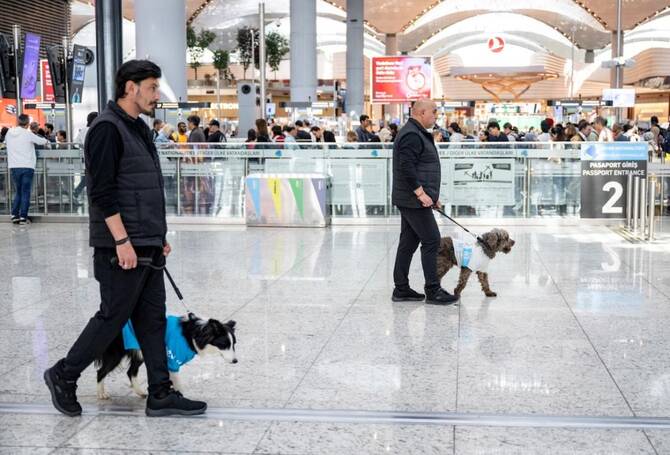
Airport personnel with therapy dogs roam Istanbul Airport searching for stressed travelers on May 3, 2024. Istanbul Airport is likely to overtake London Heathrow soon as the busiest aviation hub in Europe. (AFP file photo)
Short Url
Updated 05 February 2026
Follow

Istanbul gaining fast on Heathrow as Europe’s busiest airport

  • Istanbul Airport, where traffic has surged since its inauguration in 2018, saw passenger growth of 5.5 percent to 84.44 million
  • Turkiye has benefitted as a gateway between Europe and Asian destinations as well as being a hub for flights between Russia and the rest of the world

PARIS: London Heathrow remained the busiest aviation hub in Europe last year but Istanbul Airport was nearly neck-and-neck and is likely to overtake it soon, an industry group said Thursday.
With 84.48 million passengers, Heathrow had a 0.7 percent increase in traffic last year, ACI Europe reported, citing the use of larger planes by airlines at “the capacity-constrained British hub.”
British authorities say a third runway will be added at Heathrow but it is not expected to be ready before 2035.
Istanbul Airport, where traffic has surged since its inauguration in 2018, saw passenger growth of 5.5 percent to 84.44 million — just 40,000 behind Heathrow.
Turkiye has benefitted as a gateway between Europe and Asian destinations as well as being a hub for flights between Russia, subject to Western sanctions over its war in Ukraine, and the rest of the world.
Rounding out the top five European airports were Paris-Charles de Gaulle (72 million), Amsterdam-Schiphol (68.8 million) and Madrid (68.1 million).
Overall, passenger traffic across Europe climbed 4.4 percent last year to 2.6 billion people, “entirely driven by international traffic,” ACI Europe said.
“Travel remains among consumers’ top discretionary spending priorities — even as geopolitics and geoeconomics are likely to further test the sector’s resilience,” ACI Europe’s director general Olivier Jankovec said in a statement.
The sector continues to benefit as well from the post-COVID-19 pandemic travel restrictions, and traffic growth is expected to “normalize” at around 3.3 percent this year, Jankovec said.


Controversial Israeli minister enters area around Al-Aqsa Mosque on first Friday of Ramadan

Updated 11 sec ago
Follow

Controversial Israeli minister enters area around Al-Aqsa Mosque on first Friday of Ramadan

  • Far-right National Security Minister Itamar Ben-Gvir is seen making provocative remarks directed at Palestinians in presence of Israeli police
  • It comes amid heightened Israeli security and restrictions on Palestinians entering the mosque, despite which an estimated 80,000 people attend first Friday prayers of the holy month

JERUSALEM: Israel’s far-right national security minister, Itamar Ben-Gvir, entered the area around Al-Aqsa Mosque on Friday, coinciding with the first Friday prayers of Ramadan.

Footage shared on social media showed him arriving through the Moroccan Gate, accompanied by the Israeli police commissioner, Daniel Levy, and the Jerusalem District police commander, Avshalom Peled.

Ben-Gvir was seen making provocative remarks directed at Palestinians in the presence of Israeli police officers, the Palestinian Wafa news agency reported.

The Moroccan Gate, located near Al-Buraq Wall, is one of the main entrances to Al-Aqsa and has been under Israeli control since 1967. It is regularly used by Israeli forces and settlers to access the mosque compound.

Jerusalem Governorate said the minister’s actions came amid heightened Israeli security measures and tighter restrictions on Palestinian in occupied Jerusalem during Ramadan.

Despite this, an estimated 80,000 worshippers attended the first Friday prayers of Ramadan at Al-Aqsa Mosque, according to figures provided by the Islamic Waqf Department in Jerusalem.

From early in the morning, Israeli forces imposed strict controls on Palestinians traveling from the West Bank to Jerusalem. Dozens of elderly worshippers were reportedly turned back at the Qalandia and Bethlehem checkpoints after being told they lacked the necessary permits.

Security forces also briefly detained four paramedics and disrupted the work of journalists and medical teams at Qalandia, witnesses said.

Additional security measures were also enforced at entrances to Jerusalem’s Old City and the gates of Al-Aqsa, with young men subjected to identity checks and a number of worshippers denied access.