

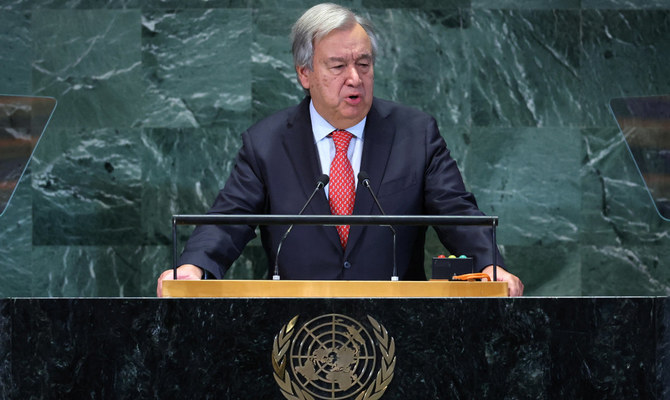

NEW YORK: The UN’s Sustainable Development Goals need a “global rescue plan,” Secretary-General Antonio Guterres warned at the opening of the High Level Political Forum on Sustainable Development at the UN General Assembly in New York on Monday.
“Eight years ago, member states gathered in this hall to adopt the Sustainable Development Goals,” he said.
“You made a solemn promise, a promise to build a world of health, progress and opportunity for all, a promise to leave no one behind, and a promise to pay for it.”
However, progress made on the SDGs has been inadequate, Guterres added. “The SDGs aren’t just a list of goals,” he said. “They carry the hopes, dreams, aspirations and expectations of people everywhere, and they provide the surest path to living up to our obligations under the Universal Declaration of Human Rights, now in its 75th year.
“Yet today, only 15 percent of the targets are on track. Many are going in reverse. Instead of leaving no one behind, we risk leaving the SDGs behind.”
Guterres said that “at the halfway point to the SDG deadline (of 2030), the eyes of the world are on you once again,” but that he believes the UNGA can turn the stagnation into progress by focusing on a number of key areas, starting with funding.
“I’m deeply encouraged by the detailed and wide-ranging political declaration under discussion here today, especially (the) commitment to improving developing countries’ access to the fuel required for SDG progress: finance,” he added.
“This includes your clear support for an SDG stimulus of at least $500 billion a year, as well as an effective debt-relief mechanism that supports payment suspensions, longer lending terms and lower rates.
“It includes your call to re-capitalize and change the business model of multilateral development banks so they can massively leverage private finance at affordable rates to benefit developing countries.
“And it includes your endorsement of reforming today’s outdated, dysfunctional and unfair international financial architecture. This can be a game-changer in accelerating SDG progress.”
Guterres encouraged nations to take action on hunger and the transition to renewable energy, which “isn’t happening fast enough.”
He also emphasized the importance of digitization and education, saying: “Too many children and young people are victims of poor-quality education.”
Support and protection for people in and out of work are also of paramount importance, while he concluded by saying: “The war on nature must stop. We must end the triple planetary crisis of climate change, pollution and biodiversity loss.”
UNGA President Dennis Francis told delegates: “The 17 SDGs serve as a beacon of hope and a roadmap for common action to create a more equitable, just and sustainable world.
“Now, at the midway point, it’s essential that we take stock of our progress and assess the remaining challenges that confront us.”
He added: “A combination of factors — including the effects of the COVID-19 pandemic, impacts of climate change and the war in Ukraine — have presented a series of complex and intersecting crises.
“And while this has dramatically altered the trajectory of the entire world, it is — as is too often the case — those in the most precarious circumstances, and those who are already the most vulnerable, who suffer the most.”
Francis echoed the call by Guterres for action on areas such as hunger and finance, calling for “bold and transformative” actions.
“While there have been setbacks, we can’t relent in our resolve and determination to do our outpost to rescue the SDGs, as we’ve been challenged by the secretary-general,” Francis said. “The fact that we’re lagging in our promise can’t be the death-knell of our blueprint.”
Sheikh Mohammed bin Abdulrahman bin Jassim Al-Thani, Qatar’s prime minister, told delegates: “We share one goal — addressing the most urgent challenges in the world: armed conflicts, food security crises and climate change.
“Needless to say, commitment to peaceful settlement of differences and respectful dialogue are best to safeguard the development gains worldwide.”
He added: “The state of Qatar is committed to the alignment of its national development plans with the SDG principles.”


