


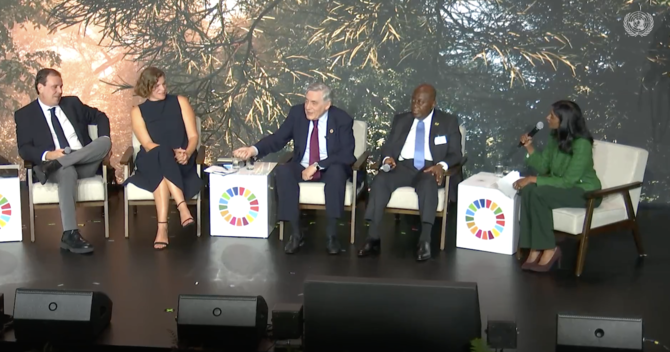
LONDON: Global problems such as climate change, pandemics and inequality cannot be solved without coordinated international action, former UK Prime Minister Gordon Brown said on Monday during the Sustainable Development Summit in New York.
The event at the UN headquarters marks the halfway point in the implementation of the organization’s Sustainable Development Goals.
Brown, who is the UN special envoy for global education, said the world needs to agree on “burden sharing,” and countries who are more able should take more responsibility.
Ghana’s President Nana Akufo-Addo said a major obstacle to achieving the SDGs is the view that for one person to be wealthy, another has to be poor.
“That’s the major obstacle. We saw it, for instance, at the time of COVID, when those who have the capacity to produce a vaccine suddenly decided that it was better to act domestically for themselves than to act for the global community,” he added.
“But this, for me, is the issue that we need to confront. Is it possible that we can create a situation whereby we accept that it’s possible for all of us 8 billion people on this planet to be able to live on this planet and make use of its resources in such a way that we can all be comfortable?”
He said: “There’s really no advantage if we continue the way it has been going before, whereby for you to be rich, I have to be poor. That matter is a matter that all of us have to come to grips with.”
Brown said the key to achieving the SDGs is acting now. “We’ve got droughts, we’ve got floods, we’ve got storms, we’ve got illiteracy, we’ve got disease, we’ve got squalor. Unless we act now, then we won’t achieve anything that we want to achieve by 2030,” he added.
Stefan Schweinfest, director of the UN Statistics Division, announced a new partnership with Google’s Data Commons to make authoritative UN data more findable, accessible and usable for everyone.

The Director of the United Nations Statistics Division Stefan Schweinfest announces a new partnership with Google’s Data Commons on Monday. (UN Web TV)
“In response to Secretary-General Antonio Guterres’ call for data-driven transformation of the United Nations, we’re modernizing UN data over the next two years to bring data together from across the entire UN system into a new, user-friendly public interface with advanced search functionality,” Schweinfest said.
“Together, we’ve built the first stage of that: the UN Data Commons for the SDGs. This new interface allows for seamless exploration of SDG data sets, the global SDG report, and analytics facilitating informed data-driven decisions for SDG acceleration.”
Agnes Kalibata, president of the Alliance for a Green Revolution in Africa, drew attention to the huge flash flood that swept thousands to their deaths in Libya last week.

The President of the Alliance for a Green Revolution in Africa Agnes Kalibata speaks at the Sustainable Development Summit on Monday. (UN Web TV)
“We need a global policy to fix climate change. We also need countries to come through on adaptation,” she said.
“The biggest challenge of all times for the African continent that we need to find solutions to is something we have no ability to find a solution to — it’s called climate change.
“That’s causing droughts and droughts and droughts and floods. And you’re seeing that across the African continent.
“And I don’t know whether Africa alone can do anything about that until we all, as the world, decide to do something.”


