

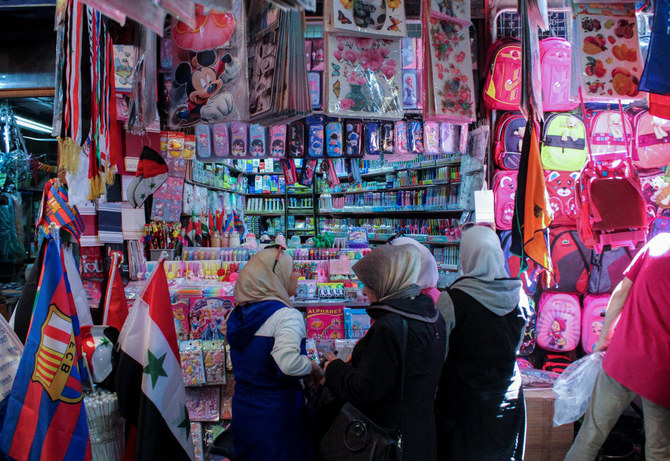
Syrian children return to school amid deep economic crisis

People shop for school supplies at a market in Damascus, Syria August 27, 2023. (Reuters)
Short Url
Updated 03 September 2023
Follow

Syrian children return to school amid deep economic crisis

  • Syria’s education ministry on Saturday called on schools “not to enforce strict school uniforms (...) and to reduce the necessary supplies” for students

DAMASCUS: Nearly four million Syrians students in government-controlled areas returned to school Sunday, braving the effects of war, a devastating earthquake and a deep economic crisis.
But many children do not have classrooms to go to in a country where many educational facilities have been damaged or destroyed and 90 percent of people live under the poverty line according to the United Nations.
Syria’s education ministry on Saturday called on schools “not to enforce strict school uniforms (...) and to reduce the necessary supplies” for students, the SANA state news agency reported.
These measures were introduced “in light of the difficult economic conditions facing the country and as part of an effort to reduce the financial burden on the population,” SANA said.

FASTFACT

More than 3.7 million students in Syria are starting the 2023-2024 academic year, spread across 14,505 schools.

“More than 3.7 million students are starting the 2023-2024 academic year, spread across 14,505 schools,” added the outlet.
Since 2011, Syria has endured a bloody conflict that has claimed over half a million lives, displaced several million people and plunged the country into a suffocating economic crisis.
The war’s widespread destruction of infrastructure has particularly impacted education facilities, with many schools destroyed and other turned into shelters.
“Even before the February 2023 earthquakes, around one in three schools remained out of service,” said a recent report from the UN children’s agency.
The natural disaster caused an estimated additional $277 million in losses and damage to the education sector.
“At the current rate of funding, UNICEF and education partners would need another 30 years to rehabilitate all damaged schools,” added UNICEF.
A third of all school-age children, nearly 2.4 million, did not attend school and another 1.6 million children were at risk of dropping out, according to the report.
Many have been forced to leave school to work and support their families who have struggled to meet their basic needs due to the drastic reduction in their purchasing power over the years of war and Western-imposed sanctions.
Government forces have regained control of most of the country after years of fighting, but areas in seven of Syria’s 14 provinces remain outside the control of Damascus.
Sunday also marked the start of the school year in areas controlled by the semi-autonomous Kurdish administration in the northeast of the country.


Deal is signed in Beirut to transfer 300 Syrian prisoners in Lebanon to their home country

Updated 4 sec ago
Follow

Deal is signed in Beirut to transfer 300 Syrian prisoners in Lebanon to their home country

  • Lebanon’s Deputy Prime Minister Tarek Mitri and Syria’s Justice Minister Mazhar Al-Wais expressed hope that this step will boost confidence and progress relations
  • Lebanon and Syria have signed an agreement to transfer over 300 Syrian detainees from Lebanese prisons to continue their sentences in Syria
BEIRUT: Lebanon and Syria signed an agreement Friday to transfer more than 300 Syrians from Lebanese prisons to continue serving their sentences in their home country, a step that will likely help improve strained relations between the two neighbors.
The signing came a week after Lebanon’s Cabinet approved a treaty with Syria for the transfer of prisoners. The deal was signed at the government headquarters in the Lebanese capital, Beirut, by Lebanon’s Deputy Prime Minister Tarek Mitri and Syria’s Justice Minister Mazhar Al-Wais.
“This is a very important first step on the road of a comprehensive treatement regarding Syrian prisoners in Lebanese prisons,” Mitri told reporters, adding that the implementation of the agreement would start on Saturday.
“Both countries want to move forward but there are some pending matters,” Al-Wais said. “This step will boost existing confidence and we hope that relations will progress more.”
Mitri said that next, officials from the two neighboring countries, will discuss the transfer of Syrian detainees who are still waiting trial in Lebanon.
Lebanon and Syria have a complicated history, with grievances on both sides. Many Lebanese resent nearly three decades of domination and military presence in their country by Syrian forces that ended in 2005.
Many Syrians resent the role played by the Lebanese militant group Hezbollah when it entered Syria’s civil war that broke out in 2011 in defense of then-President Bashar Assad and his government. Assad was overthrown in December 2024 and fled to Russia where he is now in exile.
After Assad’s fall, relations with Syria’s new Islamist-led authorities remained tense and skirmishes occurred along the unmarked border between the two nations.
Mitri also said Saturday’s signing was “an expression of a joint political will that states that the Lebanese-Syrian relations are based on confidence and mutual respect.”
Asked whether the deal will include Lebanese citizens such as Sunni Muslim cleric Ahmed Al-Assir, Mitri said that it only covers Syrian prisoners.
There are about 2,500 Syrian prisoners in Lebanese prisons and jails, some of whom are held on charges related to their involvement with armed opposition groups that sought to overthrow Assad — in some cases, the same groups that are now ruling Syria.
Earlier this week, Mitri told The Associated Press that most of the detainees who will be transferred to Syria were not convicted of violent crimes. Some of those convicted of violent crimes may be transferred if they have already served seven and a half years of their sentence in Lebanon, he said.