


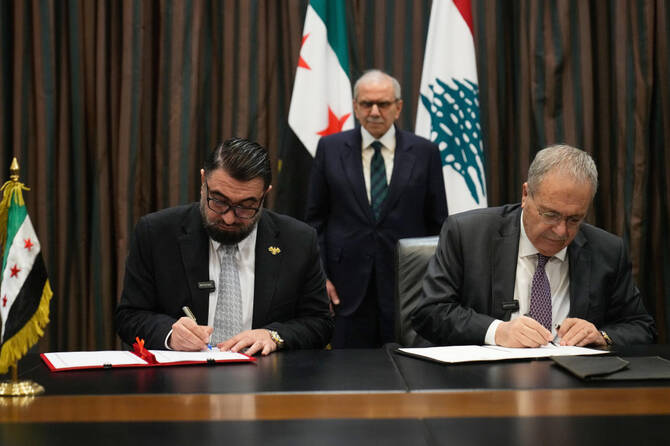

BEIRUT: In a historic first, Lebanon and Syria signed a landmark prisoner transfer agreement on Friday, paving the way for the repatriation of hundreds of Syrian inmates held in Lebanese prisons.
The agreement, hailed by Lebanese officials as a major breakthrough in bilateral judicial cooperation, will result in the relocation of about 300 Syrian prisoners, many of whom have spent over a decade in Lebanese detention. The first transfers are scheduled to begin early on Saturday.
The deal was finalized after months of technical and legal negotiations, culminating in six consecutive sessions led by a joint Lebanese-Syrian committee co-chaired by the two countries’ justice ministers.
Under the terms of the agreement, inmates may be transferred to their home country to serve the remainder of their sentences — provided they offer written consent. The legal framework, effective immediately on signing and publication, bypasses lengthy bureaucratic hurdles that typically stall such processes.
The development signals a shift in Lebanese-Syrian relations, long strained by decades of political tension and the aftermath of Syria’s military presence in Lebanon, which ended in 2005.
According to the agreement, transfer operations must be completed within three months, with prisoners moved in phases, either in groups or individually.
Lebanon currently holds an additional 2,500 Syrian detainees awaiting final verdicts. Their uncertain legal status underscores the enormous strain on an overcrowded prison system already burdened by Lebanese and foreign inmates.
A judicial source said Syrian detainee cases remain “gridlocked in the courts, caught between adjudication delays, resource shortages, and the entanglement of security and judicial concerns.”
Lebanon is also grappling with a long-standing unresolved issue: the fate of Lebanese citizens abducted and imprisoned in Syria during its years of military presence. Despite the collapse of the former Syrian regime and the opening of Syrian prisons, no trace has been found of many of those who went missing.
The signing ceremony at the government palace brought together Lebanese Prime Minister Nawaf Salam, Deputy Prime Minister Tariq Mitri, and Justice Ministers Mazhar Al-Wais of Syria and Adel Nassar of Lebanon.
Al-Wais described the deal as “intricate and impossible to resolve through a single sweeping agreement,” but said it marked a significant stride toward justice in addressing prisoner conditions and establishing a basis for future bilateral cooperation.
He said the deal covers about 300 Syrian prisoners, calling it “a critical step in tackling the file of the disappeared and inmates who have endured extended incarceration in Lebanese facilities.”
Al-Wais said that the agreement was the result of sustained efforts and underscored a shared political will to strengthen Lebanese-Syrian relations on the basis of trust and mutual respect.
Work is also underway to set a timeline for reviewing the cases of detainees not covered by the current agreement, including individuals who have spent lengthy periods in detention with no clear information about their fate, he said.
Mitri said the agreement had been unanimously approved by the Lebanese Cabinet, and that both countries would later sign an additional accord to address the issue of Syrian detainees.
“Lebanon and Syria have a genuine opportunity to redefine their relationship on new foundations based on equality and mutual respect,” Mitri said, describing the agreement as “an effort to move away from a long legacy of unequal relations, coercive practices, and issues imposed by force rather than governed by law.”
Lebanese Minister of Information Paul Morcos said the agreement will significantly ease the overcrowding in Lebanese prisons,” adding that Lebanon could benefit in the future from a similar mechanism to address prison conditions.
As part of efforts to support the Lebanese army, French Foreign Minister Jean-Noel Barrot held talks with Lebanese officials, describing the discussions as “successful and positive”.
At the same time, a French team from the mechanism overseeing the implementation of the Israel-Lebanon ceasefire toured the Marjeyoun and Hasbaya areas, including the zone between Kfarkela, Marjeyoun, and the Kfarshouba barracks south of the Litani River.
Ahead of his arrival in Beirut, Barrot highlighted that the Lebanese army must be given the means to continue its mission of disarming Hezbollah.
His visit comes weeks ahead of an international conference that Paris will host on March 5, aimed at rallying support for the Lebanese armed forces.
Speaking at Irbil airport, the French minister said that his country’s “vision for Lebanon is that of a strong, sovereign state holding a monopoly on arms.”
Achieving this begins with providing the Lebanese Armed Forces with the resources and capabilities required to disarm the militant group, he said.
Lebanese Army Commander Gen. Rodolphe Haykal recently held talks in Washington with US officials.
An official source told Arab News that the visit was positive and took place within the framework of cooperation between the US and Lebanese armies.
Republican Sen. Lindsey Graham said in a post on X on Friday that he ended his meeting with Haykal after asking him whether he considered Hezbollah a terrorist organization, to which Haykal replied: “No, not in the context of Lebanon.”
The source said that the brief meeting will not affect measures aimed at supporting the Lebanese Army.


