CAIRO: Libya’s foreign minister on Monday was sacked and fled the country, a day after Israel revealed that its chief diplomat met with her last week — news that prompted scattered street protests in the chaos-stricken North African nation.
Prime Minister Abdul Hamid Dbeibah, who heads one of Libya’s rival governments, said he referred her for an investigation over the meeting, which was the first ever between top diplomats of Libya and Israel. Dbeibah did not clarify on what grounds Mangoush would be investigated. However, it is illegal to normalize ties with Israel under a 1957 law in Libya, which has long been hostile toward Israel.
Mangoush fled to Turkiye following the Israeli announcement of the meeting, according to a Libyan Foreign Ministry official.
Israeli Foreign Minister Eli Cohen and Mangoush met in Rome last week. It was a small breakthrough for Israel’s government, whose hard-line policies toward the Palestinians have led to a cooling of its burgeoning ties with the Arab world.
Cohen said they discussed the importance of preserving the heritage of Libya’s former Jewish community, including renovating synagogues and cemeteries. The talks also touched on possible Israeli assistance for humanitarian issues, agriculture and water management, according to Israel’s Foreign Ministry.
The Libyan Foreign Ministry tried to play down the meeting, calling it “unprepared and an unofficial meeting during a meeting with Italy’s foreign minister.” It said in a statement that Mangoush’s encounter with Cohen didn’t include “any talks, agreements or consultations.”
Dbeibah’s decision to sack Mangoush suggested that he was not aware of the meeting. However, two senior Libyan government officials told The Associated Press the prime minister knew about the talks between his foreign minister and the Israeli chief diplomat.
One of the officials said Dbeibah gave the green light for the meeting last month when he was on a visit to Rome. The prime minister’s office arranged the encounter in coordination with Mangoush, he said.
The second official said the meeting lasted for about two hours and Mangoush briefed the prime minister directly after her return to the capital, Tripoli. The official said the meeting crowned US-brokered efforts to have Libya join a series of Arab countries establishing diplomatic ties with Israel.
The official said normalization of relations between Libya and Israel was first discussed in a meeting between Dbeibah, and CIA Director William Burns, who visited the Libyan capital in January.
The Libyan premier gave initial approval for joining the US-brokered Abraham Accords, but he was concerned about public backlash in a country known for its past support for the Palestinian cause, the official said.
The official, meanwhile, said Mangoush, who was surprised by the Israeli announcement, quickly fled the Libyan capital on a private flight to Istanbul.
Both officials spoke on condition of anonymity for their safety.
Jalel Harchaoui, an associate fellow specializing in Libya at the London-based Royal United Services Institute for Defense and Security Studies, said Dbeibah has sought to please foreign governments as he has come under growing pressure from the UN and other countries over the political stalemate in his nation.
Harchaoui said the Libyan prime minister’s decision to sack his foreign minister “undoubtedly” aimed at calming public anger.
In New York, UN spokesman Stephane Dujarric wouldn’t comment on the matter, calling it an internal issue, but said: “We are concerned about the safety of the foreign minister. There are reports that she’s been threatened and she had to flee the country. Her safety is paramount.”
A day after proudly announcing what it called a “historic” meeting, Israel’s Foreign Ministry on Monday put out a statement saying that neither Cohen nor the ministry was responsible for “leaking” the news.
An Israeli official said the ministry was forced to go public Sunday after an Israeli news site planned to publish a report on the meeting. The official, who spoke on condition of anonymity to discuss the behind-the-scenes diplomacy, said that Israel informed the Libyans about the leak and said that both countries had previously agreed they would announce the meeting at an unspecified time.
Libya was plunged into chaos after a NATO-backed uprising toppled longtime dictator Muammar Qaddafi in 2011. The oil-rich country has been split between the Western-backed government in Tripoli and a rival administration in the country’s east. Each side has been backed by armed groups and foreign governments. Qaddafi was hostile to Israel and a staunch supporter of the Palestinians, including radical militant groups.
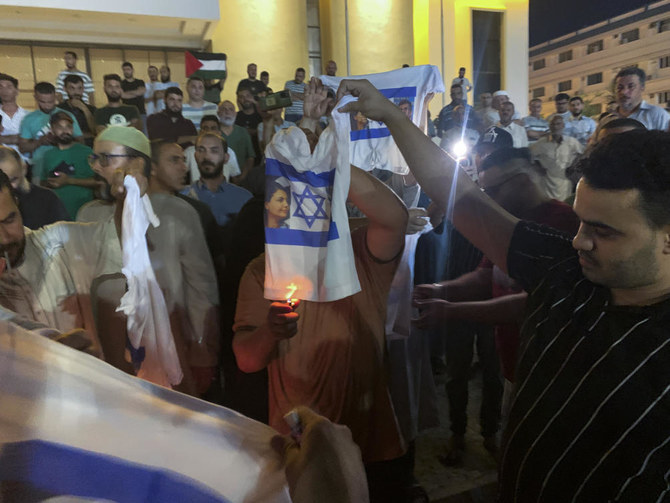
Sunday’s announcement of the meeting prompted scattered protests in Tripoli and other towns in western Libya. Protesters stormed the foreign ministry headquarters to condemn the meeting, while others attacked and burned a residence for the prime minister in Tripoli, according to local reports.
In the town of Zawiya protesters burned the Israeli flag, while others held the Palestinian flag. There were also protests in the city of Misrata, a stronghold for Dbeibah, according to footage circulated on social media and verified by The Associated Press.
Khalid Al-Mishri, a politician who was the chair of the State Council, a Tripoli-based legislative body, condemned the meeting and called for the dismissal of Dbeibah’s government, which is close to the US and the West.
“This government has crossed all prohibited lines and must be brought down,” he wrote on the Twitter.
The House of Representatives of Libya’s rival government in the east also slammed the meeting as a “legal and moral crime.” It convened an emergency session Monday in the eastern city of Benghazi, and called for the country’s public prosecutor to probe Dbeibah’s government communications with Isreal.
In Israel, Yair Lapid, a former foreign minister and prime minister, criticized Cohen for going public with the sensitive meeting.
“Countries of the world this morning are looking at the irresponsible leak of the meeting of the Israeli and Libyan foreign minister and asking themselves: is it possible to manage foreign relations with this country? Is it possible to trust this country?” Lapid said in a statement.


![]()

Libya’s foreign minister sacked, flees country after meeting with Israel’s chief diplomat
Short Url
https://arab.news/2fbve
Libya’s foreign minister sacked, flees country after meeting with Israel’s chief diplomat
- Libya does not recognize Israel and supports the establishment of a Palestinian state
- Mangoush fled to Turkiye following the Israeli announcement of the meeting


Latest updates




© 2026 SAUDI RESEARCH & PUBLISHING COMPANY, All Rights Reserved And subject to Terms of Use Agreement.