

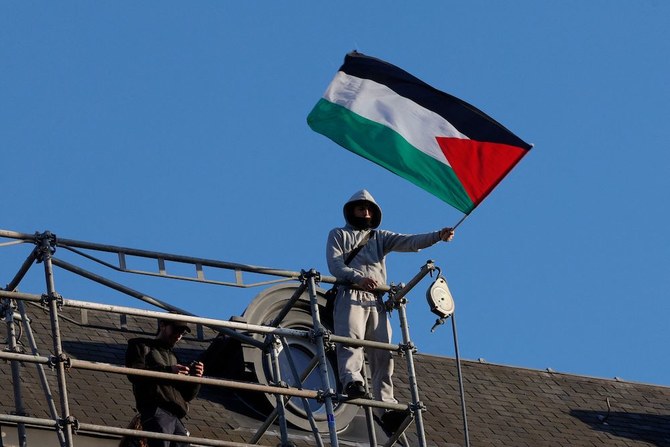


BARCELONA: Spain, Norway and Ireland formally recognized a Palestinian state on Tuesday in a coordinated effort by the three western European nations to add international pressure on Israel to soften its devastating response to last year’s Hamas-led attack. Tel Aviv slammed the diplomatic move that will have no immediate impact on its grinding war in Gaza.
Spanish Prime Minister Pedro Sanchez told his nation in a televised address from Madrid that “this is a historic decision that has a single goal, and that is to help Israelis and Palestinians achieve peace.”
Israel’s Foreign Minister Israel Katz quickly lashed out at Spain on X, saying Sanchez’s government was “being complicit in inciting genocide against Jews and war crimes.”
Ireland and Norway soon joined Spain in formalizing a decision they had jointly announced the previous week.
The Palestinian flag was raised in Dublin outside Leinster House, the seat of the Irish parliament.
“This is an important moment and I think it sends a signal to the world that there are practical actions you can take as a country to help keep the hope and destination of a two-state solution alive at a time when others are trying to sadly bomb it into oblivion,” Irish Prime Minister Simon Harris said before his Cabinet meets to formally sign off on the decision.
Norwegian Foreign Minister Espen Barth Eide said in a statement that “for more than 30 years, Norway has been one of the strongest advocates for a Palestinian state. Today, when Norway officially recognizes Palestine as a state, is a milestone in the relationship between Norway and Palestine.”
While some 140 countries have recognized a Palestinian state — more than two-thirds of the United Nations — none of the major Western powers has done so. Still, the adherence of three European countries to the group represents a victory for Palestinian efforts in the world of public opinion, and will likely put pressure on EU heavyweights France and Germany to rethink their position.
Relations between the EU and Israel have nosedived with the diplomatic recognitions by two EU members, and Madrid insisting on Monday that the EU should take measures against Israel for its continued deadly attacks in southern Gaza’s city of Rafah.
After Monday’s meeting of EU foreign ministers, Irish Foreign Minister Micheál Martin said “for the first time at an EU meeting, in a real way, I have seen a significant discussion on sanctions” for Israel.
Harris, the Irish leader, insisted Tuesday the EU should consider economic sanctions for Israel, saying “Europe could be doing a hell of a lot more.”
Norway, which is not an EU member but often aligns its foreign policy with the bloc, handed diplomatic papers to the Palestinian government over the weekend ahead of its formal recognition.
At the same time, the EU’s foreign policy chief Josep Borrell threw his weight behind the International Criminal Court, whose prosecutor is seeking an arrest warrant against Israeli Prime Minister Benjamin Netanyahu and others, including leaders of the Hamas militant group.
The formal declaration and resulting diplomatic dispute come over seven months into an assault waged by Israel following the Oct. 7 Hamas-led attack in which militants stormed across the Gaza border into Israel, killing 1,200 people and taking some 250 hostage. Israel’s air and land attacks have killed 36,000 Palestinians, according to Gaza’s Health Ministry, which does not distinguish between combatants and civilians.
Last week’s joint announcement by Spain, Ireland and Norway triggered an angry response from Israeli authorities, which summoned the countries’ ambassadors in Tel Aviv to the Foreign Ministry, where they were filmed while being shown videos of the Oct. 7 Hamas attack and abductions.
Slovenia’s Prime Minister Robert Golob said Monday his government will decide on the recognition of a Palestinian state on Thursday and forward its decision to parliament for final approval.
The United States and Britain, among others, back the idea of an independent Palestinian state alongside Israel but say it should come as part of a negotiated settlement. Netanyahu’s government says the conflict can only be resolved through direct negotiations.
In his speech on Tuesday, Sanchez said that the recognition of a Palestinian state was “a decision that we do not adopt against anyone, least of all against Israel, a friendly people whom we respect, whom we appreciate and with whom we want to have the best possible relationship.”
The Socialist leader has spent months touring European and Middle Eastern countries, including stops in Oslo and Dublin, to garner support for the recognition of a Palestinian state. He called for a permanent cease-fire, for stepping up humanitarian aid into Gaza and for the release of hostages still held by Hamas.
Spain’s foreign minister, Jose Manuel Albares, will meet with the Arab Contact Group in Spain’s capital on Wednesday, including Palestinian Prime Minister Mohammad Mustafa, Qatari Prime Minister Sheikh Mohammed bin Abdulrahman Al-Thani, and the foreign ministers of Saudi Arabia, Turkey and Jordan.
Sanchez said that his intention was to back the beleaguered Palestinian Authority, which lost effective political control of Gaza to Hamas. He laid out his vision for a state ruled by the Palestinian Authority that must connect the West Bank and Gaza via a corridor with east Jerusalem as its capital.
The Western-backed Palestinian Authority administers parts of the Israeli-occupied West Bank, cooperates with Israel on security matters and favors a negotiated two-state solution. Its forces were driven out of Gaza by Hamas when the militants seized power there in 2007.
The Palestinians have long sought an independent state in Gaza, the West Bank and east Jerusalem, territories Israel captured in the 1967 Mideast war. The idea of a land corridor linking Gaza and the West Bank through Israel was discussed in previous rounds of peace talks, but no serious or substantive peace negotiations have been held in over 15 years.
“We will not recognize changes in the 1967 border lines other than those agreed to by the parties,” Sanchez added.
“Furthermore, this decision reflects our absolute rejection of Hamas, a terrorist organization who is against the two-state solution,” Sanchez said. “From the outset, Spain has strongly condemned the terrorist attacks of Oct. 7. This clear condemnation is the resounding expression of our steadfast commitment in the fight against terrorism. I would like to underline that starting tomorrow we would focus all our efforts to implement the two state solution and make it a reality.”
Ireland’s government said that it will appoint an ambassador and create a full embassy in Ramallah in the West Bank.
Israel, which rejects the possibility of Palestinian statehood, recalled its ambassadors to Ireland, Norway and Spain after they announced the decision last week.
Norway’s Barth Eide added Tuesday that “it is regrettable that the Israeli government shows no signs of engaging constructively.”
“The recognition is a strong expression of support for moderate forces in both countries,” Norway’s top diplomat said.


