

Norway to facilitate transfer of funds to Palestinian Authority

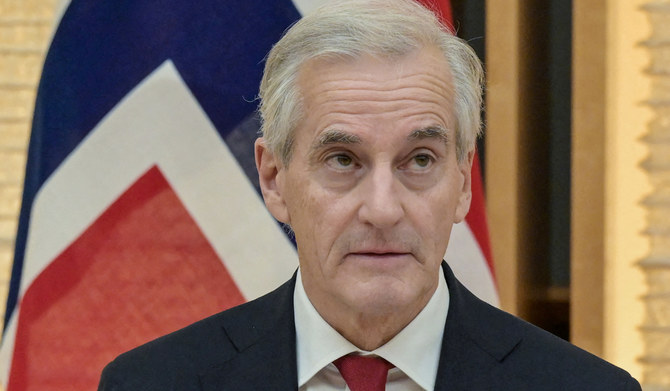
Norway's Prime Minister Jonas Gahr Store speaks to the media after a bilateral meeting with Japan's Prime Minister Fumio Kishida at his official residence in Tokyo, Japan, on December 7, 2023. (REUTERS)
Short Url
Updated 19 February 2024
Follow

Norway to facilitate transfer of funds to Palestinian Authority

  • The portion of the revenue Norway will keep equals the portion that Israel estimates for Gaza, said a Norwegian foreign ministry spokesperson

OSLO: Norway has agreed to help facilitate the transfer of frozen tax funds earmarked for the Palestinian Authority (PA) that were collected by Israel, the Norwegian government said on Sunday, providing vital funding to the Western-backed entity.
Under interim peace accords reached in the 1990s, Israel’s finance ministry collects tax on behalf of the Palestinians and makes monthly transfers to the PA, but a dispute broke out over payments in the wake of the Oct. 7 attack by Hamas.
The temporary solution will allow payments to resume and prevent a financial collapse for the PA, enabling it to pay salaries and provide essential services such as schools and health care, Norway said.
“This is critical to promoting stability in the region and for the Palestinian Authority to have legitimacy among its people,” Norwegian Prime Minister Jonas Gahr Stoere said.
Under the solution agreed with Israel and Palestinian officials, Norway will serve as an intermediary for holding revenues that Israel has withheld since Oct. 7.
“The Palestinian Authority is then willing to accept the other funds,” Norway said.
The portion of the revenue Norway will keep equals the portion that Israel estimates for Gaza, said a Norwegian foreign ministry spokesperson.
Accessing the revenue is key to the survival of the PA, which exercises limited self-rule in the Israeli-occupied West Bank.
Several Western countries, including the United States, also want the PA to play a role in the administration of the Gaza Strip should the war come to an end.
On Nov. 2, Israel said it would proceed with a tax revenue transfer to the PA in the West Bank but would withhold funds bound for Gaza, ruled by Hamas but where the PA helps cover public sector wages as well as medicine and social assistance programs.
But on Nov. 6, the PA said it wanted the money in full and would not accept conditions that prevent it from paying its staff. It is estimated to spend some 30 percent of its budget in Gaza.
On Jan. 21, Israeli officials said the Israeli cabinet had approved a plan for frozen tax funds earmarked for the Gaza Strip to be held by Norway instead of transferred to the PA.


EU diplomats to meet Board of Peace director over Gaza’s future

Updated 4 sec ago
Follow

EU diplomats to meet Board of Peace director over Gaza’s future

  • Former Bulgarian politician and UN diplomat Nikolay Mladenov has been chosen by Trump to manage the Board of Peace
  • Mladenov will meet with the EU’s foreign policy chief Kaja Kallas and foreign ministers from across the 27-nation block
BRUSSELS: The European Union’s top diplomats are set to meet Monday with the director of the Board of Peace in Brussels after a shaky and controversial embrace of US President Donald Trump’s efforts to secure and rebuild the war-ravaged Gaza Strip.
Nikolay Mladenov, a former Bulgarian politician and UN diplomat chosen by Trump to manage the Board of Peace, will meet the EU’s foreign policy chief Kaja Kallas and foreign ministers from across the 27-nation bloc. The EU diplomats are also expected to discuss the war in Ukraine and fresh sanctions on Russia.
Just across the Mediterranean Sea from the Middle East, the EU has deep links to Israel and the Palestinians. It now plays a crucial oversight role at the Rafah border crossing, and is the top donor to the Palestinian Authority.
The question of whether to work with the Trump-led board has split national capitals from Nicosia to Copenhagen. The EU is supportive of the United Nations’ mandate in Gaza.
EU members Hungary and Bulgaria are full members of the board, as are EU candidate countries Turkiye, Kosovo and Albania.
Twelve other EU nations sent observers to the inaugural meeting in Washington on Thursday: Austria, Croatia, Cyprus, Czech Republic, Finland, Germany, Greece, Italy, Netherlands, Poland, Romania and Slovakia. The EU flag was displayed at the event alongside EU observer and member nations.
European leaders like French President Emmanuel Macron and European Commission President Ursula von der Leyen turned down invitation to join, as did Pope Leo XIV. But von der Leyen did send European Commissioner for the Mediterranean Dubravka Šuica to the meeting in Washington as an observer.
French Foreign Minister Jean-Noël Barrot said sending Šuica without consulting the European Council, the group of the bloc’s leaders, broke EU regulations.
“The European Commission should never have attended the Board of Peace meeting in Washington,” Barrot said in a post on X. “Beyond the legitimate political questions raised by the ‘Board of Peace,’ the Commission must scrupulously respect European law and institutional balance in all circumstances.”
“It is in the remit of the Commission to accept invitations,” von der Leyen spokesperson Paula Pinho said Friday.
While the executive is not joining the board, it is seeking to influence reconstruction and peacekeeping in Gaza beyond being the top donor to the Palestinian Authority, she said.
Trump’s ballooning ambitions for the board extend from governing and rebuilding Gaza as a futuristic metropolis to challenging the UN Security Council’s role in solving conflicts. But they could be tempered by the realities of dealing with Gaza, where there has so far been limited progress in achieving the narrower aims of the ceasefire.