

On Eid in Karachi, surge in orders for specials made using sacrificial meat from customers

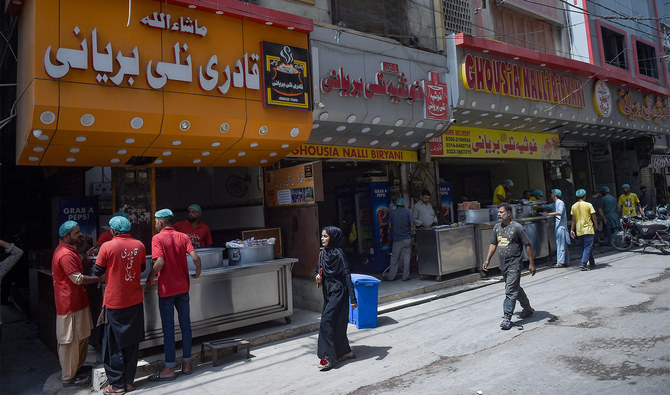
In this photograph taken on September 16, 2023, 'Qadri Nalli Biryani' and 'Ghousia Nalli Biryani' restaurants are seen adjacent to each other along a street in Karachi. (AFP/File)
Short Url
Updated 17 June 2024
Follow

On Eid in Karachi, surge in orders for specials made using sacrificial meat from customers

  • Many prefer to cook some dishes at home and order others from restaurants that prepare food using meat provided by customers
  • Slow cooked meats like sajji and roast, malai boti, and all kind of kebabs are among favorites customers get restaurants to prepare

KARACHI: While sweets and desserts steal the spotlight during Eid Al-Fitr around the world, on Eid Al-Adha the focus shifts to savory delights, especially dishes prepared with the mutton and beef of animals sacrificed to mark the annual religious holiday. 

Things are no different in Karachi, Pakistan’s commercial and culinary center, where restaurants on the iconic Burns Road and other food streets start preparing meat specials for Eid. 

“People don’t realize it’s Eid-Al-Adha if they don’t get spicy dishes,” said Agha Owais, the owner of Agha Sajji, a restaurant that specializes in slow cooked meats in various forms as well as spicy biryani rice. 

After the Eid sacrifice, Owais said, his restaurant got busy preparing hundreds of orders from people who brought over sacrificial meat to the eatery for special dishes to be prepared using it.

“The women at home are often tired during Eid so they prefer to entertain guests by opting for good, spicy, and clean food from reputable places with high-quality ingredients,” Owais said. 

A resident of Karachi civil lines, Sadiq Abubakar, said he preferred to have biryani and dried meat dishes prepared at home on Eid but ordered BBQ specials from restaurants. 

Among favorites are malai boti, melt-in-the-mouth chunks of boneless chicken, lamb or beef marinated in a mildly flavored cream sauce made with fresh herbs, seekh kebabs made with spiced minced or ground meat formed into cylinders on skewers and grilled, and dhaga kebabs, made without a binding agent like eggs, chickpea or maize flour, but in which a dhaga, or thread, is wrapped around the kebab to hold it better over the grill while cooking.

“Sometimes we give a goat’s leg to a restaurant and get karahi made out of it,” Abubakar said.

“IT’S THE TASTE”

S.M. Iqbal, the owner of New Delhi Gola Kebab House, said his restaurant was closed for Eid dining in order to complete takeaway orders, especially made using people’s own sacrificial meat.

“People also invite us [for catering] to their homes, but we don’t go very often because our outdoor work is at a large scale,” Iqbal said. “We can’t go for 10-15 kgs [of meat], we only go if there’s an order for at least 100 people.”

He said most customers got dhaga and fried kebabs made, which were a specialty at his restaurant.

“It’s the taste that pushes people to bring sacrificial meat to our restaurants,” Iqbal said. “Allah has given us the taste that attracts people.”

Customer Mustafa Tahir said offering guests a mix of homemade dishes and food prepared by restaurants created a good balance during Eid. 

“Have them [restaurants] prepare dishes too, they’ll make good food,” he said. “Combine three or four flavours, invite guests at home, and truly enjoy Eid-Al-Adha as it should be enjoyed.”


Government to move Imran Khan to hospital as lawyers seek his release from jail on health grounds

Updated 8 sec ago
Follow

Government to move Imran Khan to hospital as lawyers seek his release from jail on health grounds

  • Minister says the government is fulfilling its legal duty, urges against politicizing the matter
  • Khan’s family says the ex-PM spoke to sons for 20 minutes, calls for urgent eye treatment

ISLAMABAD: Pakistan’s government said on Saturday it has decided to transfer jailed former prime minister Imran Khan to a hospital and form a medical board for his eye treatment, as opposition protests over the issue entered a second day and his lawyers moved a high court to seek his release on health grounds.

The developments follow a report submitted to the Supreme Court by a lawyer appointed as amicus curiae who was asked to visit Khan at Rawalpindi’s Adiala jail earlier this month. The report said the 73-year-old had suffered severe vision loss in his right eye due to central retinal vein occlusion, leaving him with only 15 percent sight in the affected eye.

The findings triggered a sit-in by an opposition alliance, including members of Khan’s Pakistan Tehreek-e-Insaf (PTI) party, demanding his immediate transfer to Islamabad’s Al-Shifa Hospital. Khan was also allowed to speak to his sons for about 20 minutes, according to his family, despite the former premier’s limited interactions with his family and legal team in recent months due to restrictions that the PTI has challenged in court.

In a social media post, Parliamentary Affairs Minister Tariq Fazal Chaudhry announced the government’s decision.

“Imran Khan has been provided the facility to speak with his sons on the phone and, in view of his health, it has also been decided to transfer him to hospital and constitute a medical board,” he said.

“The government gives priority to humanitarian considerations and legal requirements,” he continued. “Providing facilities to every prisoner in accordance with the law is the government’s responsibility.”

Chaudhry urged that sensitive health matters should not be politicized and said the government was fulfilling its responsibilities, calling for restraint and seriousness instead of what he described as baseless propaganda.

Earlier in the day, Khan’s lawyers filed a petition in the Islamabad High Court seeking suspension of a Dec. 20, 2025 conviction in a graft case involving state gifts, arguing that continued incarceration during the pendency of the appeal would result in a grave miscarriage of justice.

The petition says the judgment is under substantive legal challenge and requests suspension of the sentence until the appeal is decided, a remedy available under Pakistani law when serious questions are raised about a conviction.

According to medical documents cited in the filing, a specialist at the Pakistan Institute of Medical Sciences diagnosed severe damage to Khan’s right eye caused by a blood clot, stating the condition could not be adequately treated inside prison.

Meanwhile, the opposition alliance vowed to continue its sit-in outside Parliament House until Khan was shifted to hospital.

Mustafa Nawaz Khokhar, an opposition politician, told a news conference at the National Press Club that the opposition’s only demand was that Khan be granted full access to the required medical facilities.

“He has already lost vision in one eye,” he told the media.

“His treatment should take place in the presence of his family,” he continued. “Until this demand is met, we will not step back.”

Khan’s sister, Aleema Khan, also confirmed in a post on X that the former premier had spoken to his sons for about 20 minutes following a direction from the chief justice of Pakistan and that the family was now awaiting urgent treatment at Shifa International Hospital under the supervision of his personal doctors.

“We cannot and will not tolerate any further delay,” she said.