

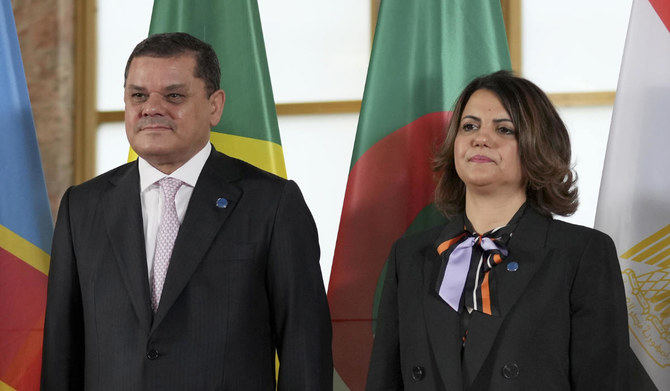

RIYADH/TRIPOLI: The head of Libya's Government of National Unity suspended Foreign Minister Najla Mangoush on Sunday and referred her for investigation after Israeli Foreign Minister Eli Cohen announced he had held talks with her last week in Rome.
Prime Minister Abdulhamid Dbeibah issued the suspension order following a backlash, with the country’s Presidential Council, which functions as head of state, demanding clarification.
The High State Council, which holds an advisory role in Libyan politics, also voiced its “surprise” at the reports of the meeting and said those responsible “should be held accountable.”
FM Mangoush has been “temporarily suspended” and will be subject to an “administrative investigation” by a commission chaired by the justice minister, Dbeibah said on Sunday evening in an official decision posted on Facebook.
Israel’s statement on the meeting, in which it said the ministers had discussed possible cooperation, prompted protests on the streets of Tripoli and its suburbs on Sunday evening in a sign of refusal of normalization with Israel. The protests spread to other cities where young people blocked roads, burned tires and waved the Palestinian flag.
On Monday an Israeli official told Reuters that the Italian-hosted meeting between Israeli Foreign Minister Eli Cohen and his Libyan counterpart last week was agreed in advance “at the highest levels” in Libya and lasted more than an hour.
News site The Libya Update reported that protesters stormed the foreign ministry headquarters in Tripoli to condemn the Mangoush-Cohen meeting in Rome.
‘Just a casual encounter’
Libya’s Foreign Ministry clarified that Mangoush had rejected a meeting with representatives of Israel and that what had occurred was “an unprepared, casual encounter during a meeting at Italy’s Foreign Affairs Ministry.”
In a statement, the Libyan ministry accused Israel of trying to “present this incident” as a “meeting or talks.” The statement said the interaction did not include “any discussions, agreements or consultations” and added the ministry “renews its complete and absolute rejection of normalization” with Israel.
In the Israel foreign ministry statement, Cohen was quoted as saying that the two discussed “the importance of preserving the heritage of Libyan Jews, which includes renovating synagogues and Jewish cemeteries in the country.”
“I spoke with the foreign minister about the great potential for the two countries from their relations,” Cohen said in the statement.
The meeting was facilitated by Italian Foreign Minister Antonio Tajani, Israel’s foreign ministry said, adding they had discussed possible cooperation and Israeli aid in humanitarian issues, agriculture and water management.
There was no immediate confirmation of the meeting from Rome.
Earlier on Sunday evening, Libya’s Presidential Council requested “clarifications” from the government, according to Libya Al-Ahrar TV, citing correspondence from spokeswoman Najwa Wheba.
The Presidential Council, which has some executive powers and sprang from the UN-backed political process, includes three members representing the three Libyan provinces.
The letter said that this development “does not reflect the foreign policy of the Libyan state, does not represent the Libyan national constants and is considered a violation of Libyan laws which criminalize normalization with the ‘Zionist entity’.” It asked the head of government “to apply the law if the meeting took place.”
Abraham Accords
Since 2020 Israel has moved to normalize ties with the United Arab Emirates, Bahrain, Morocco and Sudan through the so-called “Abraham accords” brokered by the United States.
Libyan foreign policy is complicated by its years of conflict and its bitter internal divisions over control of government and the legitimacy of any moves made by the Tripoli administration.
The Government of National Unity was installed in early 2021 through a UN-backed peace process but its legitimacy has been challenged since early 2022 by the eastern-based parliament after a failed attempt to hold an election.
Previous foreign policy moves by the GNU, including agreements it has reached with Turkiye, have been rejected by the parliament and subjected to legal challenges.


