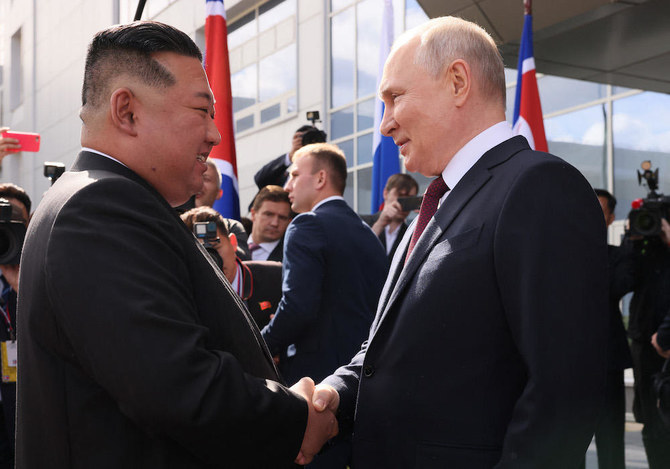
SEOUL: Vladimir Putin promised to build trade and security systems with North Korea that are not controlled by the West and pledged his unwavering support in a letter published by North Korean state media on Tuesday ahead of his planned visit to the country.
In a letter published in North Korea’s Rodong Sinmun, a ruling Workers’ Party mouthpiece, the Russian president said the two countries have developed good relations and partnerships over the past 70 years based on equality, mutual respect and trust.
“We will develop alternative mechanisms of trade and mutual settlements that are not controlled by the West, and jointly resist illegitimate unilateral restrictions,” Putin wrote. “And at the same time – we will build an architecture of equal and indivisible security in Eurasia.”
He thanked North Korea for supporting what Russia calls its special military operation in Ukraine, and vowed support for Pyongyang’s efforts to defend its interests despite what he called “US pressure, blackmail and military threats.”
The article was published a day after the two countries announced that Putin will visit North Korea for the first time in 24 years for two days starting on Tuesday.
Putin’s foreign policy adviser Yuri Ushakov said Russia and North Korea may sign a partnership agreement during the visit that would include security issues.
He said the deal would not be directed against any other country, but would “outline prospects for further cooperation, and will be signed taking into account what has happened between our countries in recent years — in the field of international politics, in the field of economics ... including, of course, taking into account security issues.”
Russian Defense Minister Andrei Belousov, Foreign Minister Sergei Lavrov and Putin’s point man for energy, Deputy Prime Minister Alexander Novak, will be part of the delegation.
Ahead of the visit North Korea appears to have been making preparations for a possible military parade in downtown Pyongyang, commercial satellite imagery showed.
US State Department spokesperson Matthew Miller repeated charges on Monday that North Korea had supplied “dozens of ballistic missiles and over 11,000 containers of munitions to Russia” for use in Ukraine.
He said the United States had seen Putin “get incredibly desperate over the past few months” and look to Iran and North Korea to make up for equipment lost on the battlefield.
Moscow and Pyongyang have denied arms transfers.
Formally known as the Democratic People’s Republic of Korea (DPRK), North Korea has been under UN sanctions for its ballistic missile and nuclear programs since 2006, and those measures have been strengthened over the years.
For the past several years the Security Council has been divided over how to deal with Pyongyang. Russia and China say more sanctions will not help and want such measures to be eased. They proposed some sanctions be lifted in December 2019, but have never put their draft resolution to a vote.
In May 2022, the pair vetoed a US-led push to impose more UN sanctions on North Korea over its renewed ballistic missile launches. Russia then vetoed in March this year the renewal of a panel of experts monitoring enforcement of UN sanctions.
China and Russia say joint military drills by the United States and South Korea provoke Pyongyang, while Washington accuses Beijing and Moscow of emboldening North Korea by shielding it from more sanctions.
After North Korea, Putin will visit Vietnam on June 19-20.


![]()

Putin vows trade, security agreements with North Korea ahead of visit
Short Url
https://arab.news/nvfa5
Putin vows trade, security agreements with North Korea ahead of visit
- North Korean leader Kim Jong Un extended an invite to Putin during a visit to Russia’s Far East last September


Latest updates


Recommended


© 2026 SAUDI RESEARCH & PUBLISHING COMPANY, All Rights Reserved And subject to Terms of Use Agreement.