

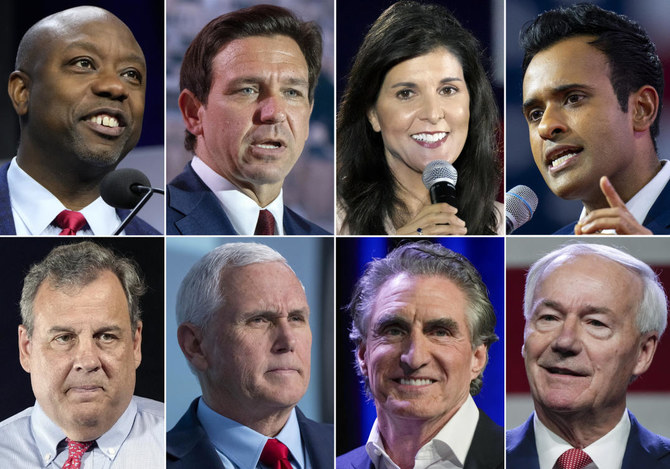
With Donald Trump absent, Republican rivals trade attacks at first 2024 debate

Republican candidates: top row, Sen. Tim Scott, Gov. Ron DeSantis, Nikki Haley, Vivek Ramaswamy, bottom row, Chris Christie, Mike Pence, Gov. Doug Burgum and Asa Hutchinson. (AP Photo)
Short Url
Updated 24 August 2023
Follow

With Donald Trump absent, Republican rivals trade attacks at first 2024 debate

  • Raucous two-hour debate offered a view of the deep challenges the contenders face in seeking to dislodge former president from his perch at the top of the field

MILWAUKEE: Eight Republican presidential candidates traded barbs on Wednesday at their first debate of the 2024 election as they jockeyed for position behind the absent front-runner, Donald Trump, who derided the event in a pre-taped interview aimed at siphoning away viewers.

The raucous two-hour debate offered a view of the deep challenges the contenders face in seeking to dislodge Trump from his perch at the top of the field.

While the former president took the extraordinary step of skipping the debate entirely, his rivals were left taking shots at one another to try to emerge as the most viable alternative, five months before the first Republican presidential nominating contest in Iowa and more than 14 months before the election.

While Florida Governor Ron DeSantis has consistently stood in second place in polls, albeit well behind Trump, it was Vivek Ramaswamy, the 38-year-old tech entrepreneur and political neophyte, who was at the center of many of the Fox News debate’s most dramatic moments.

Ramaswamy, a fierce Trump defender who is rising in national polls, faced plenty of incoming fire from his more experienced rivals, who appeared to view him as more of a threat than DeSantis.

“We don’t need to bring in a rookie,” former Vice President Mike Pence said, while former New Jersey Governor Chris Christie accused Ramaswamy of sounding “like ChatGPT,” a reference to artificial intelligence.

Ramaswamy fired back by emphasizing his status as an outsider, calling everyone else on stage “bought and paid for” and accusing DeSantis of being a “super PAC puppet,” a reference to independent political action committees that typically raise unlimited sums of money from corporations and individuals.

He also took the most isolationist position on the Ukraine-Russia war, arguing that it was not a priority for the US and saying he would end military aid to Ukraine. That drew a sharp rebuke from Nikki Haley, a former ambassador to the United Nations.

The debate had been seen as a potentially pivotal moment for DeSantis, whose campaign has been riven by staff turmoil amid a slow but steady decline in the polls.

Trump, who remains the clear-cut favorite among Republican voters despite his four criminal indictments, chose to skip the event in favor of a friendly interview with conservative commentator Tucker Carlson that began streaming online minutes before the debate began. The interview had about 74 million views on X, formerly known as Twitter, during its 46 minutes.

Trump declined to directly answer provocative questions posed by Carlson, such as whether a civil war was coming in the United States. Instead, he stuck to well-worn themes: false claims that he won the 2020 election, a promise to tighten immigration controls and insults of President Joe Biden and some of his Republican rivals.

“Do I sit there for an hour, or two hours, whatever it’s going to be, and get harassed by people that shouldn’t even be running for president and a network that isn’t particularly friendly to me?” he asked Carlson.

The debate took place a day before Trump planned to surrender in Atlanta to face charges he sought to overturn his election loss in the state.

Six of the eight debaters on Wednesday raised their hands when asked whether they would support Trump as the nominee even if he had been convicted of a crime – North Dakota Governor Doug Burgum, DeSantis, Haley, Pence, Ramaswamy and US Senator Tim Scott.

Christie, who appeared to start raising his hand before wagging his finger, and former Arkansas Governor Asa Hutchinson declined. Both have been vocal critics of Trump’s efforts to overturn his 2020 election loss.

“Whether or not you believe that the criminal charges are right or wrong, the conduct is beneath the office of president of the United States,” Christie said to boos from a rowdy and partisan crowd.

That led to a sharp back-and-forth between Christie, Trump’s biggest critic among Republican candidates, and Ramaswamy, Trump’s most ardent defender.

“Honest to God, your claim that Donald Trump is motivated by vengeance and grievance would be a lot more credible if your entire campaign were not based on vengeance and grievance against one man,” Ramaswamy said, prompting Christie to retort, “You make me laugh.”

Polls show that most Republicans view the criminal charges against Trump, 77, as politically motivated, making the topic a tricky one to navigate for his rivals.

In the most recent Reuters/Ipsos poll released this month, Trump held 47 percent of the Republican vote nationally, with DeSantis dropping six percentage points from July to 13 percent. None of the other candidates has broken out of single digits.

The candidates also went after Biden, a Democrat, from the outset. Moderators Martha MacCallum and Bret Baier, both Fox News hosts, started the debate by asking about the US economy.

“Our country is in decline,” DeSantis said. “We must reverse Bidenomics so that middle-class families have a chance to succeed again.”

While the economy has shown surprising resilience, defying recession predictions with a robust labor market, polls show many voters – including a plurality of those who supported Biden in 2020 – feel the economy has worsened during his first three years in office amid persistent inflation.

The candidates were also asked about abortion, an issue that has bedeviled Republicans ever since the US Supreme Court last year eliminated a nationwide right to abortion.

Pence, the staunchest anti-abortion opponent in the field, criticized Haley for saying that a bipartisan consensus must be reached on a federal approach.

Haley, who would be the first woman to win the Republican presidential nomination, responded that it was impractical to back nationwide limits given Democratic opposition.

DeSantis, who signed a six-week ban into law in Florida, did not specify whether he would back a similar national ban, saying he understood that different states would take different stances.

“Look, I understand, Wisconsin is going to do it different than Texas,” he said. “But I will support the cause of life as governor and as president.”


US intel did not suggest a preemptive strike from Iran before US-Israeli attacks, AP sources say

Updated 5 sec ago
Follow

US intel did not suggest a preemptive strike from Iran before US-Israeli attacks, AP sources say

WASHINGTON: Trump administration officials told congressional staff in private briefings Sunday that US intelligence did not suggest Iran was preparing to launch a preemptive strike against the US, three people familiar with the briefings said.
The administration officials instead acknowledged there was a more general threat in the region from Iran’s missiles and proxy forces, two of the people said. The third person, however, said the administration emphasized that Iran’s missiles and proxy forces posed an imminent threat to US personnel and allies in the region.
The officials did not provide any clarity about what would happen next in Iran after the joint US-Israeli operation, the two people said. All three people insisted on anonymity to discuss details that have not been made public.
The information conveyed to the congressional staff contrasts with the message from President Donald Trump. “Our objective is to defend the American people by eliminating imminent threats from the Iranian regime. A vicious group of very hard, terrible people,” he said in a video message after launching strikes on Iran.
Senior Trump administration officials, who like others were not authorized to comment publicly and spoke on condition of anonymity, had told reporters Saturday that there were indicators that the Iranians could launch a preemptive attack.
The White House and Pentagon did not immediately reply to requests for comment on Sunday night. Details of the briefing were first reported by Politico.
On Tuesday, Secretary of State Marco Rubio, Defense Secretary Pete Hegseth, CIA Director John Ratcliffe and Gen. Dan Caine, chairman of the Joint Chiefs of Staff, will brief the full membership of Congress on the US military operation against Iran, the White House said Sunday. Rubio also was slated to brief Hill leadership Monday, the same day Hegseth and Caine are planning a press conference about the operation.
Three strikes, three locations, within a single minute
The military operation came after authorities from Israel and the US spent weeks tracking the movements of senior Iranian leaders, including Supreme Leader Ayatollah Ali Khamenei, and shared information that allowed the strikes to be carried out in a surprise daylight attack, according to an Israeli military official and another person familiar with the operation.
The eventual barrage of US-Israeli attacks on Iran came so quickly that they were nearly simultaneous — with three strikes in three locations hitting within a single minute — killing Khamenei and some 40 senior figures, including the head of the paramilitary Revolutionary Guard and the country’s defense minister, the Israeli military official said Sunday.
The official said a variety of factors created a golden opportunity to take out much of Iran’s leadership, like weeks of training and monitoring the movements of senior figures as well as intelligence in real-time before the attack began that key targets were gathered together.
Striking by day also gave an additional element of surprise, said the official, who said so many major, rapid-fire strikes were critical to keep key officials from fleeing after the first strike. The official said Israel closely cooperated with its US counterparts and had used a similar tactic at the beginning of last June’s war — which resulted in the killing of several senior Iranian figures.
The official also noted Khamenei having posted defiant tweets taunting President Donald Trump in the days before the attack.
The details about the strikes came as the conflict entered its second day, with Trump saying in a video message Sunday that he expected it would continue until “all of our objectives are achieved.” He did not spell out what those objectives were.
The Republican president also said the US military and its partners hit hundreds of targets in Iran, including Revolutionary Guard facilities, Iranian air defense systems and nine warships, “all in a matter of literally minutes.”
CIA had long tracked top Iranian leaders
Before the attacks, the CIA had for months tracked the movements of senior Iranian leaders, including Khamenei.
The intelligence was shared with Israeli officials, and the timing of the strikes was adjusted in part because of that information about the Iranian leaders’ location, according to the person familiar with the planning.
The intelligence-sharing between US and Israel reflects the preparation that went into the strikes, which threw the future of the Islamic Republic into uncertainty and raised the risk of escalating regional conflict.
The US regularly shares intelligence with allies including Israel. Those partnerships, and the accuracy of the intelligence they yield, is often critical not only to the success of a military operation but also to the public’s support for it.
Virginia Sen. Mark Warner, the senior Democrat on the committee, told The Associated Press that, historically, “our working relationship with the Mossad and Israel is really strong.” Mossad is the Israeli spy agency.
Warner said he has serious concerns about the justification for the strikes, Trump’s long-term plans for the conflict and the risks that US service members will face. The military announced Sunday that three American troops had been killed in the Iran operation.
“No tears will be shed over their leadership being eliminated, but always the question is: OK, what next?” Warner said.
Iran has signaled it’s open to talks with the US
A senior White House official said Iran’s “new potential leadership” has suggested it is open to talks with the United States. That official, who spoke on condition of anonymity to discuss internal administration deliberations, said Trump has indicated he’s “eventually” willing to talk but that for now the military operation “continues unabated.”
The official did not say who the potential new Iranian leaders are or how they made their alleged willingness to talk known. Separately, Trump told The Atlantic that he planned to speak with Iran’s new leadership.
“They want to talk, and I have agreed to talk, so I will be talking to them,” he said Sunday, declining comment on the timing.