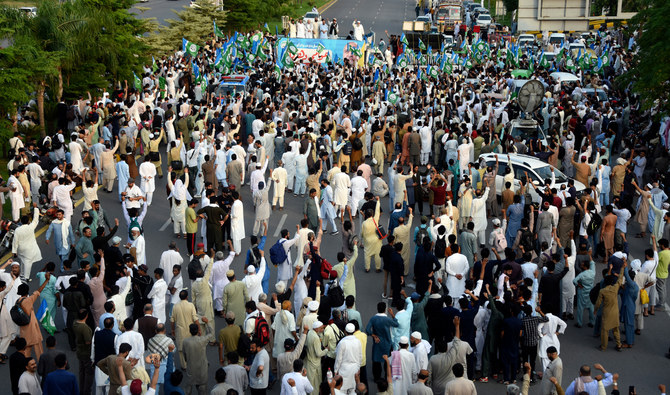
ISLAMABAD: Jamat-e-Islami (JI), a Pakistani religio-political party, on Saturday vowed to continue its sit-in in Rawalpindi against the rising cost of living and additional taxes imposed in the latest budget, despite the government forming a negotiation committee for talks with the protesters.
The JI, led by Hafiz Naeem-ur-Rehman, announced the sit-in in Islamabad to call for a reduction in power tariff amid soaring inflation and to review Pakistan’s agreements with independent power producers (IPPs).
The party’s caravans entered the capital from different directions as the district administration closed the capital’s Red Zone, which houses top government offices and the diplomatic enclave, with shipping containers and roads leading to parliament.
“Our dharna will continue as long as the government accepts our demands for a significant reduction in inflation and electricity prices,” Aamir Baloch, a JI spokesperson, told Arab News.
“The party chief Hafiz Naeem-ur-Rehman will be announcing a fresh strategy for the protests, dharna and engagement with the government today afternoon.”
The government has formed a three-member committee, which includes Information Minister Attaullah Tarar and two senior members of the ruling Pakistan Muslim League-Nawaz (PML-N) party, to hold talks with the JI leadership.
“We are ready for negotiations, but don’t disrupt public life,” Tarar said at a news conference on Friday. “The government’s three-member committee will talk to you. Amir Muqam, Tariq Fazal Chaudhry and I will negotiate with you. Whenever you express willingness, we are ready for the negotiations.”
But Baloch said the party would continue its protest and JI chief Rehman would join the sit-in at Zero Point — a major intersection in the city where various key roads and highways connect with each other — on Saturday.
He said thousands of JI workers had already reached the area, despite the government’s “brutalities.”
“The police have arrested dozens of our peaceful workers from D-Chowk,” he said, referring to a key spot close to the parliament building in Islamabad.
“The government wants to incite the peaceful protesters through such strong-arm tactics. It will be responsible for any law-and-order situation, if our workers are not released immediately.”
Police in the capital have deployed additional contingents, including personnel with riot gears, to prevent any untoward incident.
The Rawalpindi-Islamabad Expressway has also been closed with shipping containers near the Zero Point bridge, where the JI protesters have gathered.
Baloch said the party leadership would announce their future course of action after reaching Zero Point.
“One thing is for sure,” he said. “We are here to stay and will definitely stage a sit-in to press the government to meet our legitimate demands regarding inflation and taxes.”


Pakistani religious party vows to continue sit-in in Rawalpindi despite government’s offer for talks
https://arab.news/zj8dw
Pakistani religious party vows to continue sit-in in Rawalpindi despite government’s offer for talks

- Jamaat-e-Islami supporters have been holding a sit-in at a key intersection in Rawalpindi since Friday
- The party wants the government to address cost-of-living crisis, remove additional taxes in the budget
Pakistan seeks operationalization of World Bank’s $20 billion framework to advance reform priorities

Pakistan seeks operationalization of World Bank’s $20 billion framework to advance reform priorities
- Pakistan’s finance chief meets World Bank Country Director Bolormaa Amgaabazar in the capital
- The Bank’s 10-year Country Partnership Agreement for Pakistan was approved in January last year
ISLAMABAD: Pakistan’s Finance Minister Muhammad Aurangzeb on Wednesday called for the operationalization of the World Bank Country Partnership Framework (CPF) to advance the government’s key reform priorities during a meeting with the Bank’s country director, according to a statement.
The Bank’s Board of Directors approved a 10-year CPF deal with Pakistan, indicating $20 billion in financing for Pakistan under the framework. The amount will include public and private financing from the World Bank Group, with roughly half expected to come from private-sector operations led by the International Finance Corporation (IFC).
“The Finance Minister emphasized the importance of effective operationalization of the CPF, particularly in priority areas such as population management and climate change,” the finance ministry said in a statement after Aurangzeb’s meeting with the Bank’s Country Director Bolormaa Amgaabazar.
“He underscored the need for strong coordination between federal and provincial governments to ensure coherence in policy design and implementation.”
Discussions focused on population, human capital development, climate resilience, agricultural reform and energy sector sustainability, it added.
The ministry said both sides exchanged views on enhancing institutional coordination, improving transparency in project design and strengthening monitoring mechanisms to deliver intended outcomes. It highlighted that the World Bank expressed readiness to continue supporting agricultural transformation efforts in collaboration with the IFC.
“Both sides agreed to continue technical-level engagements to explore feasible solutions in line with Pakistan’s reform agenda and fiscal framework,” the finance ministry added.
Climate resilience and population control are major concerns for policymakers in Pakistan, a country whose population exceeds 241 million, making it the world’s sixth-most populous country. Limited infrastructure, health care, and educational opportunities place added strain on public services, contributing to unemployment and poverty.
The South Asian nation is also among the countries most affected by climate change. Unusually heavy monsoon rains in 2022 killed more than 1,700 people and caused over $30 billion in damages. Torrential rains and floods since late June last year have claimed more than 1,000 lives, as authorities continue surveys to assess the full extent of the destruction.


