Saudi-Turkish Business Forum sees agreements signed, investments discussed

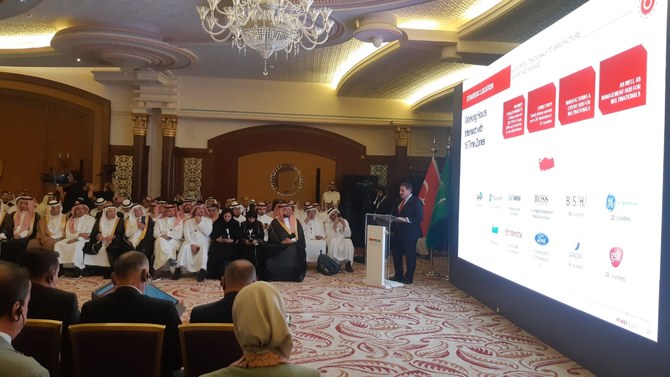
Cuneyt Saricimen, country advisor at the Investment Office of the Turkish Presidency, giving a presentation on his country’s economy (AN)
Short Url
Updated 18 July 2023
Follow

Saudi-Turkish Business Forum sees agreements signed, investments discussed

JEDDAH: More than 400 business leaders and officials attended a special meeting of the Saudi-Turkish Business Forum in Jeddah in a further boost to economic ties between the two countries.

Amid discussions around further investment opportunities, a number of agreements were signed covering manufacturing, tourism, mining, food and agriculture, as well as defense and military industries. 

Moreover, some nine agreements were signed on energy, education, digital technology, media, construction, health and real estate.  

The forum was attended by the Saudi Minister of Investment, Khalid bin Abdul Aziz Al-Falih, and the Turkish Minister of Trade, Omar Polat, with the participation of representatives from companies of both sides.  

In his speech, Al-Falih said that the National Investment Strategy is one of the main enablers to achieve the objectives of the Saudi Vision 2030 to enhance the future of investment in the Kingdom.  

This includes the development of investment opportunities, improving the business environment, and enhancing the Kingdom's competitive position on the global investment map.  

The meeting came just days after a similar event was held in the Turkish capital Ankara, which saw real estate agreements worth more than SR2.3 billion ($610 million) reached.

After the latest meeting, held in the Ritz Carlton hotel in Saudi Arabia’s second-largest city, Tuba Terekli, a Jeddah-based investor and international business consultant, told Arab News that Saudi-Turkish economic ties are expected to grow significantly in the near future. 

"There were agreements in construction between the two sides of nearly $400 million and that would probably reach $3-$4 billion in the upcoming six months," she said. 

Addressing the forum, Cuneyt Saricimen, country advisor at the Investment Office of the Turkish Presidency, shed light on the growth of the Turkish economy in a bid to encourage more trade with the Kingdom.

Others attending the event included Asaad Al-Jomoai, managing director of the Global Supply Chain Resilience Initiative at the Saudi Ministry of Investment, who gave details on the Saudi Vision 2030 and the giga-projects being developed in the Kingdom.  

Tariq Al-Zeer, general manager of the administration of real estate sector operations at the Ministry of Municipal, Rural Affairs, and Housing, used an address to highlight the investment opportunities in the Saudi housing sector. 

There are currently 1,140 Saudi companies operating in Turkiye, and 395 Turkish companies investing in the Kingdom.

Turkiye wants to strengthen its relationships with countries in the Middle East, President Recep Tayyip Erdogan had said ahead of his visit to the region, reported Turkish state-run news agency Anadolu,

"We would like to further strengthen all kinds of relations between us by traveling to Saudi Arabia, Qatar and the UAE," Erdogan had told reporters after returning from a two-day NATO Summit in Lithuania. 

In December 2022, the Saudi-Turkish Business Forum was held in Istanbul, Turkiye, in the presence of the Kingdom’s Investment Minister Al-Falih, the Turkish Minister of Treasury and Finance Nureddin Nebati, and with the participation of more than 280 companies from the two countries.


Saudi investment pipeline active as reforms advance, says Pakistan minister

Updated 7 sec ago
Follow

Saudi investment pipeline active as reforms advance, says Pakistan minister

ALULA: Pakistan’s Finance Minister Mohammed Aurangzeb described Saudi Arabia as a “longstanding partner” and emphasized the importance of sustainable, mutually beneficial cooperation, particularly in key economic sectors.

Speaking to Arab News on the sidelines of the AlUla Conference for Emerging Market Economies, Aurangzeb said the relationship between Pakistan and Saudi Arabia remains resilient despite global geopolitical tensions.

“The Kingdom has been a longstanding partner of Pakistan for the longest time, and we are very grateful for how we have been supported through thick and thin, through rough patches and, even now that we have achieved macroeconomic stability, I think we are now well positioned for growth.”

Aurangzeb said the partnership has facilitated investment across several sectors, including minerals and mining, information technology, agriculture, and tourism. He cited an active pipeline of Saudi investments, including Wafi’s entry into Pakistan’s downstream oil and gas sector.

“The Kingdom has been very public about their appetite for the country, and the sectors are minerals and mining, IT, agriculture, tourism; and there are already investments which have come in. For example, Wafi came in (in terms of downstream oil and gas stations). There’s a very active pipeline.”

He said private sector activity is driving growth in these areas, while government-to-government cooperation is focused mainly on infrastructure development.

Acknowledging longstanding investor concerns related to bureaucracy and delays, Aurangzeb said Pakistan has made progress over the past two years through structural reforms and fiscal discipline, alongside efforts to improve the business environment.

“The last two years we have worked very hard in terms of structural reforms, in terms of what I call getting the basic hygiene right, in terms of the fiscal situation, the current economic situation (…) in terms of all those areas of getting the basic hygiene in a good place.”

Aurangzeb highlighted mining and refining as key areas of engagement, including discussions around the Reko Diq project, while stressing that talks with Saudi investors extend beyond individual ventures.

“From my perspective, it’s not just about one mine, the discussions will continue with the Saudi investors on a number of these areas.”

He also pointed to growing cooperation in the IT sector, particularly in artificial intelligence, noting that several Pakistani tech firms are already in discussions with Saudi counterparts or have established offices in the Kingdom.

Referring to recent talks with Saudi Minister of Economy and Planning Faisal Alibrahim, Aurangzeb said Pakistan’s large freelance workforce presents opportunities for deeper collaboration, provided skills development keeps pace with demand.

“I was just with (Saudi) minister of economy and planning, and he was specifically referring to the Pakistani tech talent, and he is absolutely right. We have the third-largest freelancer population in the world, and what we need to do is to ensure that we upscale, rescale, upgrade them.”

Aurangzeb also cited opportunities to benefit from Saudi Arabia’s experience in the energy sector and noted continued cooperation in defense production.

Looking ahead, he said Pakistan aims to recalibrate its relationship with Saudi Arabia toward trade and investment rather than reliance on aid.

“Our prime minister has been very clear that we want to move this entire discussion as we go forward from aid and support to trade and investment.”