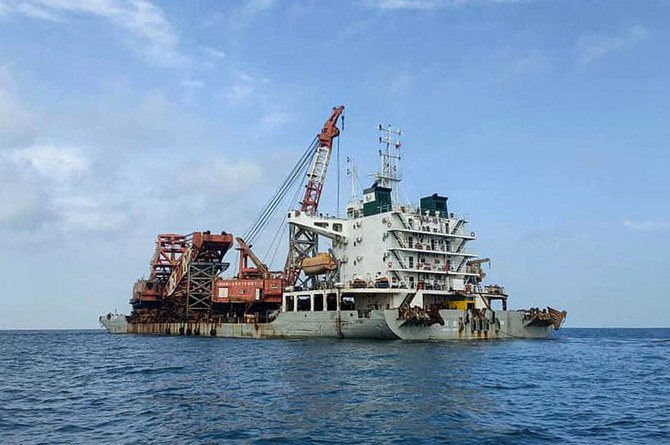
KUALA LUMPUR: Malaysia’s coast guard said on Tuesday authorities were questioning the crew of a Chinese vessel detained on suspicion of looting two British World War II shipwrecks.
Officers discovered unexploded shells upon boarding the Chinese-registered vessel, which was detained for illegal anchorage at the weekend, said Nurul Hizam Zakaria, Malaysian Maritime Enforcement Agency chief in Johor state.
“Our investigation is now directed to where these cannon shells originated from. Right now, we have officers from multi-agencies searching the big ship,” he said.
Nurul Hizam said the vessel from the city of Fuzhou had a crew of 32 comprising 21 Chinese nationals, 10 Bangladeshis and one Malaysian, some of whom were in coast guard custody for questioning.
“This case also involves the discovery of explosives,” he said.
China’s foreign affairs ministry said the Chinese embassy in Malaysia was in close communication with local authorities “to understand the situation.”
It asked Malaysia to handle the case “fairly and in accordance with the law.” Beijing also asked Malaysia to protect the rights and safety of Chinese citizens.
A senior Malaysian maritime official said on condition of anonymity that the pieces of metal and shells could have originated from two sunken British warships.
More than 800 British sailors were killed when the HMS Prince of Wales and HMS Repulse were torpedoed by Japanese aircraft in the South China Sea.
The attack on December 10, 1941, happened three days after Japan attacked the US fleet in Pearl Harbor, Hawaii.
Photos and a video shared by the Malaysian coast guard showed large pieces of corroded metal and shells, as well as a large crane and gas torches used to cut metal on board the ship.
The shells could also be linked to the discovery of unexploded World War II-era ordnance at a jetty in Johor on May 19, the maritime agency said in a statement Monday.
Nurul Hizam said the maritime agency would not tolerate any form of illegal salvage activities in Malaysian waters.
“Our national treasure must be protected and preserved,” he said, describing looting as “an uncivilized act.”
Britain’s Ministry of Defense condemned the “desecration” of maritime military graves after reports that scavengers had targeted two WWII wrecks, the BBC said Saturday.
Malaysia’s New Straits Times newspaper reported in recent weeks that illegal salvage operators had targeted high-grade aluminum and brass fixtures from the two British warships.


Malaysia searches Chinese ship suspected of looting WWII wrecks
https://arab.news/4ebk6
Malaysia searches Chinese ship suspected of looting WWII wrecks

- Officers discover unexploded shells upon boarding the Chinese-registered vessel
- Vessel from the city of Fuzhou had a crew of 32 comprising mostly Chinese nationals


Bomb attacks on Thailand petrol stations injure 4: army
- Authorities did not announce any arrests or say who may be behind the attacks
BANGKOK: Assailants detonated bombs at nearly a dozen petrol stations in Thailand’s south early Sunday, injuring four people, the army said, the latest attacks in the insurgency-hit region.
A low-level conflict since 2004 has killed thousands of people as rebels in the Muslim-majority region bordering Malaysia battle for greater autonomy.
Several bombs exploded within a 40-minute period after midnight on Sunday, igniting 11 petrol stations across Thailand’s southernmost provinces of Narathiwat, Pattani and Yala, an army statement said.
Authorities did not announce any arrests or say who may be behind the attacks.
“It happened almost at the same time. A group of an unknown number of men came and detonated bombs which damaged fuel pumps,” Narathiwat Governor Boonchauy Homyamyen told local media, adding that one police officer was injured in the province.
A firefighter and two petrol station employees were injured in Pattani province, the army said.
All four were admitted to hospitals, none with serious injuries, a Thai army spokesman told AFP.
Thailand’s Prime Minister Anutin Charnvirakul told reporters that security agencies believed the attacks were a “signal” timed with elections for local administrators taking place on Sunday, and “not aimed at insurgency.”
The army’s commander in the south, Narathip Phoynok, told reporters he ordered security measures raised to the “maximum level in all areas” including at road checkpoints and borders.
The nation’s deep south is culturally distinct from the rest of Buddhist-majority Thailand, which took control of the region more than a century ago.
The area is heavily policed by Thai security forces — the usual targets of insurgent attacks.


